Mobile telephony and the entrepreneur

This article – “Mobile telephony and the entrepreneur: An African perspective” – was originally written for the autumn edition of Microfinance Insights magazine. A copy of the original article is available as a PDF here

Whenever the words “Africa” and “economic development” meet – which is often – it’s usually in the context of external, foreign aid and large, multilateral development efforts. Large numbers and global donor agencies do, after all, have a habit of stealing the headlines. You’d be forgiven for thinking that little else was happening.

But you’d be wrong.

With penetration rates in excess of 30%, and handset sales among the highest in the world, Sub-Saharan Africa is witnessing a new kind of home grown, mobile-driven economic development. The numbers may not be that big – yet – but the impact on the ground is obvious and the difference it is making to people’s lives clear. Farmers are now able to access market information through their phones, increasing income in some cases by up to 40%. Casual labourers are able to advertise their services, allowing them to take on more work and avoid down-time waiting on street corners for work to come their way. Unemployed youth can get job vacancies on their phones, alerting them when work becomes available. And, for the first time, the un-banked can transfer money to relatives, or make payments for goods and services, through their phones.

Their impact is not restricted to economic empowerment, either. Mobile phones are also able to provide health information and advice, remind people when to take their medicine, and allow citizens to engage more actively in civil society by monitoring elections and helping keep governments accountable. Others can get wildlife early warnings, mitigating against livelihood- and life-threatening human-elephant conflict. It turns out that mobile phones can be useful for much more than just ordering pizza, looking up the football scores or arranging a Friday night out.

The impact, and uses of, mobile technology in the developing world is nothing short of staggering. What’s more, it has spurned the growth of a whole new informal sector, empowering local entrepreneurs and businesspeople the continent-over. With immense value placed on owning a phone, there’s no shortage of opportunities for people to make a little money on the way.

In “Mobile Telephony: Leveraging Strengths and Opportunities for Socio-Economic Transformation in Nigeria”, Christiana Charles-Iyoha sheds some light on the value Nigerians placed on their mobile phones, many describing losing them as literally a matter of life or death for their businesses. At the same time, many – not only in Nigeria but also many other parts of Sub-Saharan Africa – have been quick to exploit the numerous opportunities that this explosion in ownership brings.
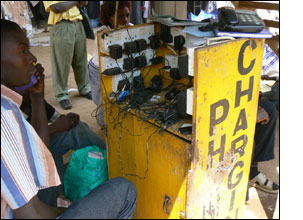
Anyone who’s travelled to an African country in the past couple of years would not have failed to notice women selling airtime on the streets, children dodging cars at main junctions selling chargers and phone covers, street vendors making a living charging people’s phones, and mobile phone repair shops helping people squeeze one last drop of life from their old phones. There is also a thriving second-hand market, with stalls selling all manner of new and recycled handsets. Entrepreneurs are even building their own mobile-mobile services, strapping phones and spare batteries to the front of bikes and travelling to where the business is.

In a now much-cited 2005 study, London Business School economist Leonard Waverman concluded that an extra ten mobile phones per hundred people in a ‘typical developing country’ leads to an additional 0.59 percentage points of growth in GDP per person. From a government perspective, taxes and revenue generated from an insatiable demand for communications no doubt fuels a large part of this growth, but there’s also little doubt a significant amount also comes from a growing, and increasingly efficient informal sector. At the bottom of the pyramid (BOP), where micro-loans of just a few dollars are a proven catalyst in helping people work their own way out of poverty, we have a technology which has the clear potential to do the same.

Of course, more phones in more hands also presents opportunities for the microfinance (MFI) sector, many of whom seek to improve the lives of those same people in or around the bottom of the pyramid (BOP). Mobile technology has already been embraced by organisations such as Grameen, with their now-much duplicated Village Phone programme, but mobile phones also present organisational opportunities through improved communications with field staff, and options to electronically capture data from the field. MFI’s are already utilising text message (SMS) technology to communicate with customers, using software such as FrontlineSMS – which turns a computer and attached mobile phone into a central SMS communications hub – to run surveys and collect information. In many remote areas where keeping in touch with borrowers, or collecting financial data, is a challenge, the humble SMS is opening up a raft of new opportunities. Grameen Village Phone in Kampala, Uganda, a user of FrontlineSMS, comments:

We use it to automate communication with our village phone operator (VPO) channel. It really makes our lives easier by giving us a clear record of what’s been sent and responded to that can be reproduced and reused elsewhere. It also helps us promote a culture of SMS use for communications

As more and more people become connected, future studies of Sub-Saharan Africa and its economic potential will find it harder and harder to ignore the growing influence of mobile technology, and the power and spirit of African entrepreneurship – and grassroots NGOs – to capitalise on it. There’s little doubt that this spirit has always been there, but perhaps it’s just taken mobile technology to create an environment in which much of it can thrive.
A Malawian perspective on FrontlineSMS

Josh Nesbit – a Senior in the Human Biology Program at Stanford University – spent the best part of this summer working in a rural hospital in Malawi, where he also implemented FrontlineSMS. Here, Alexander Ngalande, the Home-Based Care nurse at St. Gabriel’s Hospital in Namitete, talks about his experiences of the software, and how it has impacted healthcare delivery for 250,000 people (video courtesy of Josh Nesbit)

FrontlineSMS on the frontline

The October 7th, 2001 invasion of Afghanistan didn’t only mark the beginning of the “War on Terror“. It also paved way for the introduction of the first mobile phone networks into the country, networks which today find themselves pawns in a game of cat-and-mouse between the Taleban, the government, security forces, mobile operators and aid agencies working to improve the lives of hundreds of thousands of people.

Afghanistan is rarely out of the headlines. Just this morning news broke of three women aid workers and their driver being killed near Kabul, demonstrating in the most graphic terms imaginable the huge dangers faced by so many NGOs working there. Decades of invasion, war and fighting has run the country ragged. There can be fewer more dangerous places on earth to work. As recently as July 2008, the Crime and Safety Report described the security situation as remaining “volatile and unpredictable”:

“No part of Afghanistan should be considered immune from violence, and the potential exists throughout the country for hostile acts, either targeted or random, against American and other western nationals at any time. There is an on-going threat to kidnap and assassinate U.S. citizens and non-governmental organization (NGO) workers throughout the country. Afghan authorities have a limited ability to maintain order and ensure the security of the citizens and visitors”

In such a challenging and hostile environment, non-profit organisations rightly spend considerable amounts of time and effort doing everything they can to limit their exposure to risk. With improved communication often at the heart of security strategy, many have turned to the growing influence and availability of mobile phone networks in the areas where they operate, and to tools which give them the potential to communicate quickly, widely, efficiently and effectively.

Within months of the US-led invasion in late 2001, the first Afghan mobile networks began to appear. Today, Afghanistan has four privately-owned networks and, according to a recent report by the BBC, mobile phones are the “only way most Afghans are able to communicate, especially in remote areas where they are used to summon medical help or contact relatives”. The importance of mobile technology hasn’t gone un-noticed by the Taleban either, who have recently been destroying towers in an attempt to stop security forces using the technology to co-ordinate night-time attacks against them. That particular game of cat-and-mouse continues.

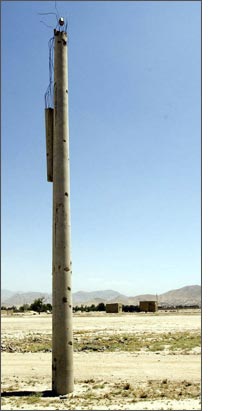
Mobile masts aren’t the only target either, for the Taleban or invading ‘liberating’ forces. As is often the case in conflict situations, infrastructure – and innocent civilians – are among the early casualties. Power lines are also a target, presenting further challenges not only for the wider civilian population but also for operators and mobile users alike (photo above of a destroyed power pylon courtesy of Jan Chipchase, “Future Perfect“).

Facing a continued and growing security threat, in January 2007 a major international humanitarian organisation approached kiwanja.net and within days started using FrontlineSMS as a field communication solution in their Afghan operations. Today they continue to use the Windows version in their main operations room (see image below), and the newer Mac version is used as a backup by a senior Security Officer. The software is primarily used to quickly pass time-sensitive security information to staff in the field via SMS.

According to the NGO:

Drivers receive updates on traffic congestion, road blocks, police operations, VIP movements, local minor security incidents and anything else that might be useful as they travel. Senior staff receive SMS messages regarding larger security incidents that may require them to modify program activities for the short term. Incidents that influence activities in other areas are sent to the sub-office group. Finally we have an ‘All Staff’ category for those situations where we need to notify or account for everyone as quickly as possible

As this use of FrontlineSMS demonstrates, the software continues to prove remarkably versatile, and its increasing use in a growing number of non-profit activities is testament to kiwanja’s approach to building tools for NGOs, and not to try and build solutions to specific problems. As a forthcoming “Publius Project” guest article argues, communication is a fundamental yet often overlooked NGO need, whether they be working in Afghanistan, Zimbabwe, Pakistan, Nigeria, Aceh or the United States, or working in human rights, activism, environmental protection, health, economic empowerment or education.

Promoting the use of FrontlineSMS among the wider NGO community – particularly those working in conflict zones – whilst at the same time trying to protect identities is a fine balancing act. After the reported killings this morning, I decided to remove the name of the organisation using FrontlineSMS in Afghanistan from this post, even though I was given permission to use it.

However keen I might be to help other NGOs in similar situations get their hands on FrontlineSMS, some things simply aren’t worth the risk…


An update following today’s attacks outside Kabul:

“… FrontlineSMS was essential for us getting the word out quickly. E-mail was down, voice was spotty but SMS still worked. We had two female staff at a school near the incident and were able to tell them to stay put till things quietened down. All my staff made it home safe today”

Zimbabweans speak out through SMS

International press interest may be on the wane following the heady heights of recent months, but the daily struggle continues for millions of people living in Zimbabwe. An inflation rate of over two million percent – usually a leading headline in itself – merely serves as a backdrop to the political maneuvering taking place following the recent flawed presidential ‘elections’.

It would be all too easy for people to lose hope, particularly in such a dis-empowering and disenfranchising environment dominated by fear, government harassment and a largely state controlled media which pushes out its own unique version of the truth. Freedom of speech is only freedom of speech when it comes with freedom from fear, something that many people don’t yet have.

But hope, it turns out, is one of the few things many people still do have, and freedom of speech has found an ally in the humble mobile phone. I recently blogged about the use of mobile phones during the ongoing troubles, and highlighted the work of Kubatana.net, a grassroots organisation who have been pioneering the use of mobile technology in civil society work. Since 2005, Kubatana have been using a combination of kiwanja‘s FrontlineSMS platform, and a couple of other custom applications developed around the technology. Kubatana continue to use it, and continue to reach out to everyday Zimbabweans through the mobile channel – one of only a few available to them.

Back in April, at the height of the troubles, Kubatana asked everyday Zimbabweans: “What would you like a free Zimbabwe to look like?”. Zimbabweans answered the call through their mobile phones, texting in their hopes for the future. Many people said that the question gave them hope in uncertain times.

Last week, while doubts lingered over the newly signed MDC/Zanu-PF deal, Kubatana reached out again to their SMS subscribers, asking them: Kubatana! ZPF and both MDCs agree to talk to resolve crisis. Send yr thoughts on this & give us yr postal or email addr if u want a copy of their agreement”. Zimbabweans responded with a range of comments and opinions, including:

The talks is good but MDC must be very clever – Zanu PF wants to swallow the MDC

Yes it’s a brilliant idea which shall help end crisis, poverty and all tribulations in Zimbabwe united we stand divided we fall Tsvangirai showed qualities of being a leader by agreeing to talk

Free and fair elections tomorrow with international observers!

It is long over due but we want justice

May be worth the effort but MDC must keep their eyes open. You can’t trust these guys. I agree with Tsvangirai that people have suffered enough

I believe it’s a good idea if they can reason together in order to solve this crisis. But they must recognise the results of the election done on 29 March

We don’t need masters, colonial or nationalist. We want public servants. So respect our votes of March 29. You asked for them

That’s better because we are suffering. We are stuck and something must be done to save the lives of Zimbabweans

The talks are okay but Mugabe must not lead the government & must step down

For as long as it is something that will result in the fulfilment of our wishes and solve our problems no hard feelings

I think it is a very bad idea for ZPF and MDCs to talk coz they are like water and oil as far as policies are concerned. What happened to ZAPU when it merged with ZPF? I dnt approve of the talks unless they start on the March 29 election which means MDC T would be the winner

No problem as long as the talks result in the formation of transitional authority & fresh, free & fair run-off being conducted thereafter

The talks are very important but MDC must not at all accept a gvt of national unity. They must go 4 a transitional gvt and pave way 4 fresh elections. Zanu PF plans 2 destroy MDC just as they did to ZAPU

In addition to direct comments and opinions, over 300 requests came in for the document to be posted to people, and over 200 for it to be emailed. This, according to Kubatana, is a small indication of just how starved most Zimbabweans are for news about their own country.

The numbers may not yet be huge, but mobiles are certainly beginning to make their mark.