

With over 25 years experience in the technology and international development sectors – and a track record in the development of innovative tools and services – kiwanja.net is uniquely-placed to help mentor and guide future social innovators and supporters in their work. Thought leadership is now a large part of what we do, helping the sector make best use of the technologies and opportunities available to all of us.
We also work on mini-projects and websites such as Everyday Problems, a site designed to highlight many of the problems people face around the world on a daily basis, even when they’re not in the news. This forms part of our wider work and support for students.
Alongside the three ideas below, the Donors Charter, the Social Mobile Long Tail and reluctant innovation, we regularly write thought leadership pieces for sites such as Forbes, Virgin, the BBC, the Guardian and Stanford Social Innovation Review. More on how we work with organisations: advisory and consultancy.
Donors Charter
Under pressure to support ‘innovative’ ideas, and often to spend large budgets, donors can end up funding projects they shouldn’t. The result is a sector full of replication, failed pilots, secrecy and little collaboration. That hurts the better-planned projects too, and leaves end users to make sense of hundreds of competing tools.
The Charter proposes a simple fix. Major funders would ask every applicant the same twelve questions before a grant is considered. Do you understand the problem? Have you looked for existing solutions? Will you work with local partners? How will you measure impact? Will you share your progress openly? A gap in the answers would not rule a project out, but the process would reinforce best practice and help donors back projects that are better thought through.
It was first set out in A New Donor Code of Conduct, published in Stanford Social Innovation Review.
The Social Mobile Long Tail
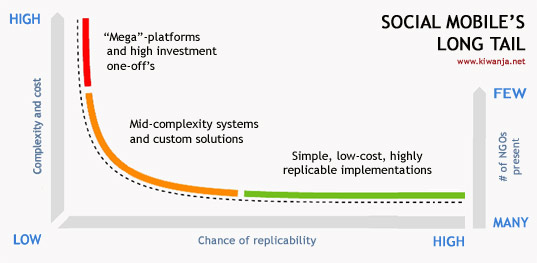
The Social Mobile Long Tail is a way of mapping the mobile-for-development landscape. Borrowing from Chris Anderson’s Long Tail, it plots mobile tools for social good by their complexity, cost and how easily they can be replicated. At the top sit a few high-cost, high-profile platforms and one-offs that grassroots NGOs can rarely afford or copy. Further along come mid-range, custom-built solutions. And in the long tail itself are simple, low-cost, appropriate tools that almost anyone can pick up and use.
The argument is that the greatest number of NGOs, and the greatest total value, sit in that tail, yet it gets the least attention and investment. If mobile phones are to deliver for grassroots organisations, our time, money and attention need to follow. The idea has shaped the thinking behind FrontlineSMS since 2008.
Reluctant innovation
Reluctant innovators are people who never set out to innovate. They come across a problem they have experienced or witnessed, one that angers, frustrates or disturbs them so much that they end up dedicating much of their lives to solving it. The problem, or the solution, finds them.
The word “reluctant” is deliberate. These are not accidental innovators who happened to get lucky. They took the harder path, for a cause bigger than themselves, when most would happily have chosen a quieter life. The idea challenges the notion that social change is a neatly planned process that can be learned in a classroom, and argues for finding your purpose first and learning the mechanics later.