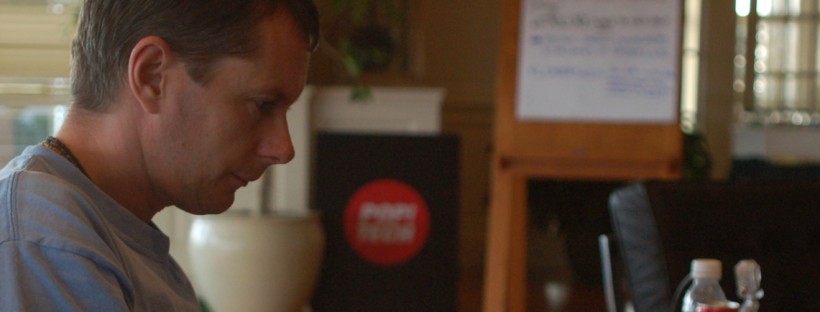
Tim Smit. In tweets.

Tim Smit may be an extraordinary individual, but he’s no ordinary entrepreneur. Founder of The Eden Project – described by some as the “Eighth Wonder of The World” – Tim has taken an unconventional if not fascinating path. By all means read those Business Bibles – but then tear them up. Read Marketing 101 – but then toss it aside. In the sometimes rigid and stuffy world of social entrepreneurship, Tim is a breath of fresh air. And his short talk last weekend at Emerge 2010 in Oxford was nothing short of inspirational.

Courtesy of Twitter, here’s a short summary of a “lucky 13” key points that stood out most for me.

Context: Never forget what you were like as a child. Push the boundaries of your imagination, live out your dreams, find that one thing which truly “switches you on”. And then relentlessly pursue it.

Context: Don’t get caught up in the lingo. Buzzwords mean little if they’re not backed up by very real action.

Context: Inspiration and innovation can happen any time, any place. No person and no structure have exclusive rights over the best ideas. Unconventional can be king. It usually is and, what’s more, it will usually come with the most compelling story.

Context: Seize the moment – it won’t last forever, and there will likely never be a “best time” to execute your idea.

Context: Not everyone will be able to take that “big risk”, but that doesn’t mean they won’t be able to join you on a journey. Inspire others to join you. Don’t travel alone. Build it, and they may just come.

Context: In ICT4D we talk about silos. Take every opportunity to step outside yours. Be open minded. Meet people who, on the surface, have very little in common with you. Explore new horizons. You have nothing to lose and everything to gain.

Context: If you don’t follow your instincts, you may always regret it. Don’t put yourself in that position. Success is just as much about “positive thinking” as “positive doing”.
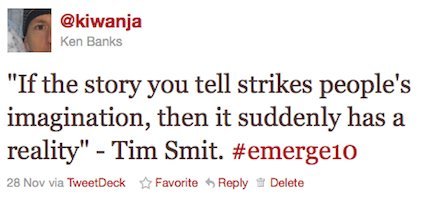
Context: Make the art of the possible seem possible for everyone. If people can imagine themselves in your shoes then your story will not only resonate, but will gain a reality and life of its very own.

Context: Organisations are only as good as the people who show up every day to work for them.

Context: Actions speak louder than words. Anyone can talk about anything. Creating and building doesn’t happen on the sidelines. Beware of the inexperienced “expert”.

Context: If you have good fortune, pass it on. Use it to help others. Think about who you were, not what you’ve become.

Context: For some people, anything they haven’t had a hand in is rubbish. Quite often, they’ve never actually done anything themselves. Avoid negativity. It’s a cop-out. (Note: Negativity is different to constructive criticism).
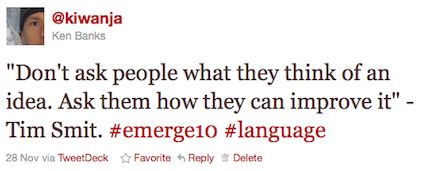
Context: Language is EVERYTHING.

This is the second time I’ve had the pleasure of hearing Tim speak. If you ever get the chance, grab it. After all, Tim might be the person you never knew you were meant to meet.

Pop!Tech. At 100,000 feet.

Today sees the start of Pop!Tech 2010, an annual gathering of kindred spirits in the picturesque town of Camden, Maine. Pop!Tech is always full of surprises, and yesterday proved no exception when about twenty of us found ourselves standing in a field in Augusta helping Colin Rich launch his latest ‘balloon’.

For those who don’t know, this is what Colin does. And it’s pretty incredible.

Yesterday’s launch was the “Secret Session”, one of a number of warm-up events designed to set the scene before the real conference kicked off today. And this is what we ended up doing – launching a balloon with a mannequin’s head attached. Here’s the head (with the orange GPS device exposed) next to a map displaying the ‘expected’ path the device was going to take.

After an hour’s drive out of Camden, Colin checks that the cameras are all switched on and working, and the GPS device has a fix.

Once all the electrics are go, time to dig out the helium and inflate the balloon.

After a final set of checks, and a short wait for the wind to die down, Colin releases his icy grip.

Going, going… Gone.

If all goes to plan, over the next two-and-a-half hours the balloon will capture pictures and video as it rises to approximately 100,000 feet. At that point the balloon should burst and the device will fall back to earth. The fall alone will take about half-an-hour. Colin will then head off and try to track it down, based on the co-ordinates transmitted by the GPS embedded in the mannequin’s forehead.

Who said science was boring?

Become a FrontlineSMS icon!

One of the more fun things about sharing our work at conferences, workshops and ICT4D gatherings is witnessing the reaction to our FrontlineSMS “\o/” logo. There’s something of a story behind this, and the badges that we take on the road with us have been enthusiastically gobbled up in their thousands. I will never again doubt the brilliance of the talented people at Wieden+Kennedy.

We’ve also been getting reactions from users in the field, and among our supporters, in the shape of photographs. We’ve got a growing collection, and we’ll soon be updating our Flickr page with the latest additions, and plan to make a short video of the best of them.

If you want to join in the fun, send us photos of you, your family or friends doing the \o/ and you could be a star in the first genuine FrontlineSMS video! Just email them to videopics [at] frontlinesms.com and we’ll do the rest. And if you want to take it a little further, how about trying some fun photos with the FrontlineSMS:Medic and FrontlineSMS:Credit logos? \+/ and \$/?

Three objects that define

House moves are always fun, particularly the things that re-emerge from old boxes years after they’ve been buried away. While most of it turns out to be useless, unwanted junk, sometimes you stumble across something which ended up having a bigger impact on your life than you ever imagined. Here are three objects, recently unearthed, which have done that for me.

Writing

I must have been about 10 or 11 years old when my mother bought me an old, ridiculously heavy Olympus typewriter from the “Under £10” section of our local newspaper . It was my first ever typewriter – I later ‘upgraded’ to a new model from Boots once I’d saved up enough money from my paper round – and I don’t remember much of any conversation we had before she bought it. But what I do know is that it unleashed my passion for writing. Homework was never the same again, and I must have written the majority of my poems on it, something I did a lot of in my younger years.

In 1978, the Amoco Cadiz ran aground off the Channel Islands, and for several months I took an unusually strong interest in the subject of oil – how it was found, where it came from, how much was left, how often spills happened, and so on. The culmination of this fascination was a ‘research project’ bound in a small A5 folder, imaginatively entitled “Oil: By Kenneth Banks”, which I still have to this day.

Today, writing remains a passion and is an important expressive outlet for me and my work. I’d never have imagined back in those days that I would end up writing for the BBC website, or PC World. I have a lot to thank that Olympus for. And my Mum, of course.

Computing

There was never really much to do on the estate where I was brought up, so the opening of a local club by Mr. Cooper was a main outlet for many of the children. It was a big estate, however, and the club had a waiting list. When I did eventually get the nod to join, Mr. Cooper had been using Commodore PET computers for some time in his other job – helping children with learning difficulties. During club hours we were allowed to play games on the PET, and were allocated around ten minutes each because of the high demand.

These amazing machines were powered by cassette players, and we quickly learnt the two commands we needed to use them. “LOAD” loaded the game, and when that was complete, “RUN” would execute it. I knew there had to be more to it than that, so during my short spells at the screen I’d try and figure out what else I could do. “LIST” was a revelation – a command to display the code. I soon realised that if I changed anything here, if it didn’t break the program it made it do something else. A programming career was born.

After a short while I was writing my own teaching programs for Mr. Cooper and earning extra pocket money from it. I have a lot to thank him for. Computers were hugely expensive in those days, and he gave me the opportunity to learn something which was only just starting to be taught in schools. Without this, a central pillar of my work today would never have been formed, and it’s highly unlikely I’d ever have been able to talk my way into an IT career, which I later did.

Travelling

By 1993 I was out of school and – thanks to Mr. Cooper and a few other lucky breaks – working in the local IT industry. I’d already decided that a career in finance wasn’t for me. By a few twists of fate (described later on this page of my website) I found myself on a Jersey Overseas Aid project that summer, helping build teaching accommodation in Northern Zambia. It was a life-changing experience, and took my life and career into a totally new and unexpected direction. An interest and fascination – and later, career – in development was born over those few short weeks, and I’m still as engaged in it as ever, 17 years on.

Since that first trip I’ve had the pleasure and honour to live and work in a number of other African countries – Uganda, Zimbabwe, Nigeria, Cameroon, South Africa, Mozambique, Kenya among them – and have made some incredible friends and even more incredible friendships along the way.

By September 1993, the month I returned from Zambia, the impact that trip was to have on my life was still largely unknown. Which makes it even more remarkable – perhaps strange – is that I kept a pair of socks from that first visit wrapped in a sheet of newspaper. These socks resurfaced during my recent house move. Some of my very first steps on the African continent are bound up in that marvellous red dust.

So there you have it. Three objects and three meanings that have helped define a life. Funny when you look at it like that.

What three objects define you?