
The October 7th, 2001 invasion of Afghanistan didn’t only mark the beginning of the “War on Terror“. It also paved way for the introduction of the first mobile phone networks into the country, networks which today find themselves pawns in a game of cat-and-mouse between the Taleban, the government, security forces, mobile operators and aid agencies working to improve the lives of hundreds of thousands of people.
Afghanistan is rarely out of the headlines. Just this morning news broke of three women aid workers and their driver being killed near Kabul, demonstrating in the most graphic terms imaginable the huge dangers faced by so many NGOs working there. Decades of invasion, war and fighting has run the country ragged. There can be fewer more dangerous places on earth to work. As recently as July 2008, the Crime and Safety Report described the security situation as remaining “volatile and unpredictable”:
“No part of Afghanistan should be considered immune from violence, and the potential exists throughout the country for hostile acts, either targeted or random, against American and other western nationals at any time. There is an on-going threat to kidnap and assassinate U.S. citizens and non-governmental organization (NGO) workers throughout the country. Afghan authorities have a limited ability to maintain order and ensure the security of the citizens and visitors”
In such a challenging and hostile environment, non-profit organisations rightly spend considerable amounts of time and effort doing everything they can to limit their exposure to risk. With improved communication often at the heart of security strategy, many have turned to the growing influence and availability of mobile phone networks in the areas where they operate, and to tools which give them the potential to communicate quickly, widely, efficiently and effectively.
 Within months of the US-led invasion in late 2001, the first Afghan mobile networks began to appear. Today, Afghanistan has four privately-owned networks and, according to a recent report by the BBC, mobile phones are the “only way most Afghans are able to communicate, especially in remote areas where they are used to summon medical help or contact relatives”. The importance of mobile technology hasn’t gone un-noticed by the Taleban either, who have recently been destroying towers in an attempt to stop security forces using the technology to co-ordinate night-time attacks against them. That particular game of cat-and-mouse continues.
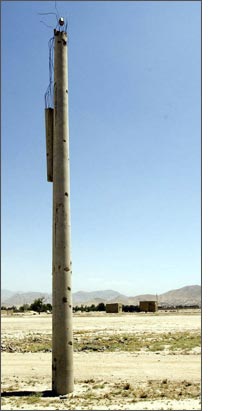
Mobile masts aren’t the only target either, for the Taleban or invading ‘liberating’ forces. As is often the case in conflict situations, infrastructure – and innocent civilians – are among the early casualties. Power lines are also a target, presenting further challenges not only for the wider civilian population but also for operators and mobile users alike (photo above of a destroyed power pylon courtesy of Jan Chipchase, “Future Perfect“).
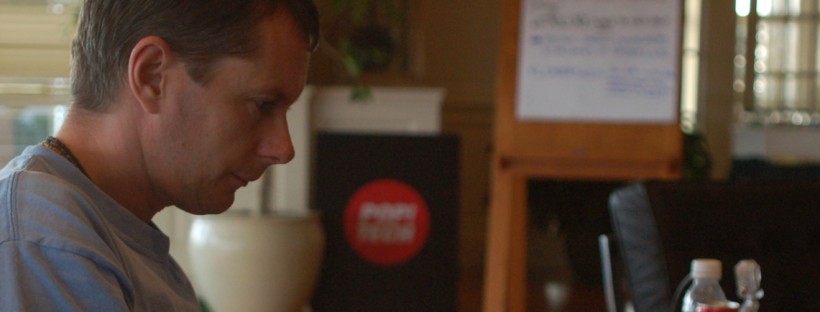
Facing a continued and growing security threat, in January 2007 a major international humanitarian organisation approached kiwanja.net and within days started using FrontlineSMS as a field communication solution in their Afghan operations. Today they continue to use the Windows version in their main operations room (see image below), and the newer Mac version is used as a backup by a senior Security Officer. The software is primarily used to quickly pass time-sensitive security information to staff in the field via SMS.

According to the NGO:
Drivers receive updates on traffic congestion, road blocks, police operations, VIP movements, local minor security incidents and anything else that might be useful as they travel. Senior staff receive SMS messages regarding larger security incidents that may require them to modify program activities for the short term. Incidents that influence activities in other areas are sent to the sub-office group. Finally we have an ‘All Staff’ category for those situations where we need to notify or account for everyone as quickly as possible
As this use of FrontlineSMS demonstrates, the software continues to prove remarkably versatile, and its increasing use in a growing number of non-profit activities is testament to kiwanja’s approach to building tools for NGOs, and not to try and build solutions to specific problems. As a forthcoming “Publius Project” guest article argues, communication is a fundamental yet often overlooked NGO need, whether they be working in Afghanistan, Zimbabwe, Pakistan, Nigeria, Aceh or the United States, or working in human rights, activism, environmental protection, health, economic empowerment or education.
Promoting the use of FrontlineSMS among the wider NGO community – particularly those working in conflict zones – whilst at the same time trying to protect identities is a fine balancing act. After the reported killings this morning, I decided to remove the name of the organisation using FrontlineSMS in Afghanistan from this post, even though I was given permission to use it.
However keen I might be to help other NGOs in similar situations get their hands on FrontlineSMS, some things simply aren’t worth the risk…
An update following today’s attacks outside Kabul:
“… FrontlineSMS was essential for us getting the word out quickly. E-mail was down, voice was spotty but SMS still worked. We had two female staff at a school near the incident and were able to tell them to stay put till things quietened down. All my staff made it home safe today”
 operating systems in the latest release. That said, it comes as no surprise that the majority of new users have requested the Windows version (79%). The majority of Apple Mac requests (13%) came from either techies or users in developed/Western markets, and almost without exception all Linux requests – trailing in third place at 8% – came from the developer or techie community. This reflects what we originally expected, and justifies our original focus on a fully-automated Windows installer, as opposed to the Mac and Linux versions which require a little manual configuration. (This is set to change, however, as we work with


