Tim Smit may be an extraordinary individual, but he’s no ordinary entrepreneur. Founder of The Eden Project – described by some as the “Eighth Wonder of The World” – Tim has taken an unconventional if not fascinating path. By all means read those Business Bibles – but then tear them up. Read Marketing 101 – but then toss it aside. In the sometimes rigid and stuffy world of social entrepreneurship, Tim is a breath of fresh air. And his short talk last weekend at Emerge 2010 in Oxford was nothing short of inspirational.
Courtesy of Twitter, here’s a short summary of a “lucky 13” key points that stood out most for me.

Context: Never forget what you were like as a child. Push the boundaries of your imagination, live out your dreams, find that one thing which truly “switches you on”. And then relentlessly pursue it.

Context: Don’t get caught up in the lingo. Buzzwords mean little if they’re not backed up by very real action.

Context: Inspiration and innovation can happen any time, any place. No person and no structure have exclusive rights over the best ideas. Unconventional can be king. It usually is and, what’s more, it will usually come with the most compelling story.

Context: Seize the moment – it won’t last forever, and there will likely never be a “best time” to execute your idea.

Context: Not everyone will be able to take that “big risk”, but that doesn’t mean they won’t be able to join you on a journey. Inspire others to join you. Don’t travel alone. Build it, and they may just come.

Context: In ICT4D we talk about silos. Take every opportunity to step outside yours. Be open minded. Meet people who, on the surface, have very little in common with you. Explore new horizons. You have nothing to lose and everything to gain.

Context: If you don’t follow your instincts, you may always regret it. Don’t put yourself in that position. Success is just as much about “positive thinking” as “positive doing”.
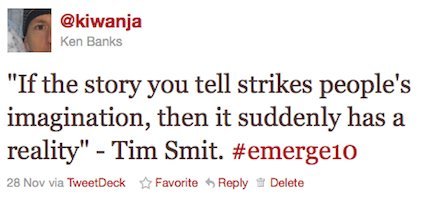
Context: Make the art of the possible seem possible for everyone. If people can imagine themselves in your shoes then your story will not only resonate, but will gain a reality and life of its very own.

Context: Organisations are only as good as the people who show up every day to work for them.

Context: Actions speak louder than words. Anyone can talk about anything. Creating and building doesn’t happen on the sidelines. Beware of the inexperienced “expert”.

Context: If you have good fortune, pass it on. Use it to help others. Think about who you were, not what you’ve become.

Context: For some people, anything they haven’t had a hand in is rubbish. Quite often, they’ve never actually done anything themselves. Avoid negativity. It’s a cop-out. (Note: Negativity is different to constructive criticism).
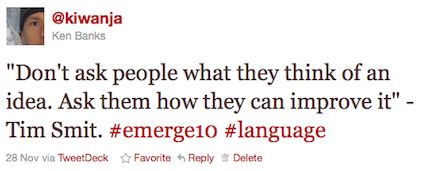
Context: Language is EVERYTHING.
This is the second time I’ve had the pleasure of hearing Tim speak. If you ever get the chance, grab it. After all, Tim might be the person you never knew you were meant to meet.

 The Christmas/New Year break is always a good time to reflect, and look back (and forward) on what’s been achieved (and what remains to be achieved). It’s also a good time for renewal. Perhaps that’s why the end of the year/the start of the next brings up so many anniversaries for me.
 “Over the next few months we will delve into the human stories behind the growth of mobile technology in the developing world. We’ll take a closer look at the background and thinking behind FrontlineSMS, and hear from a number of users applying it to very real social and environmental problems in their communities. We will also hear thoughts and insights from other key mobile innovators in the field, from anthropologists to technologists to local innovators.”