Time for a top-down bottom-up development challenge?

Earlier last week I stumbled into a post on Chris Blattman’s website provocatively titled ‘Is this the most effective development program in history?‘ It in, he shares the story of how, in 2011, the Nigerian government handed out $60 million to 1,200 Nigerians – that’s about $50,000 each – to help them create, run and/or scale a business. “Three years later there are hundreds more new companies, generating tons of profit, and employing about 7,000 new people”. Not bad for a reasonably modest amount of money.

Although I see this as more of an investment program rather than a development initiative, I come to similar conclusions to Chris. What if we channelled more funds to the middle and the bottom, and let market forces and entrepreneurialism in-country take over?

Today I read another post, this time on the Guardian development professionals network,  which poses a not-too-dissimilar question. In ‘Five reasons funding should go directly to local NGOs‘, Jennifer Lentfer – creator of how-matters.org and Director of Communications at International Development Exchange – argues that we should channel more funding directly to local innovators, NGOs and social entrepreneurs on the ground in developing countries. To put things in context, only about 1% of humanitarian aid goes directly to local actors in the global south at the moment. The rest goes through what Dhananjayan Sriskandarajah calls ‘fundermediaries’. In other words, larger global development players who then ‘trickle’ it down (or so the theory goes).

Jennifer’s call for more local funding is based on five key arguments:

1. While outsiders struggle with concepts such as ‘community participation’ and ‘local empowerment’, there are often “dedicated and embedded local partners who are working hard to understand and address their own problems” who do get it.

2. Local organisations, by their very nature, are intrinsic to the local communities they serve, and are part of the social fabric. They belong there, and are often more vested in developing meaningful, sustainable, long-lasting solutions.

3. The larger the (outside) institutions, the more funds they need to divert internally to sustain themselves and their staff, offices and operational budgets.

4. Most local institutions are free from the burden of annual reports, log frames and three year funding models meaning that many have greater staying power than outside, larger institutions who come and go based on a range of external factors.

5. There is proof, albeit in low quantities (because of the lack of direct funding at this level) that “grassroots grantees get results”.

In a separate postDhananjayan Sriskandarajah shares five excuses donors give for not funding local NGOs directly. Among these are that local NGOs don’t have the expertise or capacity to fill in all the forms; it is too expensive to administer the smaller grant amounts suitable for smaller organisations; that funds need to be channelled through ‘trusted partners’ to manage risk; money laundering and anti-terror rules make it hard to give to ‘non-trusted partners’; and a pressure for funds to be put through organisations in their home country (i.e. organisations which, more often than not, are also in the global north). 

I’ve been arguing for more direct support for local innovators, social actors and NGOs for well over a decade, so each of these posts resonated strongly. It has also been a central part of my argument that we build tools that local organisations can take and use on their own terms, again something I’ve been speaking about on the ICT4D circuit since 2003.

Of course, not all international NGOs are the same, and not all grassroots are the same, either. But if there’s evidence that in certain circumstances local players have better chance of achieving a desired impact, often for less money, then it’s right and proper that we investigate further.
fixingdevelopment

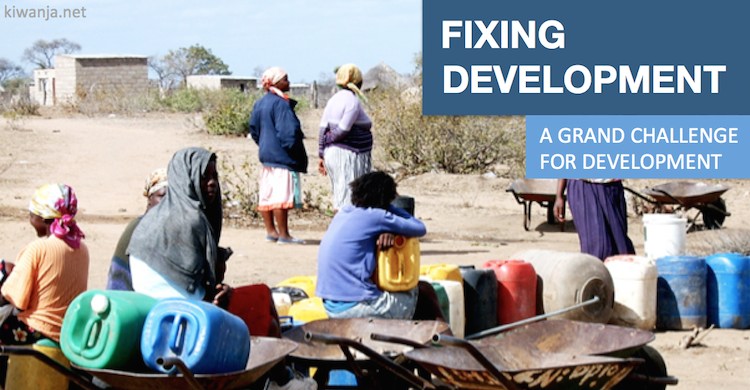
So, how about a new Development Challenge, modelled on the same types of competition where investors start with the same amount of money (not real money, mind you) and aim to turn it into as much as they can within a fixed period of time? It would need to be a fairly long-term experiment, and it could go something along the lines of:

1. Identify half-a-dozen international ‘fundermentaries’
2. identify half-a-dozen grassroots NGOs
3. Determine a modest starting budget – the same amount for each organisation
4. Allow them to dictate where and how they spend the money via a short proposal
5. Using an independent evaluator, take some baseline data based on (4)
6. Disburse the funds (real money in this case)
7. Come back in a predetermined period of time (at least three years)
8. Using an independent evaluator, carry out some monitoring and evaluation

Which projects are still running? What impact have they had? What changes have they helped facilitate? How sustainable are they? What changes have there been in the community? How did the approaches of the local organisations differ from the others? What conclusions can we draw from all of this?

We wouldn’t have much to lose by trying out an experiment like this, but a whole lot to gain. Of course, if it was shown that grassroots designed and managed projects performed better, the international development community would have some awkward and difficult questions to answer.

And if the international community does better? Well, then it’s just business as usual.


A version of this post also appeared on the Stanford Social Innovation Review

New idea? Or old idea done better?

Last week I received my yearly mailing of Ashoka’s inspiring ‘Leading Social Entrepreneurs’ publication. It’s always fascinating flicking through the work and lives of some quite extraordinary individuals helping make their part of the world a better place.

Ashoka-Book

At the end, it struck me how many solutions there were between the covers of the publication, and how many further answers were out there to the world’s social and environmental ills. I also wondered what was happening with most of those ideas. Were they being implemented in single (or sometimes multiple) locations by single social innovators or organisations? Or had others taken those ideas and applied them where they lived and worked?

Philanthropy is always looking for new ideas, innovative ideas. I’d be surprised if we didn’t have enough good answers already, and what we should instead be doing is encouraging others to use those rather than continually come up with new ones.

What technology-for-conservation might learn from technology-for-development

Although the majority of my more recent work has sat in the ‘global development’ bucket, much of my early interest lay in conservation. Before I stumbled into the world of mobiles-for-development (m4d) I was helping with biodiversity surveys in Uganda and running primate sanctuaries in Nigeria, and focusing my academic studies on the role of anthropologists in the creation of national parks. My first m4d project looked at the potential of mobile technology in conservation, and it was my work around Kruger National Park over 2003 and 2004 that lead to the idea behind FrontlineSMS.

Conservation is still one of my biggest passions, and I returned to my roots a couple of years ago when I was asked to speak about the potential for, and use of, emerging technology in the global conservation effort at the 2013 WWF Kathryn Fuller Symposium. You can watch that talk below (it’s also available, along with other talks, in the Audio & Video section of this website).

The following year I was invited to an event at the University of Aberdeen in Scotland, and gave a similar talk at their inaugural Digital Conservation event on how the sector might draw lessons on technology use from global development. Following my talk, I was invited by the organisers to join them in co-authoring a paper for a forthcoming special edition of Ambio Journal focusing on “Digital conservation: Understanding the impacts of digital technology on nature conservation“. One element of the paper proposes a rework of kiwanja’s Donors Charter for the conservation community.

Late last month, that special edition hit the shelves. Here’s the summary of our paper, which was proudly co-authored with Georgina Maffey, Hilary Homans and Koen Arts:

The application of digital technology in conservation holds much potential for advancing the understanding of, and facilitating interaction with, the natural world. In other sectors, digital technology has long been used to engage communities and share information. Human development – which holds parallels with the nature conservation sector – has seen a proliferation of innovation in technological development. Throughout our paper, we consider what nature conservation can learn from the introduction of digital technology in human development. From this, we derive a Charter to be used before and throughout project development, in order to help reduce replication and failure of digital innovation in nature conservation projects. We argue that the proposed charter will promote collaboration with the development of digital tools and ensure that nature conservation projects progress appropriately with the development of new digital technologies.

You can download a full PDF of the paper from the kiwanja website here or via the Ambio website here.

The case of We Care Solar and our failure to spot winners

“The first ever US$1 million UN-DESA Energy Grant has been awarded to We Care Solar, a non-profit organisation, to enhance and expand the use of its ‘Solar Suitcase’. By making solar power simple, accessible and affordable, this device allows for the provision of electricity for medical procedures during childbirth in many developing countries, helping to avoid life-threatening complications for mothers and children” – UN website

Yesterday afternoon at United Nations HQ in New York, Laura Stachel and her organisation, We Care Solar, picked up the inaugural UN-DESA award. It’s the latest in a string of awards and accolades for a project I’ve known and admired for many years. You can read more about what happened yesterday on the UN website.

Liberian Health Workers receiving their  Solar Suitcase (Photo: We Care Solar)

Liberian Health Workers receiving their Solar Suitcase (Photo: We Care Solar)

I was already a fan of simple, appropriate technology solutions to problems before I met Laura in 2009. While almost everyone else at the time seemed to be aspiring to build complex tech solutions to often simple problems, the idea behind the Solar Suitcase was beautiful in its simplicity. It was based on a rather simple hypothesis: If the power (and therefore lighting) goes down in the middle of a difficult (or any) childbirth, and there’s no backup, people can die. This is not just true of maternity wards in the developing world, where Laura first witnessed this happening. Try plunging any operating theatre anywhere in the world into darkness and see how the surgeons cope.

I always found the idea compelling, and always did what I could to help. Laura was as committed to ending these unnecessary deaths as anyone could be, and her determination was at times a source of frustration to her. She gave it everything, and taking it on changed her life. The fact she got so little support early on, despite the compelling nature of her work, was an injustice in my eyes, and another reason I always did what I could. It was another reason why I wanted to include her story in my recent book, “The Rise of the Reluctant Innovator“. In celebration of their award yesterday, we’re offering Laura’s chapter here for free (PDF).

Why Laura was so committed was clear. From her Nigerian fieldwork (2008), quoted in the book:

I had not predicted the challenges facing my Nigerian colleagues. At night, I observed maternity care, watching helplessly as doctors and midwives struggled to treat critically ill pregnant women in near-total darkness. The dim glow of kerosene lanterns often provided the only illumination. Without electricity, doctors had to postpone Caesarean sections and other life-saving procedures. When the maternity ward was in darkness, midwives were unable to provide emergency care and, on occasion, would turn patients away from the labour room door, despite their critical need for care.

The story of Laura’s response, the Solar Suitcase, is not the rosy tale of social innovation and overnight success that many people hearing about her work for the first time yesterday might think it to be. Today, things might be going well but, as Laura will remind us, there’s always more to be done, and women and children continue to die in the dark in wards the developing world over. It’s obviously great news that, as a result of yesterdays award, that number will continue to decrease, but that level of support hasn’t always been there, despite the compelling nature of what she was doing.

Poster for the Solar Suitcase (Courtesy Laura Stachel)

Poster for the Solar Suitcase (Courtesy Laura Stachel)

After that Nigerian trip in 2008, Laura and her partner, Hal, sketched out the early plans for the Solar Suitcase. That done, they needed money to build a prototype. A $12,500 competition at UC Berkeley looked like the perfect place to get it, but out of twelve finalists they didn’t win. In her own words, Laura felt dejected and, worse, felt she’d let down colleagues in Nigeria who she had promised to help. But someone there believed in them. Thomas Kalil, a campus official who had been at the competition, called Laura up and told her they should have won. He committed to helping. Within three weeks he had pulled together $25,000 from The Blum Center for Developing Economies and Berkeley Big Ideas, and We Care Solar was born. Considerable challenges remained as the work progressed, and on numerous occasions anyone with less determination would have quit. There’s nothing more deflating that having huge belief in what you’re doing, only to find so few others who share it. If you want the real story behind what it means to innovate, read Laura’s chapter. Trust me, it’s worth it.

The story of We Care Solar is littered with opportunities for the official development sector to come on board. But on so many occasions it didn’t. There could be many reasons for this. Perhaps the technology wasn’t clever enough? Maybe donors didn’t see the potential in what Laura was doing? Maybe they were too busy looking for the next big thing? Maybe all of the above?

Yesterday’s award is proof that Laura was right sticking to her belief in the Solar Suitcase, despite the immense personal sacrifices that involved. And we should be grateful that she did. We talk a lot in the development sector about ‘picking winners’ and the ‘need to support things that work’. But that clearly didn’t happen here. Until now. How many Laura’s are out there who don’t battle through, who call it a day on potentially life-changing ideas because they can’t get the support they need? Or, worse, because they are constantly rejected?

Hindsight is a wonderful thing, but what’s not compelling about giving light to maternity wards in the developing world? What’s not compelling about wanting to stop women and babies dying in the dark? And why did it take so long to help someone fix it?