Putting data integrity on the map

We were excited to join colleagues and friends in Washington, DC, on Tuesday 9th August to release the first edition of our “User Guide on Data Integrity”, a tool that will help FrontlineSMS users around the world better understand the flow of information into and out of the platform, the risks and vulnerabilities to that data, and simple ways they can mitigate those risks.

Review by Cathryn Paine reposted from the FrontlineSMS blog

To kick off the discussion around the new guide, we hosted a panel discussion at Johns Hopkins’ School of Advanced International Studies, where FrontlineSMS’ Sean McDonald joined Jon Gosier of metaLayer, Development Seed’s Paul Goodman, and Internews Vice President for New Media Kathleen Reen, who moderated the event. This research effort, based on FrontlineSMS user input and research by Kristina Lugo and Carol Waters, focused not on mobile system security, a critical issue better addressed by others, but more on the ways that contextualized program design and implementation can improve data quality and reduce user risk. Above all, we learned through the process, context is key. Understanding the needs and norms of the target population, and the goals of the project itself, is vital in determining the proper tools and approach to designing a FrontlineSMS workflow that can achieve those goals.

The panel discussion centered on these key points, especially the role that stakeholders play in the reliability and integrity of project data. Issues from misinterpretation, to unconscious bias, to lack of corroboration can creep into an improperly designed data collection effort, polluting the entire dataset in the process. To mitigate these threats, Jon emphasized focusing on localization and usability in project design—understanding the users or beneficiaries of a project is the best way to minimize human error and maximize data integrity.

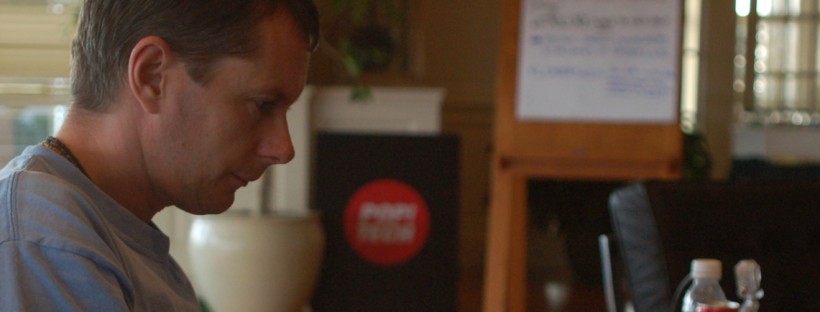
Paul Goodman during a project planning session, sketching out project workflow which includes FrontlineSMS use. Photo credit: Paul Goodman

Paul contextualized these points with insights from mobile projects in Haiti and Benin, focusing on the process of implementing new technologies—from design to training to implementation. Particularly, the panel discussion focused on assuming that program data would be made public, in an effort to design projects that achieve important goals while minimizing risks associated with data sharing or system compromise.

Throughout the conversation, the discussion kept coming back to the importance of user-focused, context-aware approaches and resources in ICT projects. No matter how complicated the technology, an informed and engaged community of project staff and participants is really the best tool for safeguarding quality data. All in all, a great discussion that we hope to keep going through the forum and ongoing interactions!

You can download a PDF of the FrontlineSMS User Guide on Data Integrity here.

Joining the UK Africa Delegation

This week represents something of a first for us as we head to Africa as part of a UK business delegation lead by David Cameron, the British Prime Minister. Also in attendance is Lord Green, the Minister for Trade and Investment, and Andrew Mitchell, Secretary of State for International Development, along with a number of prominent business leaders from across the UK.

This trip is exciting for a number of reasons. Firstly, it represents the beginnings of a closer working relationship with government, something we’ve been keen to explore for some time. Secondly, in a visit dominated by big business, it gives us the perfect opportunity to demonstrate what the non-profit sector in the UK has to offer, and highlight many of the exciting developments – and potential – of mobile technology for social good across the African continent:

Africa has always been key for us. Our work is all about technology innovation, and how mobile phones can help solve some of Africa’s bigger problems. As the developers of FrontlineSMS, a piece of free text messaging software used across the continent, our key objective as part of the delegation is to foster closer relationships with the private sector and government, and understand how we can best support local innovation and entrepreneurship in the mobile sector. It remains an area with huge potential

Tonight we’re in Lagos, Nigeria after spending the first full day in Johannesburg and Pretoria. The South African leg of the trip kicked off with breakfast meetings with South African business leaders, followed by a short audience with David Cameron and Jacob Zuma and a quick photo opportunity. An official Press Conference was the final act of the morning, held by both leaders at the government building.

Events back home have lead to the cancellation of the visits to Rwanda and Southern Sudan – a real shame – so we’ll be heading home tomorrow (Tuesday) after lunch meetings with a number of Nigerian politicians. The BBC posted an article earlier today on the Africa visit, and the pressure the Prime Minister is under to return to London.

The Rolling Stones School of Management Innovation

What do the Rolling Stones and FrontlineSMS have in common? Not much, you might think. Well, they’re not users, they’re a little better-off than us and they’re considerably more famous. But there is something a little more subtle we share with them – management innovation.

In his autobiography – “Life” – published last year, Keith Richards describes the evolution of The Rolling Stones‘ management. Three quite distinct individuals played key roles in getting the band to where they are today. From an article last November in The Week magazine:

“First up was Andrew Loog Oldham – described as an oddity of the London music scene – who successfully branded The Stones as the “dirty, snarling and mean” antidote to the then clean-cut Beatles. Then came Allen Klein, a lawyer expert in negotiating with record companies. Finally, there was Prince Rupert Lowenstein, a private banker with no roots in the music industry, who professionalised the outfit – establishing separate companies to handle publishing, merchandising and touring – which made The Stones one of the richest bands in history”

The evolution and management of FrontlineSMS can also be broken down into three phases:

  • Technology innovation
  • Organisational innovation
  • Business model innovation

As The Stones example demonstrates, each phase requires a very different skill set, and it would take an extraordinary individual to be able to manage and deliver successfully on each. While I may have been the right person – in the right place at the right time at the very least – to successfully deliver on Phase One, that doesn’t mean I’m the right person for Phase Two, or Three. A large part of building a successful organisation is assembling a talented, diverse team with complementary skill sets. Identifying gaps and being honest about our own strengths and weaknesses is a large part of the process.

The social entrepreneurship sector, however, remains largely laser-focused on the innovator, the person behind Phase One. Recognising that organisations develop in phases, and have different needs at each, there needs to be a slight shift in how we view – and support – entrepreneurs and the vehicles or organisations they help create.

With this in mind, there might well be a few things the social entrepreneurship sector could learn from The Rolling Stones.

The FrontlineSMS trump card

This time last year I was on my way back from Washington DC where I’d spent a week at the National Geographic Explorers Symposium. It was one of those am-I-really-here? events where you randomly share a lift with the likes of Bob Ballard – who discovered the wreck of the Titanic – or Spencer Wells, who’s trying to figure out where we all came from.

I couldn’t be there this year, but I did receive a nice surprise in the mail from a friend who works for National Geographic Traveler Magazine. At this year’s event they produced a deck of cards with the names of each of the Explorers and Emerging Explorers. I love what they’ve done with ours.

All that’s missing is the \o/ logo.  ;o)

That aside, hearty congratulations to everyone who made the Explorers Class of 2011!