It was a cold evening last October when I heard from National Geographic that we’d won an Emerging Explorer Award for our work in mobile. Seven months is a long time to keep a secret, but now news is out it will hopefully be the ideal platform to help us spur further development of FrontlineSMS, and increase interest in wider circles around the potential for simple, appropriate mobile technologies to solve some of the more pressing problems people face in the world today.
Although it’s wonderful to get this kind of recognition, it also makes it a good time to clarify a few key points about the work we’re doing.
Exploring

First, I believe National Geographic took a bold step picking a mobile project as one of their Awardees. Explorers are usually associated with more physical, tangible acts such as climbing, diving, flying, discovering and so on. Trying to come up with a new approach to applying mobile technology to a problem is a different way of thinking about “exploring”, and I think it raises a number of very interesting questions. Something for a future blog post, no doubt.
Approaching

Second, first and foremost I believe the Award is recognition of our approach. Over the past five years – yes, it’s almost been that long – we’ve developed a clear methodology based on “handing over our technology and stepping back” (as one conference delegate once put it to me). The National Geographic article summed it up perfectly:
The key, Banks believes, is a hands-off approach. While his website provides free support and connects participants worldwide, users themselves decide how to put the software into action. “FrontlineSMS gives them tools to create their own projects and make a difference,” Banks notes. “It empowers innovators and organizers in the developing world to reach their full potential through their own ingenuity. That’s why it’s so motivating, exciting, and effective”
If we look at what’s happening today – with very little of it controlled by us – we’re seeing something of an ecosystem developing around FrontlineSMS. Sure, the software isn’t perfect and it’s constantly improving and evolving, but people are being drawn to it because it allows them to do what they do, better. It’s something they can build on top of, something they know of and to a large degree trust, and something which allows them to immediately tap into a wider community of users, donors and supporters.
It can act as a springboard for their own ideas and visions in a way other solutions aren’t. And only a few of these people are technical, and that is key. “Focus on the users and all else will follow” is something we seem to come back to again and again, but without it – and without users – all we have left is a bunch of code and a Big Idea.
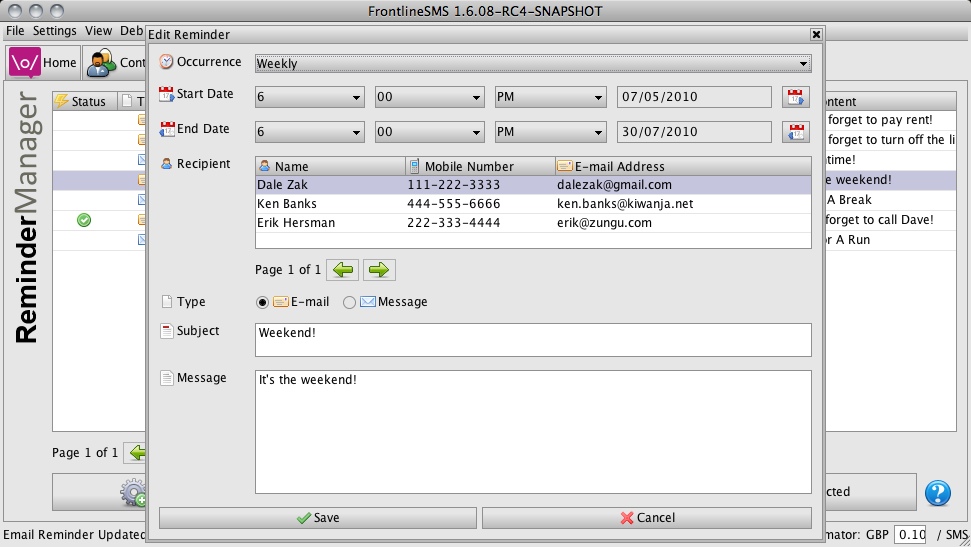
The FrontlineSMS ecosystem is witnessing the creation of increasing numbers of plug-ins – medical modules, microfinance modules, mapping tools, reminders and analytical tools among them, and we’re hearing more and more from established, well-known entrepreneurial organisations who have chosen to implement and integrate FrontlineSMS as one element of their work. Laura, our new Project Manager, is just beginning to reach out and make sense of this activity, much of which we currently know very little about. Allowing users to take your platform and just run with it is empowering for them, but creates a unique set of challenges for us.
Recognising

Third, and finally, are the recipients of the Award. I may have been fortunate enough to have got the fledgling FrontlineSMS concept off the ground way back in the summer of 2005, but it’s been a truly monumental, global effort getting it to where it is today, recognising – of course – that we still have a long way to go. From bloggers to donors, from developers to journalists, from testing partners to users, people have stuck with us and supported us in ways I would never have imagined.
Sure, the software can do some pretty neat things, and thanks to Alex and Morgan (our two developers) it continues to improve. But what really draws the majority of people to our work is the approach. For five years we’ve remained 100% focussed on the end user, and have not been distracted by newer, sexier emerging technologies. People really seem to get that. We’ve also concentrated on building, and on remaining positive. There is much wrong in the world, but that should never stop anyone making a contribution, however small.
So, a big thank you to National Geographic for putting their faith in our work; to Laura, Alex, Morgan and Josh, our dedicated core team; to the MacArthur Foundation for taking a gamble on a guy living in a van in 2007, and to the Hewlett Foundation, Open Society Institute, HIVOS, the Rockefeller Foundation and the Omidyar Network for helping us continue to develop and grow.
Finally, thanks to everyone who has supported us, spoken about us, written about us, promoted us and helped us, and thanks to the users for taking our software and doing some truly inspirational things with it. We owe all of this to you.

 After three years with a mainly software and community focus, the second half of 2010 sees us turn more of our attention to organisational development, and it’s already been something of a growth year.