Sitcoms+SMS: Tackling HIV/AIDS in the DRC

In this, the first of a series of guest posts on how FrontlineSMS is being used around the world, Becky McLaughlin – Marketing Director at Rien que la Vérité – talks about their current use of the platform, and the impact it has had on their work

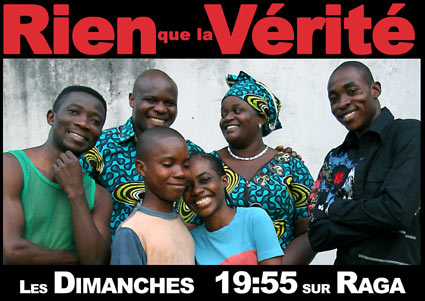
“Based in the Democratic Republic of Congo, Rien que la Vérité was born in 2006 when some of the finest musicians in the Congo united to produce a CD of songs speaking against the spread of HIV/AIDS. Since 2006, the Rien que la Vérité platform has produced 14 music videos, a documentary, and an all-day stadium concert. In its present incarnation, Rien que la Vérité is touching the lives of the people of the Congo through their television screens as they follow the lives of a Kinois family on a locally-produced TV drama.
rqlv_family_ad

Rien que la Vérité – the TV series – launched nationally on November 30th, 2008 and first implemented FrontlineSMS in the airing of its second episode on December 14th. Each episode broadcast is accompanied by short talk-show segments during which a host introduces music clips, talks to well-known musicians and actors, and interviews representatives from local NGOs and organizations whose message dovetails with a theme introduced in the show.

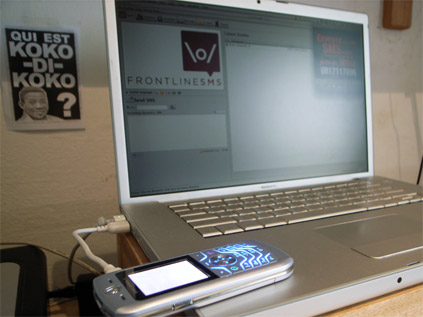
During the December 14th show, the audience was invited to participate by sending an SMS with the name of their favorite character. The responses were collected using FrontlineSMS. This simple first step allowed Rien que la Vérité to test the software and to begin an exploration of our audience’s perceptions and preferences. As the show continues we plan to introduce more simple polls that will help tailor the show to the audience’s tastes, and give viewers a sense of ownership of the program.
drc-tv-frontlinesms

This, however, is the most basic use we foresee. We are now launching a drive to support fan clubs, so that people who watch the show can find each other, meet, and talk about the show and the topics it introduces – a process that will begin to normalize conversation about HIV/AIDS. We’ll use FrontlineSMS to collect contact information from interested fans, then broadcast messages with times and locations for local club gatherings. We also intend to use FrontlineSMS in our research for measuring the impact the show has on our target audience. We’ll send out questions via SMS to fans before and after each show, measuring any changes in attitude, knowledge, or self-reported practices due to exposure to the show’s messaging.

FrontlineSMS will be a critical tool in our goal to entertain and educate. Like its television format, Rien que la Vérité’s future development must remain grassroots, and FrontlineSMS is an excellent vehicle for this.”

Becky McLaughlin
Marketing Director
Rien que la Vérité
www.abcd-laverite.com

FrontlineSMS takes on rural healthcare in Malawi

Today sees the official launch of the new version of FrontlineSMS. To celebrate, kiwanja.net invited Josh Nesbit – a Senior in the Human Biology Program at Stanford University – to talk about its use in east Africa where he’s spending the best part of this summer introducing the system into a rural hospital in Malawi. You can read Josh’s Blog here

“St. Gabriel’s Hospital is no stranger to assaults on well-being spread by disease and illness. Located in Namitete, Malawi, St. Gabriel’s serves 250,000 rural Malawians spread throughout a catchment area one hundred miles in radius. With a national HIV prevalence rate of 15-20%, children orphaned by AIDS will represent as much as one tenth of the country’s population by 2010. With tuberculosis (TB), malaria, malnutrition and pneumonia ravaging immuno-compromised populations, the health system – including St. Gabriel’s Hospital – faces a disquieting burden. Malawi’s health challenges are compounded by its devastatingly low GDP per capita, by some measures the lowest in the world.

With just two doctors and a handful of clinical officers, St. Gabriel’s Hospital is strikingly understaffed. This perennial state of affairs explains the shift of primary healthcare in other, similar settings, to Community Health Workers (CHWs), trained for specified tasks. Through the hospital’s antiretroviral (ARV) treatment program – drug therapy for HIV/AIDS – over 600 volunteers have been recruited. These volunteers are spread throughout villages in the Hospital’s catchment area. Some CHWs are HIV and TB drug adherence monitors, while others accompany patients during long journeys (up to a hundred miles, often by foot) to the hospital.

A few of the more inspired volunteers record their activities in notebooks, and travel to the hospital to have their good work acknowledged. The vast majority, however, remain disconnected from hospital activities, interacting with hospital staff only to pick up their drugs. It’s not that they don’t want to play a legitimate role in a community health system – there is no communication to foster such a role.

Enter FrontlineSMS. The program, developed by Ken Banks and his team at kiwanja.net, is the cornerstone of a new, text-based communications initiative at St. Gabriel’s Hospital. Funded by the Haas Center for Public Service at Stanford University and the Donald A. Strauss Foundation, I’m currently knee-deep in a pilot program.

FrontlineSMS is being used to connect the hospital with its CHWs, expanding the role of the volunteers. Drug adherence monitors are able to message the hospital, reporting how local patients are doing on their TB or HIV drug regimens. Home-Based Care volunteers are sent texts with names of patients that need to be traced, and their condition is reported. “People Living with HIV and AIDS” (PLWHA) Support Group leaders can use FrontlineSMS to communicate meeting times. Volunteers can be messaged before the hospital’s mobile testing and immunization teams arrive in their village, so they can mobilize the community. Essentially, FrontlineSMS has adopted the new role of coordinating a far-reaching community health network.

The hospital sees intense promise in the formidable duo of FrontlineSMS and the cell-phone-yielding health worker. The usefulness of a well-managed communications network is undeniable, particularly when the information is so vital. In the first hours of the pilot program, a deceased patient’s extra ARVs were secured, the Home-Based Care unit was alerted of ailing cancer patients, and a death was reported (saving the hospital a day-long motorbike trip to administer additional morphine).

Rural healthcare has found, in FrontlineSMS, a powerful protagonist”.