Social mobile gets its own “roadmap”

After three workshops on three continents, conversations and meetings with countless NGOs, academics, researchers and technologists, and many hours of conference calls, W3C this week released their “Mobile Web for Social Development Roadmap”, a comprehensive document which sits at the heart of the wider work of the Mobile Web for Development Interest Group (MW4D).
According to the Roadmap document, its purpose is to help:
“… understand the current challenges of deploying development-oriented services on mobile phones, evaluate existing technologies, and identify the most promising directions to lower the barriers of developing, deploying and accessing services on mobile phones and thereby creating an enabling environment for more social-oriented services to appear”
The Roadmap is split into two distinct sections. The first covers challenges and issues in developing mobile tools for social development, and the second looks specifically at technology options. The primary audience are individuals, organisations and entrepreneurs interested in social mobile; the mobile industry itself; academics; international organisations and, finally, policy makers and regulatory bodies.
The Roadmap is very much a work-in-progress, and the MW4D Interest Group welcomes comments, recommendations and suggestions to help shape it as the work moves forward.

After three workshops on three continents, conversations and meetings with countless NGOs, academics, researchers and technologists, and many hours of conference calls, W3C this week released their “Mobile Web for Social Development Roadmap”, a comprehensive document which sits at the heart of the wider work of the Mobile Web for Development Interest Group (MW4D).

According to the Roadmap document, its purpose is to help:

“… understand the current challenges of deploying development-oriented services on mobile phones, evaluate existing technologies, and identify the most promising directions to lower the barriers of developing, deploying and accessing services on mobile phones and thereby creating an enabling environment for more social-oriented services to appear”

The Roadmap is split into two distinct sections. The first covers challenges and issues in developing mobile tools for social development, and the second looks specifically at technology options. The primary audience are individuals, organisations and entrepreneurs interested in social mobile; the mobile industry itself; academics; international organisations and, finally, policy makers and regulatory bodies.

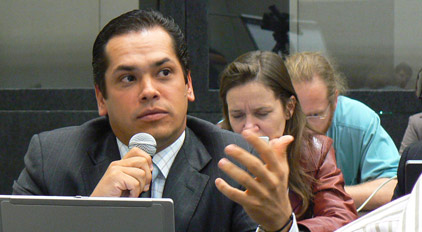
Question time in Sao Paulo (2008). Other meetings were held in Bangalore (India) in 2006, and Maputo (Mozambique) in 2009. Photo: Ken Banks, kiwanja.net

The Roadmap is very much a work-in-progress, and the MW4D Interest Group welcomes comments, recommendations and suggestions to help shape it as the work moves forward.
“Inappropriate” appropriate technology?

For some time things have been hotting up in the mobile for development space, and new tools are emerging all the time. But while these solutions extend all the way across the technological spectrum, almost all claim to be “appropriate” in one way or another. Clearly something isn’t right.

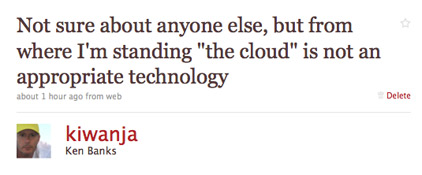
An appropriate use of Twitter?

For a while it was “scale”, and then “enabling environments”, and now it seems to be all about “appropriate technology”. I remember studying sustainable development at university, and coming to the conclusion that the term was so widely misunderstood and overused, it had almost become meaningless. I think we’re in danger of having the same thing happen with many of the terms we wildly band around in mobile. Part of the problem is that people are rarely asked to justify their positions or claims, so we never really quite know what anyone means.

In a recent PC World article I wrote, entitled “Appropriate Technology and the Humble Mobile Phone” funnily enough, I broadly defined appropriate technology as “anything that is suited to the environment in which it is used”. There are many factors that need to be considered in deciding how suitable something is – how complex it is to use, whether it can be used largely unaided, whether it can be fixed or maintained locally, how easily it can be localised, whether it can stand the field conditions, and so on.

You could also add to that whether or not the underlying infrastructure is in place for the technology to actually work. Makes sense, no? If we take anything that uses “the cloud“, for example, then I’d argue that it’s largely “inappropriate” unless you’re working in predominantly urban areas or in predominantly ‘developed’ countries. Many of the projects I see are aimed largely at the opposite – developing country and rural. On top of that, many of the areas where I’ve worked have little or no Internet access of any description, and very few people have devices that could access it, even if it was there.

In a recent must-read post – “The sun is shining in Africa” – Miquel provides some compelling arguments as to why “the cloud” is not an appropriate technology for much of the developing world:

The other big point missed in all this Cloud business is how it’s screwing the rest of the world outside of well, the US, and maybe Europe. This is the problem in how when people who proselytize a new technology don’t know understand the underpinnings of it, they often miss big gaping holes in the actual implementation of it

Maybe it’s no coincidence that there’s been a rise in use of “the cloud” and “appropriate technology” terminology at the same time. Let’s just get one thing straight, though. Technologies that use “the cloud” are not bad technologies, just as technologies which base themselves on simple SMS aren’t either. People that build and promote mobile technologies for developing regions just need to be clearer where their target audience are, and base their technology choice on what works – and what’s available – in the places where those people live and work.