Differentiation and the non-changing face of innovation

Last week at the Rutberg Summit in London – an event dominated by senior mobile industry executives – one of the more interesting topics for me was differentiation. How will the new Microsoft/Nokia relationship impact the mobile OS ecosystem? What does the proliferation of Android mean to the many handset manufacturers bundling it with their phones? In a world being increasingly dominated by just a small number of mobile operating systems, how does one smartphone manufacturer differentiate themselves from the next?

Of course, the operating system on a phone is just one part of it. Not only is our choice of OS becoming increasingly limited, so is our choice of “look”.

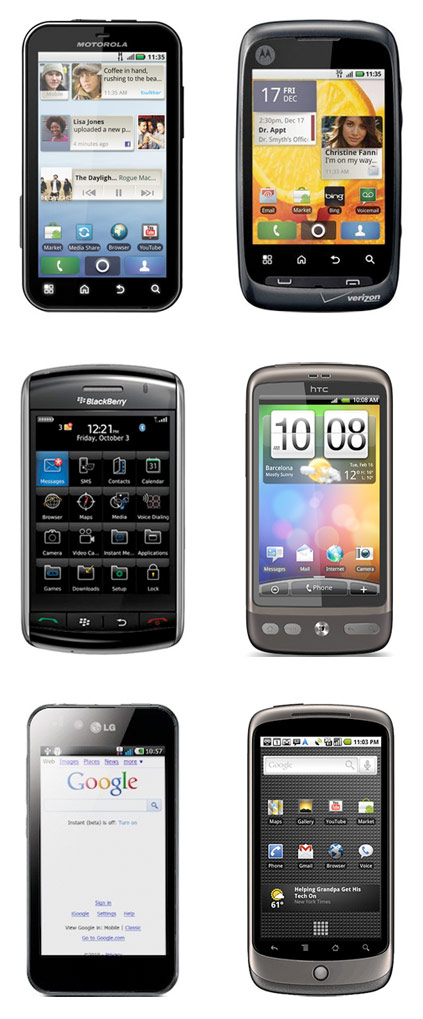
Take this image – a small cross-section of the handsets on the market today. We’re almost at the stage where you can have any smartphone you like, as long as it looks like one of these. Spot the difference? Not much.

This week, Apple took out another law suit – this time against Samsung – accusing it of stealing/borrowing/using its iPhone design for it’s latest range of phones. (Apple also claim the Galaxy is a little too close to looking like an iPad). The Register has a good article on all of this.

If being a consumer really is all about choice, then there’s certainly less of that today than there used to be. It will be interesting to see where all this goes – court battles included – and where the growing tension between innovation and differentiation ultimately takes us.

Open or not open? That is the question.

For many of the open source “purists” in the ICT4D field, there is only one (relatively rigid) way to run an open source project. For others – usually those who have had to actually work through the many challenges and complexities of open sourcing a piece of software – things are rarely that clear-cut. Being “open”, and “openness” in itself, can mean many different things.

Three bits of news from the past fortnight highlight how difficult and controversial being truly “open” can be.

1. Twitter

In an attempt to “ensure users can interact with Twitter the same way everywhere”, the company announced that they were considering restricting – and even blocking – access to their API for third party applications. Although this may make sense from a business or user-experience perspective, it was arguably the very explosion of these third party Twitter clients which accelerated the growth of the service. Twitter’s decision to be more strategic with their API, rather than let anyone anywhere build applications around it, is a clear attempt to regain control of the micro-blogging service. The full story is available on the BBC Technology pages.

2. Android Marketplace

Right from its inception, Apple have been heavily criticised in some quarters for the way they control every aspect of the running of their App Store. Applications are vetted and quality tightly controlled, meaning that not “any-old-application” makes it into the store. While this may be problematic for application developers, end-users (such as iPhone and iPod Touch owners) get a largely guaranteed experience – apps that work, apps that have a reasonable and familiar UI experience,  and apps that are malware and virus free. The Android Marketplace is everything that the App Store isn’t, and whilst it’s fully open and community-managed approach may make the purists purr, for the end user the experience can be much more of a challenge. You can read more on the BBC here, where the open nature of the Android platform is described as a “boon and a danger”.

3. Android Honeycomb

“In the great mobile-device wars, Google has portrayed itself as the open-source crusader doing battle against the leaders in proprietary software—Apple, Microsoft, and Research In Motion”. This argument held up strong until a couple of weeks ago when Google – again in the “interests of the user experience” – decided to delay releasing the source code of its latest Android operating system. This has caused something of a shock in the mobile world, but for others it comes as no surprise.

Problematic as they may be, these little nuggets of news confirm one thing – that the mobile industry is in a constant state of flux. Two things we can be sure of, though, are that even seemingly unambiguous terms such as “open” can never be taken for granted, and that open can never be assumed – by default – to be better than closed.

Nigerian youth ask: What about us?

I owe a lot to Nigeria. Throughout 2002 I lived in Calabar where I helped run a primate sanctuary. I made many friends and gained a real understanding of many of the problems facing the country. Five years later, in 2007, a loose coalition of Nigerian NGOs took our FrontlineSMS platform and monitored their elections with it, a breakthrough moment for us and for them.

This guest post, by Nosarieme Garrick, speaks volumes for the strength and character of the many Nigerians I’ve met over the years. It’s an honour to be able to help spread her message. I hope it resonates with you, too.

“The journey back to Nigeria was unexpected, but the planning came like a hurricane. One day I was chasing a story in New York, the next I was planning my trip back to the capital city of Abuja. So here I am pushing for the youth to truly exercise their civic duties in every sense of the word.

It started almost a year ago with a post on CNN Amanpour’s blog offering constructive criticism to Nigeria’s leaders, which received a deafening response, and persuaded me that sitting from the comfort of my Brooklyn apartment, ranting about that which ails Nigeria wasn’t good enough.

At the time a number kept haunting me – 70% of Nigeria’s population was under the age of 30, that’s 105 million people, yet the educational system is deplorable, food prices are so high that the average student can’t afford it, and millions of kids work the streets everyday hawking goods to help their families out. The majority of the country is disenfranchised. I looked at the political arena of Nigeria, and started to understand why, the lack of representation for the youth, with most of our political leaders way over the age of 50.

I realized the Nigerian youth had no voice. People had been making decisions for us, and we’d let them because we didn’t believe our votes would be counted. Countless times international observers had reported cases of electoral fraud but it never mattered, we’d watched complacently.
Growing up in Nigeria, every kid was aware of one thing if nothing else – children were to be seen and not heard. We didn’t stay in the room when our elders were talking, we didn’t question anything our elders said, and we definitely didn’t hold an opinion on their actions, wrong or not. In a sense there was a culture of fear created, what were we afraid of? Maybe lashes, being reprimanded, I’m not too sure anymore, we just knew that’s how things were. The home was a reflection of our leaders, we knew they were up to no good, but we said nothing for fear of jail, or even worse – death.

In April of 2010, I got together with some friends and came up with Vote or Quench, a youth driven, social media-focused organization seeking to engage our young people in Nigeria’s opaque political arena, and build a bridge between the diaspora and Nigerians at home. Inspired by the monitoring of election violence in Kenya, and the Iranian Green Revolution, we decided that 2011 would be the year young Nigerians would hold Nigeria’s leaders accountable, and create an atmosphere that encourages free and fair elections.

Since my return home, I have understood that we were not the only youths that felt that way. We paired up with a number of youth empowerment organizations (Enough is Enough, Sleeves Up) along with several blogs (CP-Africa, Last Plane To Lagos ) and young Nigeria celebrities (Nneka) to push for a mass awareness campaign for the crucial two week voter’s registration period. On January 11th, 2011 we challenged the youth to dream up the positive change that could happen if Nigerians went out and voted, using the hashtag #IFNAIJAVOTES. The campaign was a success, trending in Nigeria, and garnering massive support around the world to get people out to register. The registration period saw a huge turn out, with a recorded 64.5 million registered voters out of the eligible 76.5 million, despite huge setbacks by the flawed process. This spoke tons on the willingness of young Nigerians to go out and vote.

The culture of intimidation is quickly losing its edge as we have seen through the courageous, death defying acts of the Arab world. The youth have risen up and are standing up for their civil rights, and this is being mimicked through the world, Nigeria being one such example.

We are teaming up with these organizations once again to call for the first ever youth-centered presidential debate. As youth make up the 70% block of registered voters, we understand the power of our vote, and request that our candidates take an evening to address the youth that has been failed by previous administrations. Since the handover to civilian rule in 1999, presidential candidates threw out vague rhetoric about their plans to fix our country, however power outages are still a norm, infrastructure has yet to be developed outside of major cities, and what’s even more alarming is that our unemployed youth are quickly falling to crime, used as political weapons to disrupt elections, used to divide communities as we’ve seen in Jos, or are joining militia groups in the Niger Delta.

We will be utilizing social media and SMS to crowd source questions from Nigeria’s youth. We want to give the youth a platform to have their frustrations heard, and hear directly from our aspirants, in order for them to be held accountable for the promises they make. The problems of a militant youth in the Niger Delta are not dissimilar to those of a child bride in North, nor are they dissimilar to an undereducated youth of the east, resorting to kidnapping to make a living.

We want to know what these candidates have in store for the youth to get them back on track and give them the future that is owed to them by the country. We want to know why they are deserving of the youth vote. We are standing up, and asking: “WHAT ABOUT US?

Here’s how you can help:

Many young Nigerians have no voice, and we are here to provide them with one that is so desperately needed. For one day, we’re asking you to support them and do your part for our collective future.

What: Campaign to Support “WHAT ABOUT US?”
How: Dedicate your profile pictures and social network statuses to “WHAT ABOUT US?” and attend a virtual event at http://tinyurl.com/WAUEVENT
When: Thursday March 3rd, 2011

Thank you.”

A product from around the world, but loudly repping Nigeria, Nosarieme Garrick is a journalist, entrepreneur and activist currently leading the VoteorQuench.org campaign in raising awareness for youth participation in Nigeria’s upcoming elections. You can follow her – @Nosalikes on Twitter – or email her – Nosarieme [at] voteorquench.org

48 hours @ #MWC11

I’ve just spent two days at Mobile World Congress in Barcelona – courtesy of the GSMA – an event described as the “must-attend annual gathering of the mobile industry”. An estimated 50,000 senior mobile leaders from 200 countries converge on Barcelona for four days to talk, sell and promote all-things mobile. It’s pretty full-on.

Here’s a very brief round-up of some of the things that caught my eye (and ear) over the course of those two days.

Move over 3G – it’s now all about 3D. LG showed off what they claim to be the world’s first full 3D smart phone – the LG Optimus 3D – which supports the recording, viewing and sharing of 3D content. Not everyone’s convinced that there’s a market for this, me included, and most people I spoke to more broadly about the various 3D technologies on offer at the Congress said that most made their eyes go funny. Conclusion: Work in progress.

Still on the subject of new phones, Sony Ericsson showed off their highly anticipated “Playstation Phone”, or Xperia Play if you want the official title. Expect to see it in some European and Asian markets from next month, and in the US from the spring (courtesy a CDMA version and tie-up with Verizon).

Something which appealed to the environmentalist in me was Sharp’s “Touch Wood” mobile range, an “eco-friendly phone made with the surplus wood culled from overgrown forests in Japan”. Felt good, too.

There was plenty of talk around the humble SIM card, too. The Embedded SIM project continued to build up a head of steam, proposing a “worldwide standard that will allow the remote management of SIMs, effectively removing the need for a physical SIM card and allowing them to be embedded in many different types of device”. It will be interesting to see whether they embrace the multi-SIM phones turning up all over much of the developing world. And Gemalto showed off their “Facebook SIM card“, effectively allowing even the most basic, entry-level phones to access a limited range of Facebook functionality.

According to a survey carried out last month, mobile apps “attract almost as much mobile device use as messaging, and exceed the totals for voice calls and web browsing”. Over the past few years the usage debate seems to have moved from voice vs. SMS to SMS vs. web. Expect it to now move more towards web vs. apps.

When I attended my first Mobile World Congress in 2008, Android was the new kid on the block, having just been announced a few months earlier. This year, Android was pretty hard to escape.

With the developing world now accounting for four in every five mobile connections, the potential of emerging markets was not forgotten, either (although the definition of an emerging economy remains open to debate – China, for example, continues to be counted as “emerging”, as does India). That aside, the Congress Daily produced an interesting breakdown:

On a more personal level, it was great to catch up with friends at the GSMA Development Fund, the UN Foundation, Grameen Foundation, ClickatellWieden+Kennedy, National Geographic, Vital Wave and the mHealth Alliance, to grab lunch with Jan Chipchase, share a glass of champagne with the Text to Change team, and catch up with Nigel Waller at Movirtu. There were many more people I didn’t get to meet, but I’ll hopefully bump into them at various other events during the course of 2011.

Further reading
An expanded version of this article was published on the Guardian “Poverty Matters” Blog, here.