ICT4D postcards: The story so far

A couple of weeks ago I sent out an open invitation for people to contribute to the “ICT4D Postcards Project“. The idea was to gather a collection of postcards from people working in international development who had a technology theme – or influence – in their work. Postcards have been coming in since, and I thought it would be a good idea to post a few up here, ahead of the full collection which will be posted online in the coming weeks.

In short, a postcard consists of a photograph and short narrative which explains why the image is important – or how it relates – to that person’s work. The idea is to go beyond usual explanation and website narrative to reveal more personal insights and motivations of the people who work in our field.

Here’s a selection of five which have come in so far. In no particular order.

Jonathan Donner. Kigali, 2003 | Website | Twitter
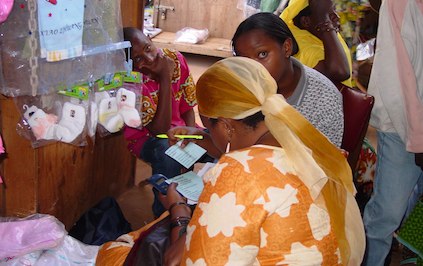
In 2003, mobile phones were just appearing in Rwanda. Penetration was just 1.5 per 100 people (1.5%) then. It is over 33% now. I organized some studies to ask microentrepreneurs about how they were using their new phones. Everyone was quite accommodating, letting us ask details about each of the last 10 calls recorded on the phones call log. Though we learned a lot about business processes and productivity, our data also demonstrated just how intertwined these phones had already become into daily life – two-thirds of the calls were with friends and family. I suspect these trends still hold.  At this moment, the interviewer (Nicole K. Umutoni) was probably looking back at me and wondering why I was taking this picture.  Now we know!

Jan Chipchase. Lagos, 2011 | Website | Twitter

That your and my cultural sensibilities about what is appropriate is irrelevant. That there are many ways to extend the internet – and that those that make the effort to do so, show us where the value is. That everything can, and will eventually be remixed.

Linda Raftree. Cameroon, June 2010 | Website | Twitter

This picture is taken on top of a large rocky hill during a workshop in Ndop, Cameroon. I love the young man’s rasta hat and the delicate lavender colored felt flower in the girl’s hair, the tender manner that they are learning together to film, and how the camera helps them see themselves and their surroundings in new ways. Up on that rock in the middle of the fields, breeze blowing under the giant sky, watching two young people teach other; the reminder that I am transient in this line of work and do not matter much in the larger scheme of things was strong, beautiful and comforting.

Erik Hersman. Liberia, 2009 | Website | Twitter

“ICT4D” represents a mental roadblock. A term that brings as much baggage with it as a sea of white SUVs, representing the humanitarian industrial complex’s foray into the digital world. It means we’re trying to airlift in an infrastructure instead of investing in local technology solutions. Like the SUVs, it’s currently an import culture that will not last beyond the project’s funding and the personnel who parachuted in to do it.

Heather Underwood. Kenya, 2011 | Website | Twitter

In August, 2011, I visited several health clinics in Kenya to determine the feasibility of using digital pen technology to enhance paper health forms. This photo was taken in a rural clinic in Mangalete. The woman using the digital pen is filling out a partograph – a paper tool used to monitor and detect prolonged or abnormal labors. She simply picked up the pen and started showing me how to properly fill out the form. When the pen’s audio suddenly informed her that she had crossed the alert line and should consider transferring the patient, her surprise and immediate understanding of the quality assurance and training benefits of this tool were incredibly gratifying. This interaction highlighted one of my core beliefs about ICT4D: big problems can often be addressed with simple solutions.

If you’re interested in taking part there’s still time. I’ll need the following:

1. A photo (high resolution if possible) – one you’ve taken, please. All it needs to qualify is to have a technology theme – radio, mobile phone, computer, solar lamp and so on.
2. Details of where it was taken and the year (if you remember).
3. A short description of what it is, and why it means something to you. Keep it short – think back of a postcard! We want personal stories – how you connect with the picture – not just a description of what it is.
4. A link to your website, blog or Twitter handle (or all three) so I can point people back to you and your work.

You can email all of this to postcards@kiwanja.net

ICT4D postcards

“Luxury Travel Stories is about the idea of connecting the world via ‘stories’ in postcard format. A photo with accompanying text no more than what would fit on the back of a postcard”.

Last month I was invited to contribute a postcard to the Luxury Travel Stories project, and chose the photo – and text – below. You can view the post, and those from other contributors, here. The whole site is based on the idea of “connecting the world via ‘stories’ in postcard format. A photo with accompanying text no more than what would fit on the back of a postcard”. Like “Dear Photograph” (which I blogged about here), it’s a simple but compelling idea.

It was 2004, and I was working on a project which took me to the intersection of technology and international development. Much to many people’s surprise, mobile phones were beginning to make their way into parts of rural Africa, including areas like that in the photo. This is Bushbuckridge – an area which straddles Kruger National Park in South Africa. These women spend most of their days queueing for water, and we pulled up one morning when I took this shot. I use it a lot in my work. It highlights the challenges we face in the development community, and challenges me to think hard about the role of technology – if any – in improving people’s lives.

One of the things I’ve always maintained is that we often know little about the background and motivation of people working in our field, and how they came to work in it. So, in part as a way to rectify this I thought it would be great to put together a slideshow of ICT4D-related postcards to share online.

If you’d like to take part I’ll need the following:

1. A photo (high resolution if possible) – one you’ve taken, please. All it needs to qualify is to have a technology theme – radio, mobile phone, computer, solar lamp and so on.
2. Details of where it was taken and the year (if you remember).
3. A short description of what it is, and why it means something to you. Keep it short – think back of a postcard! We want personal stories – how you connect with the picture – not just a description of what it is.
4. A link to your website, blog or Twitter handle (or all three) so I can point people back to you and your work.

You can email all of this to postcards@kiwanja.net

Once I have enough I’ll pull everything together and drop it into Slideshare. If enough people contribute it might be fun to map the photos, and stories, on Ushahidi.

Looking forward to seeing where this goes…

Rethinking socially responsible design in a mobile world

“The Curry Stone Design Prize was created to champion designers as a force for social change. Now in its fourth year, the Prize recognizes innovators who address critical issues involving clean air, food and water, shelter, health care, energy, education, social justice or peace”.

Yesterday was an exciting day for us as we announced FrontlineSMS had won the prestigious 2011 Curry Stone Design Prize. This award follows closely on the heels of the 2011 Pizzigati Prize, an honourable mention at the Buckminster Fuller Challenge and our National Geographic “Explorer” Award last summer. It goes without saying these are exciting times not just for FrontlineSMS but for our growing user base and the rapidly expanding team behind it. When I think back to the roots of our work in the spring of 2005, FrontlineSMS almost comes across as “the little piece of software that dared to dream big”.

With the exception of the Pizzigati Prize – which specifically focuses on open source software for public good – our other recent awards are particularly revealing. Last summer we began something of a trend by being awarded things which weren’t traditionally won by socially-focused mobile technology organisations.

Being named a 2010 National Geographic Emerging Explorer is a case in point, and last summer while I was in Washington DC collecting the prize I wrote down my thoughts in a blog post:

On reflection, it was a very bold move by the Selection Committee. Almost all of the other Emerging Explorers are either climbing, diving, scaling, digging or building, and what I do hardly fits into your typical adventurer job description. But in a way it does. As mobile technology continues its global advance, figuring out ways of applying the technology in socially and environmentally meaningful ways is a kind of 21st century exploring. The public reaction to the Award has been incredible, and once people see the connection they tend to think differently about tools like FrontlineSMS and their place in the world.

More recently we’ve begun receiving recognition from more traditional socially-responsible design organisations – Buckminster Fuller and Clifford Curry/Delight Stone. If you ask the man or woman on the street what “socially responsible design” meant to them, most would associate it with physical design – the building or construction of things, more-to-the-point. Water containers, purifiers, prefabricated buildings, emergency shelters, storage containers and so on. Design is so much easier to recognise, explain and appreciate if you can see it. Software is a different beast altogether, and that’s what makes our Curry Stone Design Prize most interesting. As the prize website itself puts it:

Design has always been concerned with built environment and the place of people within it, but too often has limited its effective reach to narrow segments of society. The Curry Stone Design Prize is intended to support the expansion of the reach of designers to a wider segment of humanity around the globe, making talents of leading designers available to broader sections of society.

Over the past few years FrontlineSMS has become so much more than just a piece of software. Our core values are hard-coded into how the software works, how it’s deployed, the things it can do, how users connect, and the way it allows all this to happen. We’ve worked hard to build a tool which anyone can take and, without us needing to get involved, applied to any problem anywhere. How this is done is entirely up to the user, and it’s this flexibility that sits at the core of the platform. It’s also arguably at the heart of it’s success:

We trust our users – rely on them, in fact – to be imaginative and innovative with the platform. If they succeed, we succeed. If they fail, we fail. We’re all very much in this together. We focus on the people and not the technology because it’s people who own the problems, and by default they’re often the ones best-placed to solve them. When you lead with people, technology is relegated to the position of being a tool. Our approach to empowering our users isn’t rocket science. As I’ve written many times before, it’s usually quite subtle, but it works:

My belief is that users don’t want access to tools – they want to be given the tools. There’s a subtle but significant difference. They want to have their own system, something which works with them to solve their problem. They want to see it, to have it there with them, not in some “cloud“. This may sound petty – people wanting something of their own – but I believe that this is one way that works.

What recognition from the likes of the Curry Stone Design Prize tells us is that socially responsible design can be increasingly applied to the solutions, people and ecosystems built around lines of code – but only if those solutions are user-focused, sensitive to their needs, deploy appropriate technologies and allow communities to influence how these tools are applied to the problems they own.

Further reading
FrontlineSMS is featured in the upcoming book “Design Like You Give a Damn 2: Building Change From The Ground Up”, available now on pre-order from Amazon.

Rewarding open source for social good

Do you know a software developer building open source tools with the potential to positively impact communities around the world? If you do – or you are one – then read on.

The Tides Foundation is now accepting nominations for this year’s Pizzigati Prize. The Antonio Pizzigati Prize for Software in the Public Interest annually awards a $10,000 cash grant to one individual who has created or led an effort to create an open source software product of significant value to the nonprofit sector and movements for social change.

The 2012 winner will be announced in April at the Nonprofit Technology Network annual conference in San Francisco. Each year, starting in 2006, the Pizzigati Prize has accepted nominations for talented and creative individuals who develop open source software products that demonstrate impressive value to the nonprofit sector. Tides welcomes nominations from both developers and the nonprofits who work with them.

Earlier this year I had the honour of picking up the Pizzigati Prize in Washington DC on behalf of everyone at FrontlineSMS. According to the Pizzigati jury, we’d managed to:

create software that speaks directly to the reality that millions of people globally have only simple mobile phones and no access whatsoever to the Internet. The software they developed turns mobile phones into grassroots organizing tools for everything from mobilizing young voters to thwarting thieving commodity traders.

The 2010 Pizzigati Prize winner, Yaw Anokwa, led the development on Open Data Kit, a modular set of tools that’s helping nonprofits the world over on a wide variety of battlefronts, from struggles to prevent deforestation to campaigns against human rights violations.

“Open source software developers like these fill an indispensable role”, explained Tides Chief of Staff Joseph Mouzon, a Pizzigati Prize judge and the former Executive Director of Nonprofit Services for Network for Good. “The Pizzigati Prize aims to honor that contribution – and encourage programmers to engage their talents in the ongoing struggle for social change”.

The Pizzigati Prize honors the brief life of Tony Pizzigati, an early advocate of open source computing. Born in 1971, Tony spent his college years at MIT, where he worked at the world-famous MIT Media Lab. Tony died in 1995, in an auto accident on his way to work in Silicon Valley.

Full details on the Pizzigati Prize, the largest annual award in public interest computing, are available online.

Please nominate, share or enter as appropriate. Good luck!