Build it, and they will come (if it’s useful)

It’s incredible to think that exactly four years ago I was gearing up to write the early FrontlineSMS prototype. Although a lot was undecided, a central pillar of my early thinking was that a “platform approach” would be the most flexible and appropriate, and that it would be wrong and restrictive of me to try and build a specific, local solution to the communications problem I’d witnessed in South Africa the year before. I figured that if I could avoid the temptation to try and solve a problem that wasn’t mine, but build something which allowed its local owners to solve it, then interesting things might happen.

Africa Journal, Fall 2007Today, the dizzying array of uses NGOs have found for FrontlineSMS is testament to that early approach, and the software is today driving projects in ways I could never have imagined. The Africa Journal most neatly summed up its impact when they wrote, back in 2007:

FrontlineSMS provides the tools necessary for people to create their own projects that make a difference. It empowers innovators and organisers in the developing world to achieve their full potential through their own ingenuity

Non-profits in over fifty countries have either applied, thought about applying, experimented or played with FrontlineSMS in the context of their own work, imaginatively considering ways in which the software – and the rise of text messaging – can be be turned to good use. As a result we’ve seen solid growth in the FrontlineSMS user community, but this is just one piece of the puzzle. Building community with users is one thing, but getting traction with developers is another.

And today, something very exciting is beginning to happen.
N2Y4If you take a look at the N2Y4 Mobile Challenge this year, you’ll notice something quite interesting. Three of the ten finalists are building their solutions around the FrontlineSMS platform, and a fourth used it as a major component in early prototyping exercises. You can add to these work that Ushahidi‘s developers have been recently carrying out, or students at MIT, or human rights activists in the Philippines, or the FrontlineSMS:Medic team, or university-based agriculture projects, all of whom have started integrating FrontlineSMS into their own tools and solutions. This kind of integration is what we always intended, and the software has been written in such a way to make it as painless as possible. Usability alone, however, is never a guarantee that people will buy into your vision.

It may have its critics, but the “Build it and they will come” mantra is truly alive and kicking in the FrontlineSMS world, and the finalists in N2Y4 are testament to this. FrontlineSMS:Medic, IJCentral and FrontlineSMS Alerts each have FrontlineSMS at the core of their proposals. Freedom Fone carried out much of their early proof-of-concept work with the software. Each of these projects are trying to solve a range of problems (note that voting is open until Friday 10th April).

FrontlineSMS:Medic – SMS for Medical Records and Mobile Lab Diagnostics [vote]
FrontlineSMS:Medic is a team committed to empowering community health workers in the developing world using appropriate mobile technology. After almost a year of working with FrontlineSMS in Malawi, they are launching FrontlineSMS:Medic to extend the capabilities of this software and bring it to health centers across several continents

IJCentral: Movement to Support Global Rule of Law [vote]
IJCentral, in tandem with documentary film “The Reckoning: The Battle for the International Criminal Court”, will be the core of a social network for global justice to combat the entrenched culture of impunity for crimes against humanity, implementing a multi-platform citizen engagement strategy using geolocated mobile phone SMS text messages, to build a worldwide constituency for the rule of law visualized on the IJC Map. Success will be an active global constituency supporting the justice mandate of the ICC, to prosecute perpetrators of the worst crimes, no matter how powerful

FrontlineSMS + Cell Alert = FrontlineSMS Alerts [vote]
This team have created a whole new suite of information tracking and delivery modules including Grant Alerts, Regional Conflict Alerts, Genocide and Blockade Alerts, World Food Aid Alerts, and Economic Aid Alerts. These tools are particularly powerful when used with FrontlineSMS. Recent trials proved the concept in El Salvador and Pakistan. Essential and timely market data that is unavailable in rural El Salvador and rural Pakistan due to a lack of Internet access was made accessible in these trials through the use of FrontlineSMS. Through their trials, Cell Alert was used to locate and deliver essential market data to beta testers in rural areas through the software

Freedom Fone [vote]
Freedom Fone is a free open source software tool that can be used to build and update a dial-up information service in any language. Its easy to use interface lowers the barriers to using Interactive Voice Response for outreach. Freedom Fone empowers non-technical organizations to build automated information services that are available to the public 24 hours a day, 7 days a week. Pre-recorded audio files are stored by Freedom Fone in a Content Management System. This is updated through a simple to use browser interface. Callers then phone in to listen to the audio options available to them

The competition judges will decide which of these projects have merit, and which ones walk away with the prize money, if any. Of course, none are FrontlineSMS entries as such, and I have had nothing to do with any of the entries, or their decision to enter. What I do think is significant, however, is that it shows what’s possible if we focus on building simple, appropriate, open social mobile tools and platforms, and let users impose their own will and vision on it.

If we build it – and it’s useful – it turns out that they might just come.

Time to eat our own dog food?

Is the future of social mobile an empowered few, or an empowered many? Mobile tools in the hands of the masses presents great opportunity for NGO-led social change, but is that the future we’re creating?

In The White Man’s Burden – Why the West’s Efforts to Aid the Rest Have Done So Much Ill and So Little Good”, William Easterly’s frustration at large-scale, top-down, bureaucracy-ridden development projects runs to an impressive 384 pages. While Easterly dedicates most of his book to markets, economics and the mechanics of international development itself, he talks little of information and communication technology (ICT). The index carries no reference to ‘computers’, ‘ICT’ or even plain old ‘technology’.

But there is an entry for ‘cell phones’.

"Small is Beautiful"E. F. Schumacher, a fellow economist and the man widely recognized as the father of the appropriate technology movement, spent a little more time in his books studying technology issues. His seminal 1973 book – Small is Beautiful – The Study of Economics as if People Mattered” – reacted to the imposition of alien development concepts on Third World countries, and he warned early of the dangers and difficulties of advocating the same technological practices in entirely different societies and environments. Although his earlier work focused more on agri-technology and large-scale infrastructure projects (dam building was a favorite ‘intervention’ at the time), his theories could easily have been applied to ICTs – as they were in later years.

Things have come a long way since 1973. For a start, many of us now have mobile phones, the most rapidly adopted technology in history. In what amounts to little more than the blink of an eye, mobiles have given us a glimpse of their potential to help us solve some of the most pressing problems of our time. With evidence mounting, I have one question: If mobiles truly are as revolutionary and empowering as they appear to be – particularly in the lives of some of the poorest members of society – then do we have a moral duty, in the ICT for Development (ICT4D) community at least, to see that they fulfill that potential?

You see, I’m a little worried. If we draw parallels between the concerns of Easterly and Schumacher and apply them to the application of mobile phones as a tool for social and economic development, there’s a danger that the development community may end up repeating the same mistakes of the past. We have a golden opportunity here that we can’t afford to miss.

But miss it we may. Since 2003 I’ve been working exclusively in the mobile space, and I’ve come to my own conclusions about where we need to be focusing more of our attention if we’re to take advantage of the opportunity ahead of us. Don’t get me wrong – we do need to be looking at the bigger picture – but there’s not room at the top for all of us. I, for one, am more than happy to be working at the bottom. Not only do I find grassroots NGOs particularly lean and efficient (often with the scarcest of funding and resources), but they also tend to get less bogged down with procedure, politics and egos, and are often able to react far more quickly to changing environments than their larger counterparts. Being local, they also tend to have much greater context for their environments, and in activism terms they’re more likely to be able to operate under the radar of dictatorial regimes, meaning they can often engage a local and national populace in ways where larger organizations might struggle.

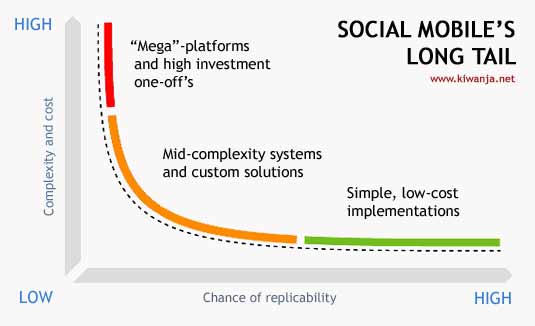
So, waving my grassroots NGO flag, I see a central problem of focus in the mobile applications space. Let me explain. If we take the “Long Tail ” concept first talked about by Chris Anderson and apply it to the mobile space, we get something like this. I call it “Social Mobile’s Long Tail”.

Social Mobile Long Tail, kiwanja.net

What it demonstrates is that our tendency to aim for sexy, large-scale, top-down, capital- and time-intensive mobile solutions simply results in the creation of tools which only the larger, more resource-rich NGOs are able to adopt and afford. Having worked with grassroots NGOs for over 15 years, I strongly believe that we need to seriously refocus some of our attention there to avoid developing our own NGO “digital divide”. To do this we need to think about low-end, simple, appropriate mobile technology solutions which are easy to obtain, affordable, require as little technical expertise as possible, and are easy to copy and replicate. This is something I regularly write about, and it’s a challenge I’m more than happy to throw down to the developer community.

Another key problem that we have emerges as a symptom of the first. Because larger international development agencies, by their very nature, tend to pre-occupy themselves with the bigger issues, they often inadvertently neglect the simple, easier-to-fix problems (the “low hanging fruit” as some people like to call it). The Millennium Development Goals (MDG’s) are good examples of the kinds of targets which are far easier to miss than hit.

In mobile terms, using the technology to enhance basic communications is a classic “low hanging fruit”. After all, that’s what mobile phones do, and communication is fundamental to all NGO activities, particularly those working in the kinds of infrastructure-challenged environments often found in the developing world. Despite this, there are few tools available that take advantage of one of the most prolific mobile communication channels available to grassroots NGOs – the text message (or SMS).

Much of my own work with FrontlineSMS has sought to solve this fundamental problem, and in places such as Malawi – where Josh Nesbit, FrontlineSMS, a laptop and one hundred recycled mobile phones has helped revolutionise healthcare delivery to 250,000 rural Malawians – the benefits are loud and clear. In other countries, where activities of international aid organizations may be challenged or restricted by oppressive, dictatorial regimes, grassroots NGOs often manage to maintain operations and often provide the only voice for the people. In Zimbabwe, Kubatana.net have been using FrontlineSMS extensively to engage a population not only starved of jobs, a meaningful currency and a functioning democracy, but also news and information. In Afghanistan, an international NGO is using FrontlineSMS to provide security alerts to their staff and fieldworkers. The software is seen as a crucial tool in helping keep people safe in one of the world’s most volatile environments. With a little will, what can be done in Zimbabwe and Afghanistan can be done anywhere where similar oppression exists.

Destined for the rubbish

In cases such as these – and there are many more – we need to stop simply talking about “what works” and start to get “what works” into the hands of the NGOs that need it the most. That’s a challenge that I’m happy to throw down to the ICT4D community. There’s only a certain amount of talking and critiquing we can, and should, do.

There are, of course, many issues and challenges – some technical, some cultural, others economic and geographical. The good news is that few are insurmountable, and we can remove many of them by simply empowering the very people we’re seeking to help. The emergence of home grown developer communities in an increasing number of African countries, for example, presents the greatest opportunity yet to unlock the social change potential of mobile technology. Small-scale, realistic, achievable, replicable, bottom-up development such as that championed by the likes of Easterly and Schumacher may hardly be revolutionary, but what would be is our acknowledgement of the mistakes of the past, and a co-ordinated effort to help us avoid making them all over again.

I spent the best part of my university years critiquing the efforts of those who went before me. Countless others have done the same. Looking to the future, how favourably will the students and academics of tomorrow reflect on our efforts? If the next thirty years aren’t to read like the last then we need to re-think our approach, and re-think it now.

Radios. Batteries. Solar. Implications

Things rarely stand still in the mobile world, but a number of fairly significant announcements have been made in the past few days alone, many of which have significant short- and long-term implications for mobile users in developing countries. Here’s the top three which caught my eye.

#1 Radio

The powerful combination of rural radio and mobile phones – text messaging in particular – continues to attract considerable attention in the ICT4D world, and rightly so. Radio still has the widest reach of any communications medium, and mobile phones present new opportunities to enrich the user experience. It comes as no surprise to see Nokia leading the way once again, yesterday announcing the launch of the new Nokia 5030 handset.

Nokia 5030 kit

According to Nokia’s official Press Release:

The Nokia 5030 is the company’s first phone with an internal FM radio antenna, which eliminates the need for a headset or external speakers. The one touch FM radio and channel selection keys on the side of the device ensure the product lives up to its XpressRadio name. Placed sideways on the table, the Nokia 5030 doubles as a portable FM radio and is ideal for emerging markets, where people rely on a radio as their main source of entertainment and news. The Nokia 5030 has up to a day of listening time and 10 hours of talk time, which comes to life with the powerful loudspeaker. The Nokia 5030 is expected to begin shipping in the second quarter of 2009 with an estimated retail price of less than 40 Euros [about $50]

[For further radio-related information check out White African’s recent post on radio in Liberia, Bill Siemering’s Developing Radio Partners, Farm Radio International and my recent PC World article – “Mobile Phones Join the Rural Radio Mix“]

#2 Batteries

Also yesterday, the BBC reported news of a “new manufacturing method for lithium-ion batteries could lead to smaller, lighter batteries that can be charged in just seconds”.

BBC headline

The implications for fast-charge batteries in parts of the developing world where regular, reliable mains electricity is a challenge are obvious, not to mention the financial savings to the user (and the potential environmental gains). What’s more, connect these to solar or wind chargers and a process which may have previously taken an hour or more might well be reduced to just minutes. Because the changes needed to the manufacturing process to make these ‘super batteries’ are minimal, there are hopes that they could be brought to market as soon as 2011.

#3 Solar

Solar panel - Credit: Peng Wang, Chinese Academy of Sciences And today, MIT’s Technology Review reported on a new kind of dye-sensitised solar cell – one that is more efficient, cheaper and durable than existing cells. According to Chinese Academy of Sciences professor Peng Wang, “at the moment, the use of toxic and volatile solvents in high-efficiency cells is a big hurdle for the large-scale application of dye-sensitized solar cells”. The use of a different type of electrolyte has allowed Wang and his team to produce a more robust solar cell which can prevent evaporation and leaking at high temperatures. And because the liquid can also be used with plastic, it excitingly opens up the possibility of flexible solar panels.

Three separate announcements, each with their own implications for the developing world. Maybe it won’t be long before we see mobiles powered by new kinds of super-batteries charged by more efficient, cheaper and accessible solar cells.

It doesn’t seem far off, not from where I’m standing, at least, and not if the announcements of the past couple of days are anything to go by.

Chipping away at the SMS literacy barrier

With all the excitement surrounding Monday’s launch of FrontlineForms, we almost forgot the other improvements we’ve made to the FrontlineSMS software. As well as support for IntelliSMS – another Clickatell-style online aggregator – we finally got round to adding Unicode support which, to the non-technical, means you can now send and receive messages in foreign scripts, i.e. non-Latin or non-Roman character sets. Projects in India and the Middle East have been asking for this, and it’s exciting to see it finally delivered (thanks Alex!).

FrontlineSMS Arabic

Although there are still very real literacy issues for SMS-based social mobile projects, at least allowing messages to be sent and received in the local language – assuming handset support is available – removes at least one more barrier. We’re excited to see how much this ends up being used, and what further opportunities it opens up for FrontlineSMS users around the world.