Let’s not write it off quite yet

A couple of months ago a member of the Social Mobile Group on Facebook asked an interesting, and pertinent, question. Commenting on a picture of a payphone attached to a bicycle from the kiwanja Mobile Gallery (this bike is taken around the streets of Kampala for members of the public to use to make calls), they wondered what was going to happen to these kinds of entrepreneurs as more and more people began owning their own phones.

A recent article in Fast Company magazine has set out to answer just that. Looking specifically at decreasing income levels among Grameen’s Village Phone Operators, it points the finger of blame squarely at the proliferation of mobile phones (the same finger can be pointed by the fixed payphone network, another victim). On the surface, blaming mobile proliferation seems like a safe bet. After all, if you have your own phone then why pay to use someone elses?

The increase in mobile ownership has certainly had an impact, but any time you mix economics, technology and human behaviour together, some pretty surprising things can happen. And this is where my love for anthropology comes in handy.

I was fortunate to have spent four weeks in Uganda last month, working with Grameen on their Village Phone Program at the same time that Business Week researched their own article on mobiles and economic development in Africa. Nothing beats being on the ground, and I’m very lucky to regularly get the chance to spend time in developing countries where I’m able to get a really good sense of what does and doesn’t work.

Many of the blog entries circulating the web in the last week or so – citing the Fast Company magazine and touting the ‘end of the Village Phone’ – fail to appreciate some of the subtler issues at play. The assumption that people will stop using a Village Phone the minute they own their own is not the open and shut case you might think. During my month in Uganda, I would regularly see people walking up to a Village Phone Operator, mobile in hand, look up a number and read it out to the phone lady to key into her own handset. From my own observations, this seems to happen for a number of reasons.

Firstly, for many owners, mobiles double-up as glorified contact managers, clocks, alarms, torches and, finally, a device which enables them to be contacted any time of day or night for work, or to stay connected with family or friends. Few maintain enough credit to make calls. Many taxi drivers, for example, hold just enough credit to enable them to ‘flash’ a phone (ring and hang up) to indicate that they are outside and waiting.

The reason for the lack of credit leads onto the second point. Few mobile owners want to spend a dollar or more topping up their phone – the amount needed to get enough credit for about 5 minutes of calling – when all they want to do is quickly touch base with a business contact or family member. Instead, a couple of hundred shillings gets them a 40-second call with a Village Phone operator, a smaller amount of money for a small amount of time which is utilised to the full with amazing skill.

And thirdly, call rates are actually cheaper through the Village Phones. Whether the caller has a mobile or not, and whether that phone has credit or not, many people still seek out a Village Phone to make their call because it saves them money. That’s the bottom line.

Try telling these people that the Village Phone is dead.

Mobile ownership may be increasing at a phenomenal rate in the developing world, but more people still don’t own phones than do, and most people earning a dollar-a-day are still a long way off affording one. The Village Phone has been a huge success – there is little dispute about that – but, as with any business, market changes force a period of re-evaluation and adjustment, and the mobile market has moved quicker than most.

Village Phone might well be a victim of its own success, but let’s not be too hasty in condemning it to the history books quite yet…

The Digital Divider

People tend to get pretty excited around mobile technology. In developing countries most of this excitement has centred around their proliferation into poorer rural, communication-starved areas, and their new-found potential in helping close the digital divide. Handset giants such as Nokia and Motorola believe that mobile devices will “close the digital divide in a way the PC never could”, industry bodies such as the GSM Association run their own “Bridging the Digital Divide” initiative, and international development agencies such as USAID pump hundreds of millions dollars into economic, health and educational initiatives based around mobiles and mobile technology.

But what do we really mean when we talk about the mobile helping close the digital divide? Clearly, mobiles are a relatively cheap device – when compared to personal or laptop computers, anyway. They are small and portable, have good battery life, provide instant voice communications, have SMS functionality and they have the potential to provide access to the internet.

Even the poorest members of society find ways to own one. But Houston, we have a problem.

I’ve been lucky over the past few years to have spoken at numerous conferences, workshops and companies about the uses of mobile technology in international conservation and development, and it’s something I truly enjoy doing. However, I’ve slowly noticed a knowledge gap, or should we say an awareness gap. In the West, when we talk of mobiles helping close the digital divide, many people make a huge assumption about the technologies available to users in developing countries. We look at the mobile through rose-tinted glasses, from the top of our ivory towers, through a Western prism. Call it what you like. Think about it. Most of us have fancy phones and are gifted with pretty good network coverage to drive them. Not only can we make calls, we can take good quality photos, we can make and edit little movies and upload them to the web, we can surf the web, we can play neat games, and we can download neat bits of software. Our overall experience is generally a pleasant one. Why else would we want a phone? So, with mobiles able to do all of this, their potential in developing countries is clear, right? Well, maybe…

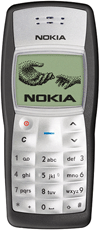
Let’s start by looking at the worlds best selling phone – the Nokia 1100 (pictured). Anyone who’s spent any time in a developing country recently would not have failed to notice the number of these around. The reason? They’re Nokia (and people just seem to love Nokia), they’re sturdy, have good battery life, the user interface is easy and they’re cheap (selling for around $40 new in Uganda, for example). They do everything the user wants – they can make and receive calls, they can send and receive SMS and the built-in alarm is very popular (only last month in Kampala my taxi driver was telling me with great excitement how his alarm still sounds, even when his phone is switched off). These are the kinds of phones in the hands of many people in the very rural areas where we see the mobile as the tool to help close the digital divide.

The problem here is that the Nokia 1100 – as with many of the low-end handsets found in the markets and shops in developing countries – has no browser of any kind, and doesn’t support GPRS (or any other form of data transmission). Accessing the internet? Dream on. But this is not the only problem. Network coverage in many rural areas lacks data support even if the phones did have it, although this is admittedly changing. There are also issues of language and content, but more importantly cost. Someone with little spare income doesn’t want to spend a large chunk of it scratching around the web to find what he or she is looking for. In many countries GPRS pricing models are at best confusing. While an SMS carries a fixed cost, calculating how many kilobytes of data make up a WAP page is anybody’s guess.

The opportunity at the bottom of the pyramid is huge, and handset manufacturers and network providers alike are working hard to fill it with phones. For them, the most important issue is cost because that’s what’s most important to their customer. And if this means providing trimmed-down handsets at the lowest possible prices then so be it. This current reality sees many of these phones with no GPRS, no browser, no Java, no camera, no colour screen – the very technologies which form the lynchpin of our plans to promote the mobile phone as the tool to help close the digital divide.

So, if we’re serious about using mobile to help close the digital divide, how about diverting international development funding towards providing a subsidised, fully-internet ready handset for developing markets? Aid donors are already providing funds to the network operators, after all. In the DRC, Madagascar, Malawi, Sierra Leone and Uganda for example, the IFC (an arm of the World Bank) recently provided US$320 to five operations of Celtel to help expand and upgrade its mobile networks (you can read more about that here). Network coverage, important as it is, is only part of the equation. From the perspective of the digital divide, who’s addressing the handset issue?

During a recent interview with the BBC I commented that “Voice is still the killer app in many developing countries. Data is going to be playing catch-up for a long time to come”. I’ve received many comments of support – and a few in disagreement – since this was published. This is a very important debate, and I hope it is one which finally starts to get some serious discussion.

Politicians fail, technologies prevail

There’s been plenty of talk in recent years about a ‘United States of Africa‘. Fantasy or reality, politically such an entity looks as far off as it ever was. But visions of a continent borderless economically and politically are gradually being replaced by another borderless phenomenon – the mobile phone network. While Europe argues about roaming tariffs and a lack of integration, East Africa silently blazes a trail.

Celtel, MTN and Vodacom are just three of a growing band of African operators tearing down national boundaries to allow their customers seamless mobility as they travel from country-to-country. “One SIM card. 6 countries” proclaims Celtel. “Travel with your Vodacom SIMcard and enjoy Vodacom tariff in Kenya and Uganda” boasts Vodacom. The speed of change in the mobile industry – more so in developing countries – continues unabated. I’d bet on Africa being the first continent to create a true ‘single network’. After all, it’s already happening.

Ironically, in the mobile industry at least, it’s Europe, and not Africa, looking more like a developing country…

The value of content in a content-driven world

Text messaging was, and remains, the surprise package for the mobile industry. Now a major income generator, SMS was never intended for mass public consumption – the channel was used mostly by engineers to test connectivity or to report the arrival of voicemail messages to users. Ironically, multimedia messaging – MMS – was planned and was supposed to signal the beginning of the end for SMS. But despite the massive effort – and marketing bucks – put in by the mobile operators, uptake was slow and remains slow to this day. People rarely want to send photos or short video to each other, and people certainly don’t want to play around with their MMS compiler to put a simple message together. Why bother with all that when SMS is much cheaper, is usually enough for the job, and much easier to work?

Multimedia messaging was a classic case of a technology looking for a market. Maybe we’re seeing it all over again with mobile TV.


A recent report in TechnologyGuardian reveals that only 0.7% of the UK’s 45 million mobile phone users watch mobile TV on their phones. Indeed. Why pay to watch content on your phone which you can already get at home on your TV? And why spend that extra money when the user experience often leaves a lot to be desired? I, for one, don’t know a single person who watches television on their mobile, either in the US, Europe or the UK.

What mobile TV is lacking is killer content. Mobile operators – as they did with 3G (another relative failure) – were convinced that people would jump at the chance to watch TV on-the-go and didn’t seem to spend too much time working out why they would want to do it and what exactly it was that they would want to watch. What they didn’t seem to figure out was that it is killer content that drives mobile data usage – the websites, services, blogs, social networks, whatever – not the technology which allows it to happen. And to prove the point, T-Mobile recently announced that sites like Bebo, MySpace and Facebook were driving mobile media usage in the UK. If the content or service is there, then people will happily use the technology at their disposal to access it.

As if things weren’t bad enough, another survey taken last month concluded that, despite the continuing emergence of new mobile applications, the address book remains the primary killer app on a mobile phone. Who would have believed it?