Mobile consumerism: Pixel by pixel

Despite the many incredible things happening around the world with mobile phones, one thing continues to trouble me – the sheer numbers of these things being manufactured, consumed and, in some cases, spat out (dumped, stuffed in drawers, or whatever). Okay, many are finding their way into new homes and markets – developing world or otherwise – which is a good thing all round. But we’ve been fed news for so long about “several million new subscribers here” and “another few million there” that we’ve almost become numb to the massive scale of the whole thing. What on earth do several million handsets look like?

I never really thought about it until now. The photo above is from “Running the Numbers: An American Self-Portrait“, a series of prints by photographer Chris Jordan that aims to examine modern American culture through the “austere lens of statistics”. What you’re seeing up there is a photograph of 500,000 mobile phones all piled up. This represents the number of mobiles ditched daily in the United States.

In India alone over 5 million new connections – ten times this number – are made every month. Now, maybe not all come with a new handset, but the manufacturers are doing their utmost to make sure they do. That’s where the battle is right now, and it’s only going to hot up. After all, on a global level more people still don’t have phones than do.

The sheer environmental cost of producing such a massive number of devices can’t be underestimated. Quite frankly, it’s huge. I don’t have any answers right now – I wish I did – and sometimes during my various talks I get asked about this. But despite that, I think it’s important that we are at least aware of the issues and don’t just stick our heads in the sand. Our love affair with the mobile phone is just one of many ‘consumptions’ taking hold in the world, as Chris Jordan’s exhibition so vividly shows. Curbing our demand for newer and newer handsets is just a small part of a much wider problem.

And, right now, no-one has any answers to that either.

From 1.0 to 2.0 to 3.0: The new web?

I don’t spend a huge amount of time searching Facebook groups, but when I saw this one it looked pretty interesting. It quite neatly captures what’s ‘happening’ with the web, and what the little number at the end means to people ‘browser-side’. Is this what’s happening?

Web1.0: Brain & Eyes – Information

Web2.0: Brain, Eyes, Ears, Voice & Heart – Passion

Web3.0: Brain, Eyes, Ears, Voice, Heart, Arms & Legs – Freedom

Is this tongue-in-cheek, or reality?

Who’s afraid of Google?

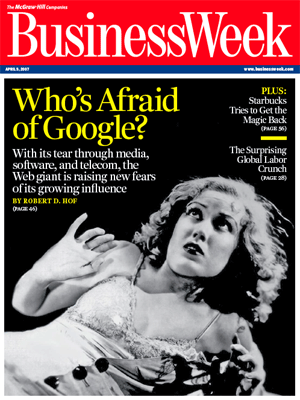
I was passing through WHSmith at Heathrow airport yesterday on my way back to San Francisco when the latest BusinessWeek magazine caught my eye. The cover story addresses fears that Google may be getting a little too big for its boots.

The timing was quite neat. Only a couple of days ago I blogged about a possible IT future dominated by Google’s technology (see below), and drew comparisons with IBM. The BusinessWeek article does the same. However, it talks of Google “building out of tens of thousands of server computers around the world that handle quadrillions of bytes of data”, which goes slightly over my tongue-in-cheek suggestion that everything could be done with five (although, to be fair, I didn’t say how big they had to be!)

Thomas J. Watson, Sr. – Right after all?

Thomas John Watson, Sr. was the President of International Business Machines (IBM) during its years of spectacular growth in the 1920’s, 1930’s, 1940’s and 1950’s. It was during this time that he nurtured IBM’s innovative management style which, until recently, kept Big Blue at the top of the global IT league (although, with over 350,000 employees worldwide, IBM is still the world’s largest information technology employer. It was finally knocked off top spot by Hewlett Packard, based on total revenue, not profits).

It was Thomas Watson’s son, Thomas J. Watson, Jr., who finally took IBM into the “modern-day” computer business after taking over the reins in 1956, one month before the death of his father. Previously the company concentrated on the building of tabulating machines and cash registers – products which were to later be replaced by mainframes and personal computers. Thomas Watson Sr. was sceptical of the role of these ‘new’ machines – still very much in their infancy in his time – and was reported to have famously said that “there is a world market for maybe five computers”. There is considerable debate as to whether he did or did not actually say this, but looking at the landscape 64 years on, maybe he had a point.

It goes without saying that there was a much larger market for mainframe and personal computers, but had Mr. Watson said that the world could perhaps be run on five computers, then he might not have looked so out-of-touch. I’m thinking Google here, with it’s plans for on-line domination. First search, and more recently on-line tools and applications which many believe will rival and eventually replace Microsoft Office as our main productivity tool. Google has had such an astronomical impact since floating only three years ago, and, as with IBM in its day, it is blazing a trail with its innovative work and management practices.

Imagine the on-line landscape by the end of the decade. Is it really so unbelievable to think that everything we do could be run from five solar powered servers in Mountain View, home of Google? Thomas Watson, Sr. could have been a lot closer to the truth than he ever imagined.

If, of course, he ever said it in the first place…