Want a holistic view of the world of social innovation? Try these four books.

We’re seeing a steady stream of great books hitting the shelves at the moment, each focusing on a different aspect of the technology/social innovation debate. While some offer hardcore theory and research, others offer softer inspiration and advice. One day we’ll have a book which captures and weaves together all four – that would be the ideal book – but for now we’ll have to read them all as separate volumes.

So, what are they? Well, if you’re interested in the whole spectrum of social change, with a slant towards the use of technology and innovation, these four books should make your summer reading list.

summer-reading


For background, theory and context:
AID ON THE EDGE OF CHAOS

Ben Ramalingam

It is widely recognised that the foreign aid system – which today involves every country in the world – is in need of drastic change. But there are conflicting opinions as to what is needed. Some call for dramatic increases in resources, to meet long-overdue commitments, and to scale up what is already being done around the world. Others point to the flaws in aid, and bang the drum for cutting it altogether – and argue that the fate of poor and vulnerable people be best placed in the hands of markets and the private sector. Meanwhile, growing numbers are suggesting that what is most needed is the creative, innovative transformation of how aid works. In this ground-breaking book, Ben Ramalingam shows that the linear, mechanistic models and assumptions on which foreign aid is built would be more at home in early twentieth century factory floors than in the dynamic, complex world we face today.


For inspiration and inside stories of social innovation:
THE RISE OF THE RELUCTANT INNOVATOR
Ken Banks

Classes in social innovation, social entrepreneurship and design thinking have become increasingly popular in recent years. On the one hand, this might be seen as a good thing. After all, the world needs as many smart, engaged citizens as it can get, particularly when you consider the multitude of challenges we face as a planet. But does a career in social change really begin in the classroom, or out in the real world? How much social change is planned, and how much accidental? And which approach tends to lead to the most meaningful, lasting or impactful solutions?


For research, theory, context:
GEEK HERESY: RESCUING SOCIAL CHANGE FROM THE CULT OF TECHNOLOGY
Kentaro Toyama

In this incisive book, Toyama cures us of the manic rhetoric of digital utopians and reinvigorates us with a deeply people-centric view of social change. Contrasting the outlandish claims of tech zealots with stories of people like Patrick Awuah, a Microsoft millionaire who left his engineering job to open Ghana’s first liberal arts university, and Tara Sreenivasa, a graduate of a remarkable South Indian school that takes impoverished children into the high-tech offices of Goldman Sachs and Mercedes-Benz, Geek Heresy is a heartwarming reminder that it’s human wisdom, not machines, that move our world forward.


FOR Inspiration, advice:
DOING GOOD BETTER: EFFECTIVE ALTRUISM AND HOW YOU CAN MAKE A DIFFERENCE
William MacAskill

Almost all of us want to make a difference. So we volunteer, donate to charity, recycle or try to cut down our carbon emissions. But rarely do we know how much of a difference we’re really making. In a remarkable re-examination of the evidence, Doing Good Better reveals why buying sweatshop-produced goods benefits the poor; why cosmetic surgeons can do more good than charity workers; and why giving to a relief fund is generally not the best way to help after a natural disaster. By examining the charities you give to, the volunteering you do, the goods you buy and the career you pursue, this fascinating and often surprising guide shows how through simple actions you can improve thousands of lives – including your own.


Happy reading!

1995. 2005. 2015. Two decades of code

Precisely ten years ago this morning I sat down at a kitchen table in Finland and started coding. Armed with a Visual Basic.net manual, a laptop and GSM modem, a couple of SIMs and a Nokia 6100 and cable – and plenty of coffee – I delved into the world of Windows programming for the very first time.

I’d already done a fair amount of professional software development over the years, designing and building a membership/fundraising system for Jersey Zoo, and a range of accounting and amortisation systems for a legal firm, but that was ten years earlier in the mid-1990’s when QuickBASIC was my weapon of choice. Ten years had passed, and I’d never written anything event-driven before. I was on a steep learning curve, but was motivated.

quickbasic

I’d already figured out earlier that year that I could drive a mobile phone by sending it a series of Hayes commands through a cable – that was my epiphany moment, so-to-speak – so my task that summer was to try and build a nice user interface around it. It sounds almost crazy now to think that a lot of this was new, but back then very few people were building messaging platforms, and even fewer building messaging platforms aimed at grassroots non-profits in the developing world. After two years working across South Africa and Mozambique it had already become blatantly clear to me that there was a growing need there that nobody seemed willing, or able, to meet.

One of the big advantages I had back in 2005 was that it was easy to hide away and be left alone to focus on a project like this. Anyone with no team, no money and a big project idea knows all too well how important it is to be able to get away and focus. Thanks to the luxury of being unknown in the ICT4D world I was able to hide well enough to write a working prototype of FrontlineSMS in just five weeks.

FLSMS-vb-net

Designing the ContactManager form

FLSMS-coding

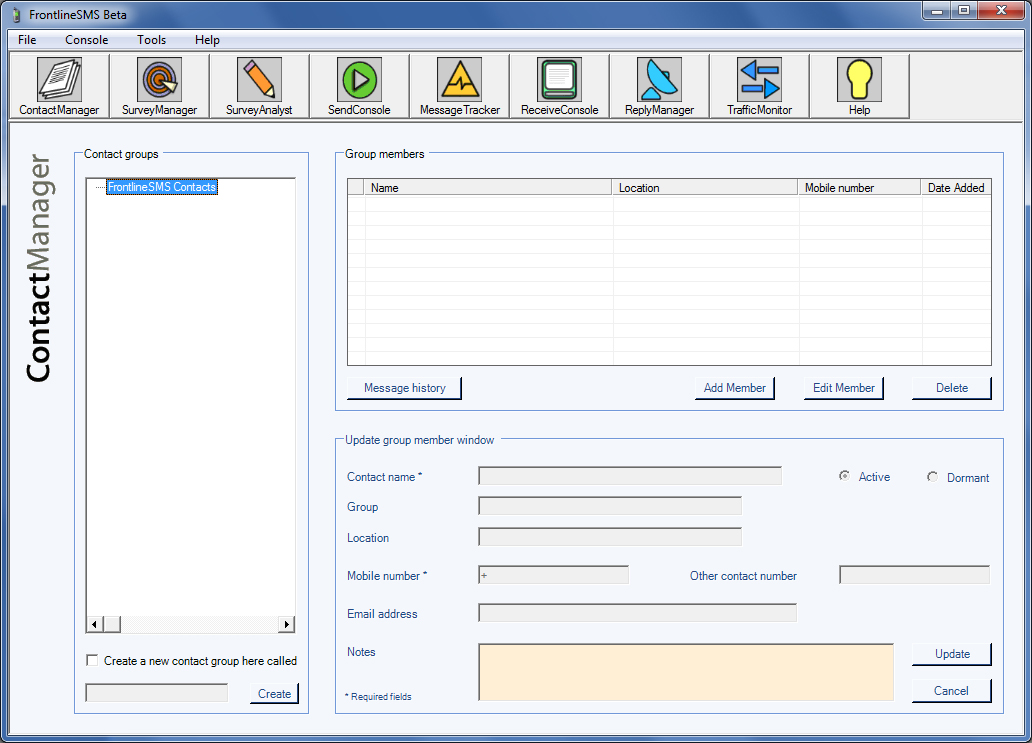
Coding ContactManager

FLSMS-ContactManager

The finished, compiled article

FLSMS-web

The first FrontlineSMS website, built in a day. The field banner was the view outside

Fast forward to today, I once again sit hidden away taking on a new coding challenge (my decades of code seem to take me from 1995 to 2005 to 2015, which may or may not be significant). In a similar vein to my attempts to tackle Windows programming in 2005 – which didn’t turn out too badly, I guess – today I’ve started work on my first iOS app. With a long list of ideas it’ll hopefully be the first of a few. Not surprisingly, they are pretty-much all based on improving how we interact and engage with the people, causes and world around us. I’m close to securing angel investment for the first app, which is another first. And it has a solid business model, which is another.

Interestingly, my brushes with code seem to have taken me through each of the key platforms of the past twenty years – MS-DOS, Microsoft Windows and, now, iOS. And, like 2005, I find myself with a window of opportunity to hide away and code as I continue my summer sabbatical. Watch this space for more.

ICT4D students: The world is your classroom

It seems courses in business and innovation are getting a hard time these days. First, Peter Jones, a 49-year-old serial entrepreneur in the UK, said he believed that hands-on experience was far more valuable to potential business leaders than several years studying theory in a lecture theatre. Then we had the likes of Peter Thiel, Scott Cook and Elon Musk telling us they believed business school graduates were hurting, rather than helping, innovation.

If we’re overstating the role of education in entrepreneurship and innovation, are we doing the same with social innovation and ICT4D?

Most people working in technology-for-development seem to agree the field isn’t in the best of health, with a whole range of problems persisting since the birth of the discipline decades ago. We have a constant stream of books telling us how we’re failing, without anything really changing. The technology toolkit expands and shifts, sure, but the difficulties we have in applying and implementing it stays the same. Is the way we’re ‘teaching people to do ICT4D’ part of the problem?

Empathy is a key step in the education process, but one we often skip (image via edsi.org.uk)

Empathy is a key step in the education process, but one we often skip (image via edsi.org.uk)

In The Rise of the Reluctant Innovator, I shared my concerns with what I saw as the institutionalisation of social change (which includes the broader global development and technology-for-development fields). The essence of the book began to develop during my time at Stanford University where I became increasingly exposed to social entrepreneurship, social innovation and design thinking as academic disciplines. I found myself meeting increasing numbers of smart young people looking to colleges and universities to equip them with the skills they felt they needed to ‘go out and change the world’.

I was a bit taken aback. You didn’t need qualifications to change the world, did you? Often I’d dig deeper and ask what they wanted to do when they graduated. Answers such as ‘I want to be a social entrepreneur’ perplexed me. Few people I know in the messy, often frustrating world of social entrepreneurship ever set out with the explicit aim of becoming one. Rather, they stumbled across a problem, a wrong or a market inefficiency which bothered them to such an extent that they decided to dedicate much – if not all – of their lives to putting it right. It was rarely, if ever, part of a wider plan.

Many of the students I met were unlikely to experience that problem, wrong, injustice or market inefficiency within the walls of their college or university. And, worse, many had never even stepped foot in the villages and communities they were aspiring to help. I agree that teaching the mechanics of social innovation or ICT4D may be helpful, yes, but only if matched with passion, and a cause, to which people can apply it, and genuine experience and empathy with – and for – the people you wish to help.

What I was witnessing at Stanford, and almost everywhere I have been since, was the increasing institutionalisation of social entrepreneurship and social innovation. This is unhelpful on many fronts, not to mention that it could easily be seen as a barrier by many motivated young people unable to take a course. Worse still, it implied that social change was a well- thought out process, when in reality it isn’t.

Bushbuckridge. Photo: Ken Banks

In ICT4D we’re so fixed on the technology – the ICT bit – that we often forget the ‘D’ – that minor inconvenience we call ‘development’. Fewer and fewer people seem to be making the effort to teach or learn the D, and this is a huge problem. It’s almost arrogant, and certainly disrespectful, to imply you can help people far far away you have never spoken to, and whose country, let alone village, you have never been to.

The first thing we should be teaching ICT4D students is development – the state of the world, how we got there, and what it means for the billions of people who for no fault of their own are on the receiving end of a life in poverty. Sure, getting on a plane and actually going somewhere for a few months (longer ideally) is difficult. But that’s no excuse for not doing it. For people who can’t, there are likely many problems in their own communities they could turn their attention to.

If we’re to fix ICT4D then the best place to start is by properly educating the ICT4D practitioners of tomorrow. If we don’t then little will change, and change is what we need.

Global development R&D: Maintaining a balance

My first brush with technology-for-development, almost twenty years ago, wasn’t on the potential of the Internet, or how mobile phones were going to change, well, everything. To be honest, neither were really on the development radar in any meaningful way back then. It’s almost funny to imagine a time when that was the case.

No, my first contact with what was to become a career in ICT4D started off with an essay on the failure of plough and cook stove projects across Africa. I was struck by the beauty of simple, locally appropriate solutions and amazed at how development experts just didn’t seem (or want) to get it. Many of their failed initiatives seemed more like a reaction against them – that, as experts, they were expected to come out with something the opposite of simple, primitive, practical. This they did, but very little of it ever worked.

smallisbeautifulIt was around this time that I also came across the work of E. F. Schumacher and his brilliant 1973 book, Small is Beautiful. The lessons in his book apply just as much today in a world dominated by digital technologies – a world he would never have imagined back then. World Watch magazine interviewed me a few years ago on why his appropriate technology ethos was just as relevant today. It’s well worth a read.

Our obsession with the latest shiny technology hasn’t gone away, either. History repeats itself and, despite being armed with a range of tools and solutions that work, experts still appear to rebel against them because they’re digitally too simple, primitive or practical. And, again, many of their alternative ‘innovative’ solutions simply don’t work.

Sure, there needs to be a degree of emphasis on new tools, new solutions, new ways of tackling old problems. This – the R&D side of the development machine – is essential but it needs to be kept in balance. The average R&D spend among top UK companies in a recent survey was 5%. No company in its right mind would spend most of its money on research and development and ignore its bread and butter, namely its current products and services, and current customers.

95-5-Rule

How about the global development sector make a commitment to spend, say, 5% of its funding on blue sky, high tech, high risk forward-looking ideas, and commit the rest to funding the really simple, primitive, appropriate solutions we already have that are proven to work? 5% of global development spending is still a few billion dollars, more than enough to invest in the next big thing.

And how about it pool these funds and create a single Global Development R&D Fund? A better coordinated approach might result in better outcomes, and it could better manage its external communications. The amount available would compare quite favourably with R&D spends of the bigger tech companies (source: Atlas)

Tech-Co-RandD-Spend

Right now, with an increasing big data, drones and wearables obsession (among others), you get the sense that global development R&D lacks coordination and spends too much of its time, energy, focus and resources on high-risk ideas. While it toys around with the next big thing people are going to bed hungry, dying of treatable diseases, at school with no pens or books, or drinking polluted water. All of these things can be put right with the technologies we possess today, but they’re not. I’ve never understood why. We should only allow ourselves the luxury of looking to the future once we’ve fixed the solvable problems of the present.

While the development community needs to naturally look ahead, it also needs to remember the people suffering today, those who might not be around to reap the benefits of any cool drone, big data or wearable solution of the future. Every life matters, after all. You get a sense that in the development space, R&D spending is way out of control as it feeds its obsession with cool, shiny and innovative.

So let’s keep that R&D budget in check, be more open with how much is being spent on speculative new ideas which may go nowhere, and make sure we don’t forget our bread and butter – our current (working) products and services, and our current customers – the poor, marginalised and vulnerable out there who, through no fault of their own, desperately need our help. Today.