

Today is a very exciting day for many colleagues in Uganda, a day which sees the launch of a suite of new services from Grameen’s AppLab project. I was fortunate enough to be involved in the very early stages of the initiative, spending a month on the ground studying a mixture of geography, culture, challenges, data availability and technologies in and around Kampala (and occasionally beyond).
One of the best times to be involved in something like this is at the very beginning – the time when everything is on the table, nothing is ruled out and there’s no such thing as a bad idea. Over the course of the month we came out with around fifty ideas for mobile services, based on our research of the Ugandan landscape, and the kinds of issues, gaps and concerns which potentially lend themselves to a mobile solution.
A large part of the fun is without doubt this multi-faceted research – understanding the landscape from multiple perspectives and sources. TV, radio, conversations with taxi drivers (who, regardless of where they drive seem to have answers to all the world’s problems), newspapers, villagers, village phone operators, waiters, children and eavesdropping conversations in bars, all of which helps build a picture of what matters to people and what doesn’t.

Image: Understanding local and national issues is an essential starting point in the mobile applications development process
Although it’s vital to start with the need, figuring out how to meet it becomes the next big challenge. Rural communities aren’t just passive recipients of information, but content generators in their own right. Communities are rich with knowledge, but more often than not this knowledge – not to mention more official sources of information – are rarely stored in anything resembling digital-friendly. Finding out who has the information you need, who owns it, how often it gets updated and how it’s stored are all part of the ongoing puzzle.
One of the most interesting and exciting phases of the AppLab work was the rapid protoyping – getting out into the field (or the matatu [bus] stations, to be precise) and offering people the opportunity to text in agriculture- or health-based questions. Any questions. What seemed to them like a smart, fully-automated system was in fact a handful of health and agriculture students sitting at computers in the MTN/AppLab offices, manually reading incoming questions and formulating 160-character answers. Suffice to say, the data gathered over a few days gave the strongest indication yet of the need and perception of such a service to potential users. The value of this kind of work cannot be understated.
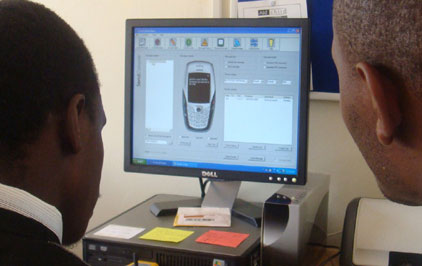
Photo: Students respond to incoming queries using the early version of FrontlineSMS, which was set up to help gather the data
Going back to today’s announcement, out of the original fifty early-stage ideas, AppLab have launched an initial suite of five:
Health Tips
Provides sexual and reproductive health information, paired with Clinic Finder…
Clinic Finder
Helps locate nearby health clinics and their services
Farmer’s Friend
A searchable database with both agricultural advice and targeted weather forecasts

Google Trader
Matches buyers and sellers of agricultural produce and commodities as well as other products (Google explains how it works here)
As part of the initial research, we looked at a whole suite of technologies on which to base solutions, including J2ME, WAP, high-end smart phones, 3G and MMS. As is usually the case, however, SMS won through and all of the services launched today are, according to AppLab, SMS-based and:
designed to work with basic mobile phones to reach the broadest possible audience. Users can access the services quickly and privately at the time of their choosing and search relevant content on-demand, like someone with access to the Internet
A lot of work continues to go into AppLab’s work in Uganda, and today hopefully marks the beginning of many new announcements (believe me, many other exciting initiatives are already in pilot stage). By working through existing structures in the country (principally MTN and the Grameen Village Phone network, not to forget Google’s growing influence), AppLab is well-placed to identify, build and deliver appropriate, relevant mobile-related services to local communities, and my congratulations go out to David, Eric and everyone who has worked so hard on the project over the past two years.
For a little more indepth analysis on today’s announcement, check out White African’s excellent blog post and the short Grameen video below. The official Press Release is available here.
