Innovation out of necessity is alive and well

(This article first appeared on the Virgin website as part of their special feature on innovation and disruption. The original post can be read here).

While much of the West debates the pros, cons, merits and current state of technological innovation, innovators in the developing world just get on with it. And they’ve never been so busy. Innovation out of necessity is alive and well, and on the rise, according to Ashoka Fellow, Ken Banks.

For many of us, innovation is the iPhone, iPad or pretty much anything that comes from today’s high-tech production line. It’s the latest phone, laptop, smart watch or passenger aircraft, and it’s designed to make things easier, quicker, more convenient and, in some cases, just more fun. We rarely question why we feel we need the latest and greatest, why we change our phones every year, or even what the drivers might be for all these high-tech innovations. Who, for example, decided the world needed an iPad-powered coffee machine?

Much of the innovation we see in the developing world, whether the innovators behind them come from there or not, is done out of necessity. They solve very real problems, many of which happen to be faced on a daily basis by many of the poorest and most vulnerable people on the planet. Innovation here isn’t about fast, shiny or modern, it’s about solving very real problems. And many of those problems aren’t going away any time soon.

Entrepreneurs in the West may well be losing the will to innovate, although I’d suggest it’s more about ability and a conducive environment than will. Many face difficulties with funding, highly competitive markets and patent wars, all of which make for challenging times. But this is far from the case throughout much of Africa, where I’ve focused most of my efforts for the past 20 years. Many innovations here are born by the side of the road, or in rural villages without any funding at all. Furthermore, market opportunities abound and patents are the last things on people’s minds. Compared to the West, African markets are still something of a Wild West in innovation terms, and this is precisely why there’s so much focus there.

Innovation out of necessity has given Kenya, for example, a world-leading position in mobile payments. On a continent where hundreds of millions of people lacked bank accounts, mobile phones provided the answer. An estimated 40% of Kenya’s GDP now works its way through Safaricom’s M-PESA system. It’s an innovation success story, and it’s provided a platform for many other innovators to offer everything from pay-as-you-go solar lighting to villagers to automated payment platforms for microfinance organisations. The further (anticipated) opening up of systems like M-PESA will spur even more innovation in the future. This is just the beginning.

When faced with very real problems that in many cases cost lives, innovators in the developing world kick into a different gear. With little funding or resources, it’s innovation in this ‘long tail’ that is most interesting – a place where people innovate out of necessity, not luxury, and as a matter of survival or ethics, not profit or markets. Health is a classic example of these drivers at work.

Six out of the 10 chapters in my recent book, “The Rise of the Reluctant Innovator”, cover health. The issues these innovators address include data collection, genetic disorders, communications between community health workers, patents, access to medicines, and solar energy as a lighting solution for maternity wards. The range of examples shows how broad and complex an issue health is, as well as the sheer scale of the need for its improvement across much of the developing world.

Many others are better placed to comment on whether entrepreneurs in the West are losing the will to innovate. Whatever the outcome of that debate, thankfully this isn’t the case in the places that matter – the places where far too many people still die from perfectly treatable diseases, or fail to reach their potential because of a lack of access to the most basic of education.

To paraphrase former Liverpool football manager, Bill Shankly, in the developing world innovation isn’t just a matter of life or death. It’s more
important than that.

Social innovation: Celebrating the unpolished

“I finished my first book seventy-six years ago. I offered it to every publisher on the English-speaking earth I had ever heard of. Their refusals were unanimous, and it did not get into print until, fifty years later, publishers would publish anything that had my name on it”
George Bernard Shaw (1856 – 1950)

Late last year The Rise of the Reluctant Innovator hit the shelves. It was my first taste of publishing, and if I’m honest it really started off as something of an experiment. It wasn’t until Archbishop Desmond Tutu agreed to get involved, the Curry Stone Foundation provided much-needed financial support, and my publisher pushed me to take it up a level, did I begin to let it take over my life. And for about three months that’s precisely what it did.

For most of us, publishing our first book is the epitome of thinking on our feet. Everything was new, and I had to take on every role imaginable. Publishing brings with it all the challenges of bigger, bolder projects – funding, timing, collaboration, design, messaging and outreach – all in one neat little package. Scale, for a change, is an easy one – it’s simply how many books you sell. If you’re keen for a taste of what life as an entrepreneur is like, publish a book.

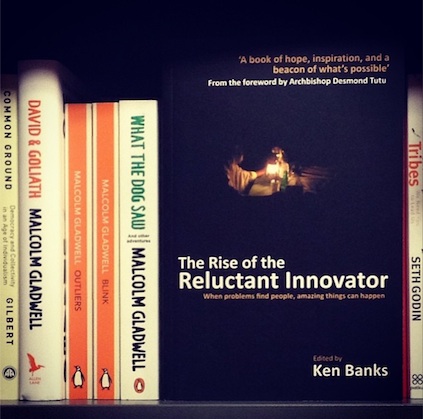
Since its release, The Rise of the Reluctant Innovator has bounced around the Amazon charts, peaking on one occasion at the #1 spot in the “Development Studies” category. Bookshops around the UK began to stock it, including Waterstones. For a while it was also on the coveted “Best new releases” shelf in my local Heffers store. Nothing beats walking into a bookshop and seeing your own book sandwiched between the likes of Malcolm Gladwell and Seth Godin.

Getting the book out there is one thing. A big thing, in fact. But then comes the public reaction. While some authors aren’t too bothered, it was important to me. The general public were among my key audience, as were students and colleges/universities. The book, after all, seeks to democratise social innovation. So it was hugely gratifying to find this review posted on Amazon one morning:

Stories for every college campus

Ken Banks has collected a volume of stories here that need to be told on every college campus. College campuses are at this moment unique seedbeds of opportunity. Populated with “Millennial Searchers” who, in increasing numbers, tell us they define life success in terms of meaning, purpose, and making a difference, and shaped by the larger movements of social entrepreneurship and sustainability, college curricula have begun shifting towards educating students to become agents for change.

What our change agents need above all right now is not more information, but stories – stories that the move them from paralysis and despair in the face of social disintegration and ecological loss to actions shaped by courage, humor, and hope. These stories do this. And because they inject so much of the raw, the uncertain, and the unformed portion of reality into their tales they are stories on which students will clamber for in the face of the challenges of their generation.

These stories speak eloquently about power – the power of connections, the power in confronting power structures for the sake of the marginal, the power of serendipity, the power of the human spirit to overcome immense challenges and work towards transformation and justice. In doing so, they function as a calling to that part of ourselves that will recreate and restore human and natural communities, that bears witness to our capacity for both good and ill, and that remembers the full range of ingenuity and wisdom we possess individually and as a species.

Wendy Petersen Boring, co-editor, “Teaching Sustainability: Perspectives from the Humanities and Social Sciences”

The book was also written in such a way to avoid ‘sell-by date syndrome’. The stories of the ten innovators, and their solutions, will never age, and neither will their advice. And this was important, because I knew the book was unlikely to set the world on fire when it launched, and that it would most likely slowly find its way into colleges and universities where it could be that book of “the raw, the uncertain, and the unformed portion of reality” that younger people seek. Santa Clara University in the USA, and Goldsmiths College in London, are among a growing number seeing this value and adopting the book. It’s going to take time, but it’s happening.

Another thing I’ve learnt is to not listen to experts. Except perhaps, when they tell you not to do something – then you’ll know that you should. During a conversation with a US book agent late last year, I was told by the expert he consulted – ‘someone who knew about these things’ – that:

I’d want to work with him to substantially transform the book from a set of stories into something more analytical and practical in terms of really going about starting one of these organisations, and that would take some real time. But even then I’m not confident about the book because there have been many published already that tell stories as good as those he’s got, as well as some that are a good deal more substantial in terms of the hands-on advice

It’s something of a revelation to me that the book I published is the polar opposite of the book I was told I should publish. If I had sought advice earlier, and taken it, my book would have been no different to the hundreds of others on the shelves. It would have focused on theory, cold analysis, expert opinion, five year plans, process, how to measure stuff and the odd third party case study. I’d never publish a book like that, not only because it’s not how I work, but also because I don’t think it in any way advances the cause. Sometimes self-publishing has its benefits – you can do anything you want, however you want. Kevin Starr nailed it when he shared his thoughts on the book recently:

These real – occasionally raw – stories do more to capture the life of the committed social entrepreneur than anything else I’ve read. Inspiring, yes, but even better, it works as a real world case-based manual for how to create change for the better

The book tries to buck the trend of ‘social innovation as a discipline’, in other words as something you need to study or learn before you can do anything. Its purpose is to create belief in talented young people with a vision to do good that meaningful change is possible, even without skills and resources. It’s not about who’s smartest – it’s about who cares the most, and who’s willing to go all the way to make that change happen.

Nor is it just a detailed analysis or unpicking of the ‘market opportunity or problem’, either, that students need – that perhaps comes later. Instead, what much of the book tries to give them is the inside line on what and how the entrepreneur was feeling when they encountered a life-changing problem. How it made them feel at a deeper level, and in turn how that passion and commitment drove them to dedicate much (if not all) of their time to solving it, and how it got them through huge obstacles and barriers. There are plenty of books that don’t do this, that don’t give the raw, unedited, deeply personal accounts of how these people and projects got started. Social innovators are rarely the hero figures we make them out to be, and people need to be able to resonate with their stories at every level.

And resonating is what they seem to be doing. From the emails and tweets I’ve received over the past three months, many people have found themselves deeply moved by some of the stories. Some have even cried on trains. Five year plans rarely do that.

Further details, including a list of endorsements and chapter contributions, and how to buy, are available from the official book website. You can also download a sample PDF which includes the cover, full foreword, introduction and endorsements, and the first two pages of each chapter, here.

Thinking the future with shift 2020

I’m excited to announce my contribution to a new book project – shift 2020: How Technology Will Impact Our Future. It’s a self-published book curated by Rudy De Waele which includes foresights on how technology will impact our future from some of the world’s leading experts.

The idea of shift 2020 is based on Mobile Trends 2020, another collaborative project Rudy launched early 2010. It’s one of the highest viewed decks on Slideshare (in the Top 50 of All Time in Technology with +320k views). Reviewing the document a couple of weeks ago Rudy realised that many of the predictions were becoming dated, and asked the original contributors for an update on their original predictions and for new foresights for the year 2020.

Rudy broadened the scope of the new book and asked new contributors to give their vision and foresights on a number of additional topics, including 3D Printing, AI, Apps, Biotech, Cloud, Connected Living, Crowdfunding, Data, Education, Entrepreneurship, Enterprise, GreenTech, Health, Hyperconnectivity, Maker Movement, Media, Retail, Robotics, Sensors, Smart Cities, Social Media, Society, Surveillance, Transport and Wearables.

shift 2020 is designed by Louise Campbell, an award winning UX and design technology professional with years of experience working with luxury fashion e-commerce brands, designing first-class, multi-platform, digital shopping experiences.

Kickstarter campaign has been launched to cover costs for the design, editing, website and promotion of the book (which will be printed by blurb.com). It includes 80 pages of original content, featuring most of the original Mobile Trends 2020 contributors in addition to some 40 new contributions from around the world – prominent futurists, trend-predictors and industry leaders. There are also opportunities for companies to personalise the cover of the book with their name and logo.

shift 2020 includes quotes, paragraphs and essays from confirmed contributors, such as:

Neelie Kroes (VP of the European Commission), Douglas Rushkoff, Salim Ismael (Singularity University), Loic Le Meur (LeWeb), Shannon Spanhake (Innovation Officer San Francisco), Adeo Ressi (The Founder Institute), Boris Veldhuijzen (The Next Web), Saul Klein (Index Ventures), Aubrey de Grey, Sunny Bates (Kickstarter / Jawbone), Carlos Domingo (Telefonica Digital), David Rowan (Wired Magazine), Laurent Haug (Lift), Martin Recke (next), Will Page (Spotify), Scott Jenson (Google), Gerd Leonhard (The Futures Agency), Yuri Van Geest, Russell Buckley, Russ McGuire (Sprint), Kwame Ferreira (Kwamecorp), Delia Dumitrescu (Trendwatching.com), Georgie Benardete (Shopbeam), Hans-Holger Albrecht (Millicom), Tariq Krim (JoliCloud), Dr. James Canton, Andrew Hessel (Autodesk), Christian Lindholm (Korulab), Eze Vidra (Google Campus), Harald Neidhardt (MLOVE), Raina Kumra (Juggernaut). Robin Wauters (Tech.eu), Nicolas Nova, Gianfranco Chicco, Shaherose Charania (Women 2.0), Ken Banks, Marc Davis (Microsoft), Felix Petersen, Kelly Goto, Erik Hersman (Savannah Fund), David Risher (Worldreader), Glen Hiemstra (Futurist.com), Jessica Colaço (iHub), Mark Kanji (Apptivation), Rohit Talwar (Fast Future), Priya Prakash (Changify), Andrew Berglund (Geometry Global), Alan Moore, Martin Duval (Bluenove), Maarten Lens-FitzGerald (Layar), Andrew Bud (mBlox/MEF), Andy Abramson, Fabien Girardin, C. Enrique Ortiz, Raj Singh (Tempo AI), Inma Martinez, Robert Rice, Ajit Jaokar, Jonathan MacDonald, Tony Fish, Dan Applequist, Redg Snodgrass (Wearable World), David Wood, Mark A.M. Kramer (razorfish Healthware) , John Kieti (m:lab), Aape Pohjavirta, Kosta Peric (Innotribe), Blaise Aguera y Arcas (Microsoft) , Michael Breidenbruecker (Reality Jockey), Tricia Wang, Louisa Heinrich (Superhuman), Mike North (UC Berkeley), Mac-Jordan D. Degadjor, Kate Darling, Simon White, Chris Luomanen (Thing Tank), Ariane Van De Ven (Telefonica), Ed Maklouf (Siine), and many others.

The eBook version will be delivered before Christmas and the printed books most likely in the new year. Check the shift2020 website for latest updates and additional information.