Start with the problem, not the technology

An interview given during the Networked Society Forum gathering in Hong Kong late last year has just been published online and in the print edition of the Ericsson Business Review.

The interview focuses on how we often define innovation too narrowly, and why “development issues such as education require us to start with the problem, not the technology”.

A PDF of the interview can be downloaded from the kiwanja website here, with a summary available on the Ericsson “Networked Society Blog” here.

Further reading
Check out the kiwanja.net Documents section for a wider selection of interviews, publications and articles.

In words and pictures: Two mobile resources

Last week saw me start out at Mobile World Congress in Barcelona, and finish up at an event focusing on the use of text messaging in the non-profit sector in London. It was a busy week but two new resources were the end result.

Pictures. If you didn’t make it to Mobile World Congress then here’s a Flickr set of 111 free-to-use photos to give you a flavour of the event. Mobile World Congress is the world’s largest mobile exhibition and conference and features CEO’s and representatives from mobile operators, device manufacturers, technology providers, vendors and content owners from around the world.

Words. On Friday, Credemus Associates ran an event in London attended by representatives from FrontlineSMS and Text to Change. “The World in the Palm of Your Hands: SMS & Mobile Communications” was the first in a new line of events which Credemus hopes will become a live platform for discussion and news on ICT to support community engagement for Local Authorities, Third Sector & Public Sector organisations. At Friday’s event, FrontlineSMS and Text to Change announced the release of a new resource on how to use SMS as an effective behaviour change campaigning tool.

Behaviour change campaigning is inherently interactive. In order to encourage positive behaviour change it is important to not only push campaign messages out to people, but to listen to the responses. To run a campaign which has a real impact, you need to listen to ensure you’re being heard. This is one of the main reasons why SMS – as a widely accessible and inherently interactive communications channel – is an ideal tool for campaigning.

You can read the FrontlineSMS blog post announcing the resource here, or download it here (PDF, 700Kb).

Happiness, and regrets of the dying.

A nurse has recorded the most common regrets of the dying, and among the top ones is “I wish I hadn’t worked so hard”. What would your biggest regret be if this was your last day of life?

Earlier this week I tweeted a link to this soberingly-titled Guardian article on the “Top Five Regrets of the Dying“. Since then I’ve had several conversations with people on the subject. For me, the line between ‘work’ and ‘life’ has become increasingly blurred over the past twenty years. Back in the early 1990’s when I first started thinking about the intersection of technology, people, conservation and development there wasn’t a job anywhere where I’d have been able to blend all those skills and interests. My ideal job didn’t exist, so I had to create it. This long-standing quote on the kiwanja website sums up pretty well where I’ve ended up today.
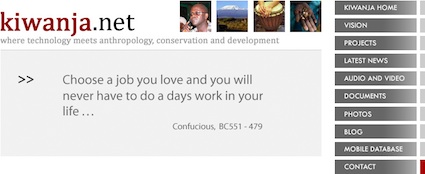
Of course, I’m one of the lucky ones. That said, like everyone I have regrets, but if anyone had told me twenty years ago – even nine years ago when I started out in mobile – that I’d be where I am today I’d never have believed them. I met too many people in my banking days who were content to spend their lives doing jobs they didn’t like – hated even – so they could “enjoy their retirement” with a good pension. For me it’s always been about the journey, not the final destination. I still don’t know where I’m going to end up, truth be told.

In sharp contrast to death and regret, Paul Lamb from Man On a Mission Consulting sent me a random email two days after the Guardian article on the subject of happiness (happy life = fewer regrets?). Having a job you love may be one way to happiness (or fewer regrets), but not everyone is lucky enough to have one of those. So, for anyone who’s yet to figure out their purpose, journey or destination, here’s a few good “Happiness Resources” gleaned from Paul’s email.

Enjoy. And be happy.

The happy secret to better work
Shawn Achor, TED Talks (2011)

The habits of happiness
Matthieu Ricard, TED Talks (2004)

10 Ways to be happy
From the Happiness Project

Taking a Kindness Day off of work
Huffington Post (2011)

The Random Acts of Kindness Foundation

AOK.TV
The “social game for good”

The Greater Good Center
The “science for a meaningful life”, courtesy UC Berkeley

The Happy Movie
(In celebration of World Happiness Day on February 11th, 2012)