“Amid all the uncertainty surrounding disruptive technologies, managers can always count on one thing: Expert forecasts will always be wrong. It is simply impossible to predict with any useful degree of precision how disruptive products will be used, or how large their markets will be”
“The Innovator’s Dilemma”, Clayton M. Christensen
Predicting the future of one of the most disruptive technologies of recent times – the mobile phone – was precisely what Rudy de Waele asked twenty-eight mobile technologists to do earlier this year. And to make things a little more interesting, these predictions were meant to focus on Africa alone. Good friend Erik Hersman and I were asked to help ensure that people we felt were best placed to contribute – African technologists, or people with considerable practical experience working with mobile technology on the continent – were represented.
The result is here.
As Clayton Christensen points out in his excellent book, predicting the future is never easy, and almost always ends in failure. During a workshop at Stanford University back in 2006, it became abundantly clear that one of the biggest challenges facing predictors was “breaking the shackles of current thinking”. 80% of people get caught out here, and to a large extent this is reflected in Rudy’s paper:
1. Pick a technology or service currently in use.
2. Predict that in xx years time there will be more of it.
The easiest way to obtain a “shackles-free” out-of-this-world prediction is to ask children, and you’ll find they have just as much chance of being right as an adult (or an expert). Quoting a PC World article I wrote on the subject a couple of years ago:
Ask people what that mobile future might look like, and we’ll likely get answers that take us in one of two directions. Adults will probably be constrained by the parameters of what they see around them today, so predictions on what a mobile phone might look like in, say, ten years, would most likely center around smaller, lighter and faster. Children, on the other hand, would probably let their imaginations run riot and talk about phones that are invisible, implanted in our brains, or both
One thing that particularly struck me about Rudy’s “Mobile Trends 2020 Africa” exercise lies in the title. Are we assuming that mobile technology in Africa will have a very different future to mobile technology in the rest of the world? Perhaps so – I’ve previously argued that “many future mobile innovations will be borne out of the realities of the developing world”.
If that were the case then that would be a future I could get excited about.
Ever wondered where the original idea for FrontlineSMS came from? Find out in this fun 50 second video put together by National Geographic as part of their 2010 Explorers Symposium.
For more information on our work with National Geographic, check out our profile page.
“In the real world, if you were to invest in a company you thought would make you a tidy profit, you wouldn’t tell the senior management they had to make a product of your choosing, restrict the number of vehicles they purchased, or expand operations into a new country. Why should we do any differently in the social sector? Why not simply invest – fund – on the basis of return in the form of impact? Isn’t that the point?”
Just as Kevin Starr “stumbled into philanthropy”, I stumbled into running an organisation. I’ve been fortunate to meet Kevin on a number of occasions, and we have a fair bit in common. For a start, we ended up in places we weren’t expecting, and we’re both graduates of the School of Learning by Doing. Although this approach can be painful at times, you often find yourself stumbling across answers you wouldn’t have if you’d followed a more traditional, established route. There’s a danger if all you ever do is stay in your comfort zone.
(I remember talking to my mother back in November 2002 when I’d just been offered my first piece of mobile consultancy. I was supposed to build a conservation portal on Vodafone live! but had never done anything with mobile before (very few people had back then). I accepted the gig, although I had absolutely no idea if I’d be able to deliver. A simple fear of failure drove me on over the proceeding twelve months).
Kevin has largely figured it out for himself, too (in between extended bouts of surfing) and the end result – the work of the Mulago Foundation – is as inspiring as it is simple. If you’ve not seen his Pop!Tech talk from last year, do yourself a favour and check it out.
In short, the Mulago Foundation looks for “the best solutions to the biggest problems in the poorest countries”. These projects need to answer four quite simple questions:
Is it needed?
Does it work?
Will it get to those who need it?
Will they use it correctly when they get it?
None of this is rocket science, of course, but it’s what comes after a project answers with four “Yesses” that you might argue was most innovative. Mulago provide unrestricted funding, the holy grail of fundraising. Funding is provided based on a vision, and a path to scale, and it’s down to the organisation to decide how best to spend the funds to achieve that. The rationale is really quite simple. As Kevin puts it:
If you don’t think an organization is smart enough to use your money well, don’t give them any
We’ve been very fortunate to have received critical – essential – funding for FrontlineSMS over the past four years (for the first two it was largely self-funded). Grants from a number of donors have enabled us to continually develop and build on what we started in 2005. The end result? A piece of software in use today in over a hundred countries, driving a dizzying array of projects.
Of course, there’s little use in developing such a useful piece of software if the organisation behind it isn’t able to survive and thrive in tandem. And this is one of the biggest challenges facing many organisations in the non-profit world, not just those focusing on mobile. Rightly, in most instances, there’s a growing expectation that NGOs need to figure out how to live without donor money, but that’s easier said than done (something I’ve also written about before).
About half-a-dozen donors can rightly lay claim to being a key part of the FrontlineSMS story, but when it comes to our organisational development there’s – so far, at least – just the one.
In the past 18 months there have been massive changes in how we go about our business. With roots in camper vans and kitchen tables, today we have offices in London and Nairobi, with another opening soon in Washington DC. We’ve gone from one person to around ten – with a dedicated developer team based in the iHub in Nairobi – and a single US Foundation to a UK-based Community Interest Company and a sub-branch in Kenya. We’re well on the way to resolving complex governance issues, appointing a Board and developing a number of exciting non-donor income streams, not to mention new mobile-based social change tools. A majority of this work has been orchestrated by an excellent senior management team, with Laura Walker Hudson driving things from the UK and Sean McDonald doing the same for us in the US.
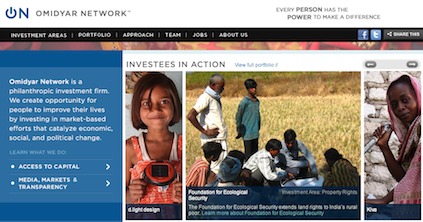
Project-based funding is still a critical part of our growth and development strategy, but all of this has happened thanks to the fantastic support of the Omidyar Network who, like Mulago, fully appreciate the value of also providing unrestricted funding to their grantees. The Omidyar Network’s investment criteria is based on five key areas. According to their website:
Alignment. We look for organizations aligned with our mission of creating opportunity for people to improve their lives. We seek for-profit companies and nonprofit organizations that use innovative, market-based approaches within our investment areas.
Impact. We identify organizations that intend to develop new markets or industries, influence policy or practices among existing institutions, alter public perception, or demonstrate the power of business to create social and financial returns. Ideal partners will inspire further entrepreneurial activity in their field.
Potential for scale. We look for organizations with significant growth potential, with the ability to scale operations and develop new markets. We ask for-profits to have the potential for a highly successful business model and nonprofits a path toward operational sustainability.
Leadership. We invest in management teams with a proven track record in their field of operation and an ability to articulate a clear vision and strategy, reinforced by a viable business plan. The organization must practice exemplary governance with operational efficiency and controls, transparent practices, and disciplined financial planning.
Innovation. We seek organizations that employ creative, entrepreneurial strategies to accomplish their goals. Investees may disrupt the status quo, establish a new business paradigm, or pioneer services for untapped markets.
If you need living proof of what a strategy like this looks like, check out Omidyar‘s and Mulago‘s impressive grant portfolios. You can also follow Omidyar on Twitter.
There is much talk of innovation in the technology arena but less, it seems, on innovation in philanthropy. Thank goodness this is beginning to change. We are, after all, all in this together.
Whenever I find myself in front of a group of students, or young people aspiring to work in development, I’m usually asked to share one piece of advice with them. I usually go with this: Get out there while you can and understand the context of the people you aspire to help. As you get older the reality is that it becomes harder to travel for extended periods, or to randomly go and live overseas.
In the early days of ICT4D and m4d – and development more broadly – it may have been seen as a luxury to understand the context of your target users (many solutions were seen as “universal”, after all). Today I’d say it’s become a necessity.
In my earlier days I did a lot of travel, mostly to and around Africa. (One thing I regret never managing to do was walk across the continent, something I started tentatively planning a few years ago). As our organisation has grown and my role within it changed, I spend more time today travelling to conferences giving talks than actually doing the work. My last major piece of extended fieldwork (i.e. longer than a week) was back in the summer of 2007 when I spent a month in Uganda consulting with Grameen’s fledgling AppLab.
There’s more to it, though, than just “getting out there”. What you learn, sense, pick up and appreciate about the place you’re in and the people you’re with largely depends on the kind of traveller you are. The truth of the matter is you’ll rarely get a real sense of a place staying for just a few days in the capital city behind the walls of a four or five star hotel. Quite often the more you get out of your comfort zone the more you learn.
I’ve been hugely fortunate to have lived and worked in many countries – mostly in Africa – since I set out to work in development almost twenty years ago. And during that time I’ve developed quite a few “travel habits” to help me get the most out of my time there.
Here’s my Top 15:
1. Stay in a locally-owned or run hotel (or even better, guest house). 2. Spend as much time as possible on foot. Draw a map. 3. Get out of the city. 4. Check out the best places to watch Premiership football. 5. Ignore health warnings (within reason) and eat in local cafes/markets. 6. Buy local papers, listen to local radio, watch local TV, visit local cinemas. 7. Use public transport. Avoid being ‘chauffeured’ around. 8. Take a camera. Take your time taking pictures. 9. Go for at least a month. 10. Visit villages on market days. 11. Spend time in local bookshops, libraries and antique/art shops. 12. Read up on the history and background of where you’re going. Buy a locally-written history and geography book. 13. Be sure to experience the city on foot, at night. 14. Wherever you are, get up for a sunrise stroll. It’s a different, fascinating (and cooler) time of day. 15. Don’t over-plan. Be open to unexpected opportunities.
Finally, if you’re looking for advice on what to take on a trip to Africa, good friend Erik Hersman (aka WhiteAfrican) has an excellent post here.
Additional suggestions
Rebecca Harrison (@rhrsn on Twitter): 16. Seize any opportunity to visit homes, especially at meal times.


 In my earlier days I did a lot of travel, mostly to and around Africa. (One thing I regret never managing to do was