Celebrating the ecosystem approach

It was a cold evening last October when I heard from National Geographic that we’d won an Emerging Explorer Award for our work in mobile. Seven months is a long time to keep a secret, but now news is out it will hopefully be the ideal platform to help us spur further development of FrontlineSMS, and increase interest in wider circles around the potential for simple, appropriate mobile technologies to solve some of the more pressing problems people face in the world today.

Although it’s wonderful to get this kind of recognition, it also makes it a good time to clarify a few key points about the work we’re doing.

Exploring

First, I believe National Geographic took a bold step picking a mobile project as one of their Awardees. Explorers are usually associated with more physical, tangible acts such as climbing, diving, flying, discovering and so on. Trying to come up with a new approach to applying mobile technology to a problem is a different way of thinking about “exploring”, and I think it raises a number of very interesting questions. Something for a future blog post, no doubt.

Approaching

Second, first and foremost I believe the Award is recognition of our approach. Over the past five years – yes, it’s almost been that long – we’ve developed a clear methodology based on “handing over our technology and stepping back” (as one conference delegate once put it to me). The National Geographic article summed it up perfectly:

The key, Banks believes, is a hands-off approach. While his website provides free support and connects participants worldwide, users themselves decide how to put the software into action. “FrontlineSMS gives them tools to create their own projects and make a difference,” Banks notes. “It empowers innovators and organizers in the developing world to reach their full potential through their own ingenuity. That’s why it’s so motivating, exciting, and effective”

If we look at what’s happening today – with very little of it controlled by us – we’re seeing something of an ecosystem developing around FrontlineSMS. Sure, the software isn’t perfect and it’s constantly improving and evolving, but people are being drawn to it because it allows them to do what they do, better. It’s something they can build on top of, something they know of and to a large degree trust, and something which allows them to immediately tap into a wider community of users, donors and supporters.

It can act as a springboard for their own ideas and visions in a way other solutions aren’t. And only a few of these people are technical, and that is key. “Focus on the users and all else will follow” is something we seem to come back to again and again, but without it – and without users – all we have left is a bunch of code and a Big Idea.

The FrontlineSMS ecosystem is witnessing the creation of increasing numbers of plug-ins – medical modules, microfinance modules, mapping tools, reminders and analytical tools among them, and we’re hearing more and more from established, well-known entrepreneurial organisations who have chosen to implement and integrate FrontlineSMS as one element of their work. Laura, our new Project Manager, is just beginning to reach out and make sense of this activity, much of which we currently know very little about. Allowing users to take your platform and just run with it is empowering for them, but creates a unique set of challenges for us.

Recognising

Third, and finally, are the recipients of the Award. I may have been fortunate enough to have got the fledgling FrontlineSMS concept off the ground way back in the summer of 2005, but it’s been a truly monumental, global effort getting it to where it is today, recognising – of course – that we still have a long way to go. From bloggers to donors, from developers to journalists, from testing partners to users, people have stuck with us and supported us in ways I would never have imagined.

Sure, the software can do some pretty neat things, and thanks to Alex and Morgan (our two developers) it continues to improve. But what really draws the majority of people to our work is the approach. For five years we’ve remained 100% focussed on the end user, and have not been distracted by newer, sexier emerging technologies. People really seem to get that. We’ve also concentrated on building, and on remaining positive. There is much wrong in the world, but that should never stop anyone making a contribution, however small.

So, a big thank you to National Geographic for putting their faith in our work; to Laura, Alex, Morgan and Josh, our dedicated core team; to the MacArthur Foundation for taking a gamble on a guy living in a van in 2007, and to the Hewlett Foundation, Open Society Institute, HIVOS, the Rockefeller Foundation and the Omidyar Network for helping us continue to develop and grow.

Finally, thanks to everyone who has supported us, spoken about us, written about us, promoted us and helped us, and thanks to the users for taking our software and doing some truly inspirational things with it. We owe all of this to you.

FrontlineSMS secures new funding

Today, the Omidyar Network announced a two year investment of $350,000 for future FrontlineSMS technical and organisational development, the result of several months discussion and planning. Omidyar come on board as our fifth donor, with funding already in place from the Hewlett Foundation, Open Society Institute/HIVOS, and the Rockefeller Foundation.

After three years with a mainly software and community focus, the second half of 2010 sees us turn more of our attention to organisational development, and it’s already been something of a growth year.

After bringing Josh Nesbit on board in late 2009 (using the OSI/HIVOS funding), in the past few months we have hired two full-time software developers – Alex and Morgan (thanks to Hewlett and Rockefeller) – and brought on board a new FrontlineSMS Project Manager – Laura (also funded by Rockefeller). The diversity of donors and the breadth of support is testament to the work everyone is doing, particularly our increasingly innovative and growing user base. No-one said this was going to be easy when we started out way back in 2005, but we’re making good progress.

We’re also hugely grateful to the management at Wieden+Kennedy who have made room for us in their central London office, and provided us somewhere to base our growing team, all at no cost. Often corporate in-kind support like this can be overlooked (and the office is very cool, too).  \o/

Today’s Omidyar investment will support three specific activities.

  1. Firstly, it will bolster our efforts to increase user adoption, and will support the work Josh and Laura are doing to create sector-specific communities (based on the use of FrontlineSMS in agriculture, human rights, the media, and so on).
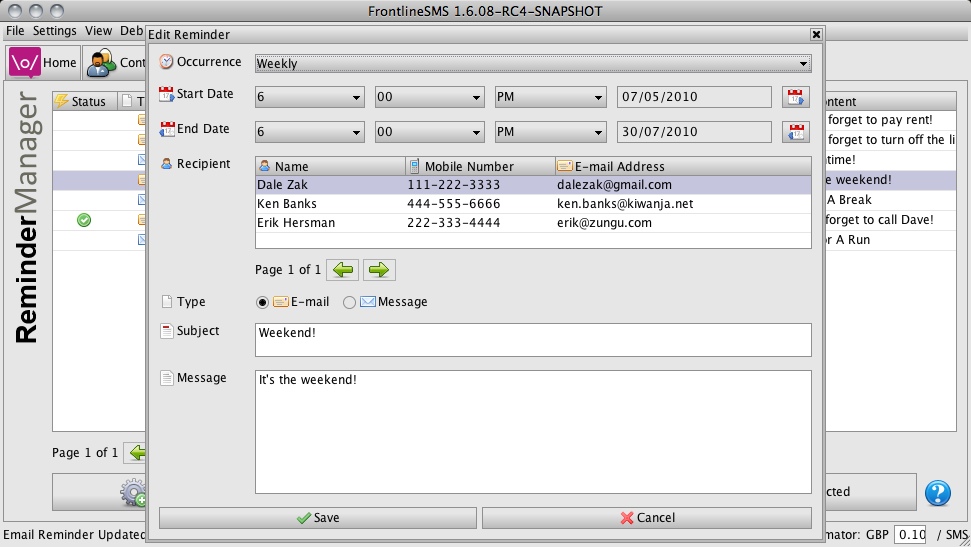
  2. Secondly, it will help further the work started using the Rockefeller funding to formalise and build on the growing FrontlineSMS developer community. Last week, for example, saw the release of a much-requested Reminders Plugin for FrontlineSMS, and other add-ons are in the works.
  3. Finally, the new funding will help with much-needed organisational development, and allow us to explore other non-grant sources of income.

    Further details on today’s announcement are available on the Omidyar website.

    Many thanks to Omidyar for their faith and support, from everyone at FrontlineSMS! We look forward to working with you over the coming two years.

    Anthropology: Taking it mobile

    Anyone taking more than a passing glance at the kiwanja.net website shouldn’t need long to figure out my four key areas of interest. I’ve always maintained that if your ideal job doesn’t exist then you have to create it, and being able to combine my passions for technology, anthropology, conservation and development is for me – through kiwanja.net – that dream job.

    Saying that, it doesn’t go without its challenges. Putting aside the difficulties faced by the global conservation and development communities, most of my thinking today centres around the sometimes uncomfortable tension between appropriate technology and the mobile phone, and the potential role of applied anthropology in helping us understand what on earth is going on out there. We can’t always rely on Indiana Jones, Hollywood’s answer to anthropology, to get us all the answers.

    Last month in the May/June edition of World Watch Magazine, John Mulrow wrote one of the best articles to date on mobile phones and appropriate technology, and this month an anthropology-focused article came to my attention via a Tweet from John Postill, a Media Anthropologist from Sheffield Hallam University in the UK. The role of anthropologists in mobile happens to be the second thing that challenges me, not because I don’t think they have a role – I’ve long argued they do – but because of the difficulties in finding both solid anthropological studies and meaningful numbers of anthropologists working in the field.

    Although I majored in anthropology at Sussex University, I’m never quite sure what “doing anthropology” really looks like, and what you need to do to “become” an anthropologist. I don’t think just having studied it at university is enough. I’ve had numerous discussions with anthropologists at a number of universities on how my anthropology training may or may not influence my work, and was recently interviewed for a forthcoming book on the role of anthropologists in the ICT4D field. I’m really looking forward to reading more when that comes out, and I’ll no doubt blog about it, too.

    So it was with great interest – and relief – that I came across a post on the wonderful “Mobile Livelihoods” blog last week which had taken a long, hard look at what anthropologists are doing in the mobile/phone field, and what they’re researching/writing about. I’m regularly contacted by students asking for help, and this makes everyone’s life so much easier. Kudos to Francisco and John for putting the hours in. You can read their post – which contains a list of 96 journal articles and details of how they categorised them – here.

    Three articles of particular interest are available here (all in PDF format). Thanks to Francisco for kindly selecting them and sending them over:

    • Horst, H., & Miller, D. (2005). From Kinship to Link-Up: Cell phones and Social Networking in Jamaica. Current Anthropology, 6(5), 755-778
    • Tenhunen, S. (2008). Mobile Technology in the Village : ICTs, culture, and social logistics in India. Journal of the Royal Anthropological Institute(14), 515-534
    • Barendregt, B. (2008). Sex, Cannibals, and the Language of Cool: Indonesian tales of the phone and modernity. The Information Society, 24(3), 160-170

    One thing that surprised me was the number of papers they found written by ‘professional’ anthropologists, which totalled just six (three of those are above). I guess that’s another challenge within the wider challenge – defining what a professional anthropologist is in the context of the mobile/technology field. Maybe we’ll tackle that another time…

    Some useful/interesting anthropology resources:

    Discover Anthropology [Website]
    worldwise development [Website]
    Mobile Livelihoods [Blog]
    Anthropologist About Town
    [Blog]
    media/anthropology [Blog]
    EASA Media Anthropology Network [Website, Mailing list]
    The Cellphone: An Anthropology of Communication [Book]
    Anthropology’s Technology-driven Renaissance [Article]

    Please post a comment, or get in touch with your own favourites, and I’ll add them to the list (thanks to those who already have!).

    FrontlineSMS gets reminders

    For some time now users have been asking how they can schedule SMS reminders in FrontlineSMS. Well, now they can thanks to some great work by Dale Zak on a ReminderManager plugin. Not only is this great news for the community, but it’s great news for us, and is testament to the growing interest external developers are taking in the software

    FrontlineSMS is powerful open source software that turns an ordinary laptop and mobile phone into a low cost communications hub. It’s used by NGOS around the world to send and receive text messages for such efforts as human rights monitoring, disaster relief, education programs and fundraising campaigns. It’s also at the heart of FrontlineSMS:Medic which is revolutionizing global health by empowering rural healthcare workers.

    So when my friend Lucky Gunasekara asked if I could develop a much requested reminder plugin, I jumped at the opportunity. For one, it gave me an excuse to dive into the FrontlineSMS source code. And two, it would benefit the entire community.

    The FrontlineSMS Reminders Plugin allows you to schedule email and SMS reminders for a specific date range occurring once, hourly, daily, weekly or monthly.

    There was a bit of a learning curve to develop the plugin, especially with my somewhat limited Java, Hibernate and Thinlet experience. Thankfully Alex Anderson and Dieterich Lawson were great help answering my questions on the FrontlineSMS Google Group.

    The plugin definitely has room for improvement, and I already have a few ideas for additional occurrence types – Every Weekend, Every Weekday, Every Sunday, etc.

    You can checkout the source code here:
    http://github.com/dalezak/FrontlineSMS-Reminders

    You can read the original article here. Thanks to Dale for kindly giving us permission to republish.