The “emerging market” handset trap

Today at Mobile World Congress, Vodafone announced “the world’s cheapest phone”. At $15 it certainly scores low on the price tag – which is good – but it also scores low on functionality – not so good. Not only is this a problem for any end user who might need (or want) to use it for things beyond voice calling and SMS, but it’s also perpetuating a long-standing problem in the social mobile world dating back over five years.

With the ICT4D community putting an increasing focus on “smarter phones” – ones which feature downloadable applications and allow for cloud-based solutions, for example – where do phones like today’s Vodafone 150 fit in? Aimed specifically at emerging markets, these are the kinds of phones Vodafone are hoping will end up in the hands of the very patients or farmers the ICT4D world is itself working hard to reach.

Low-cost phones have certainly achieved one thing – low cost – and in price terms they’ve done exactly what they said on the tin. Over the past five years or so, prices have indeed steadily dropped, as we can see if we pick an early “emerging market handset” winner from 2005 (the Motorola C113), a ZTE phone widely available in East Africa in 2008, and today’s Vodafone 150.
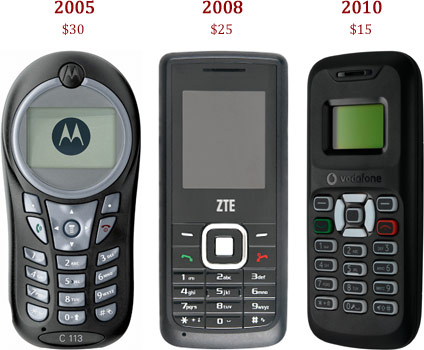
The prices may have changed, but functionality has largely stagnated. You couldn’t browse the web on the Motorola in 2005, nor the ZTE in 2008, and today you’d have the same problem on the Vodafone 150. You can’t download applications onto any of them, either. They all have monochrome screens and look pretty-much-the-same despite having a five year gap between them. Very little has changed other than price, it would seem. Voice and SMS remain king at the bottom of the pyramid, or so it would seem.

The real trick is to reduce the price of these phones whilst at the same time increasing (or at very least maintaining) functionality, a combination which no manufacturer has yet managed to crack. Nokia’s announcement last week of their cheapest 3G-enabled phone for the Indian market shows prices are shifting downward for data enabled phones, but at $90 it’s still some way off what most would consider affordable for the remaining 1.5 billion people in the world without a phone.

From today’s announcement, a sub-$40 smart phone – which really would change the game – looks to be as far off as ever.

[Related post: “The Digital Divider“]

Mobile meets citizen reporter in Mozambique

In this, the twentieth in our series of FrontlineSMS guest posts, Marcelo Mosse – Executive Director of the Centre for Public Integrity in Mozambique – talks about their use of the software in promoting citizen engagement in monitoring their national elections, and in their efforts to promote transparency in government

“The Centre for Public Integrity of Mozambique (CIP) is a not-for-profit, non-partisan, independent organisation, endowed with legal status, and with administrative, financial and patrimonial autonomy. Our general objective is to promote integrity, transparency, ethics and good governance in the public sphere, and to promote human rights in Mozambique, and we use our website to launch campaigns, document events, and publish case studies and reports on Mozambique’s political process.

In 2008, local elections took place in Mozambique and the CIP decided to try using SMS to collect events reported by citizens. We implemented FrontlineSMS and launched a press campaign aimed at making the public aware of the opportunity to report and comment on events on the electoral campaign, and events at the voting posts.

Telephone lines were made available and FrontlineSMS was installed and used by CIP staff in charge of coordinating the publishing of text messages on our website. Response from the citizens was considered satisfactory – with mobile phones in use over most of the country and accessible to almost all economic level layers, citizens showed they were eager to contribute.

Later in 2009, during the general elections in Mozambique, we increased the number of available lines for the public and launched a more comprehensive campaign (newspapers, television, and radio). The outcome was considered very satisfactory with SMSs being received right from the beginning of the electoral campaigns. FrontlineSMS was also used to get instant reports from the CIP’s correspondents placed at the 43 municipalities all over the country.

Thanks to FrontlineSMS we were able to compile reports on party and candidate practices during the electoral campaigning, citizen’s reactions and opinions on the electoral process and anomalies at the voting posts.

User experience from those using the software was positive. It was easy to understand and operate, to add phones, and manage and classify messages received. The CIP intends to continue using FrontlineSMS on other campaigns where we believe citizen contribution can be valuable”.

Marcelo Mosse
Executive Director
Centre for Public Integrity Mozambique
www.cip.org.mz

FrontlineSMS:Jobs? Yes, we’re hiring!

Update 24/02/10: Applications now closed. Please don’t apply for either of these posts. Thanks! \o/

After four years of steady growth, FrontlineSMS has witnessed a dizzying rise in activity over the past few months. One full-time position has increased to three with the hiring of Josh Nesbit as our FrontlineSMS Ambassador and Alex Anderson as our lead developer. And thanks to new funding from the Rockefeller Foundation last month, we’re now looking to build our team further and fill two more positions – in Software Development and Project Management.

Thanks to the seemingly inexhaustible support of our friends over at Wieden+Kennedy, we’ll be locating our small but growing team in their amazing central London offices – a hotbed of creativity, if ever there was one. As a result, we’re limiting our search for new team members to London and the surrounding area for now, but will look further afield as we get further established as an organisation.

So, who are we looking for?

Project Management

This might not be the best title for a role which requires the candidate to have a wide array of interests – software testing, fundraising, website maintenance, creating promotional materials and brochures, training, and helping scope new projects. We’re also going to need them to help out with community-building and support, and to run smaller specific FrontlineSMS-related projects as they arise. This position is a real moving target and, as part of a small team the candidate will have the opportunity to shape the role for themselves. All we ask for is hard work, dedication, a passion for social mobile, and a strong desire to help see our organisation grow.

Software Development

We’re also looking for a Junior/Intermediate Java Developer to assist with the maintenance and development of new features on our multi-platform desktop Java application, FrontlineSMS. There will also be opportunities to help out on another exciting web-based project we’re working on in partnership with the GSM Association and Accenture, and to help us explore the potential of iPhone, Facebook and Symbian extensions to our projects. Above all, we’re looking for someone with a passion for exploring the social potential of mobile technologies, and a willingness to contribute to all stages of the software development process, including architecture, UI, testing and deployment.

If you’re based in or around London and interested in either of these positions, click here for further details and then get in touch as soon as possible! Feel free to share a link to this post with any lists or individuals you think might be interested.

With hopes of further funding on the horizon, these are unique opportunities for individuals interested in mobile technology and social change to join and influence a small, active, growing team. Join us on our journey, and you never know – it may well be the start of a new journey all of your very own. \o/

NASA on Mars vs. Development in Africa?

Better late than never, I’m about to start reading “Dead Aid“, Dambisa Moyo’s much touted book. I’ve already read a few blog posts and reviews – some about her, some about her book – and the Guardian’s “An evening with Dambisa Moyo” seemed worth a look. In an otherwise downbeat review, one statement stood out a mile.

“Africa is to development what Mars is to NASA” – the ultimate development studies essay question. It certainly got me thinking. To what extent is Africa development’s playground, a place to ‘try things’, to experiment? Often with so little accountability – see Bill Easterly‘s “White Man’s Burden” – it’s easy to see why it’s thought of as an easy place to pilot, to test, to try out. “And if it goes wrong, well, let’s try something else, somewhere else”.

During a workshop at IDS a couple of weeks ago, I commented that the development sector in Africa was littered with the carcasses of failed projects, a kind of ‘elephant graveyard’ for the well-intended.

I’d love to see an ICT4D/African technology conference pick up on the “NASA, Mars, Development, Africa” theme. And I’d love to be in the audience. Any takers?