Mechanics vs. motivation: The two faces of social innovation

It’s been a busy and interesting few weeks, and I’ve met many people interested in many of the subjects which also fascinate me – entrepreneurship, social entrepreneurship, innovation, Africa, mobile technology and appropriate technology, among others. Being on the road is my equivalent of the town hall meeting, of door-to-door canvassing. It’s a great way – maybe the only way – to stay connected with the grassroots and meet the up-and-coming innovators of the future. I’m beginning to realise I enjoy speaking much more outside tech circles than within them. We need to introduce social mobile to new audiences, after all, rather than continually preach to the converted.

So, what am I learning from all of this? Most of the younger people I meet want stories. Sure, they want to know some of the theory, a little about the technology. But what resonates more than anything is the background to our tools and where we get our drive and motivation from. They want to resonate, to feel closer to the possibilities and potential, to see themselves in our shoes. They want to walk away with “Well, they did it. Why can’t I?”.

This was most apparent during talks to students and faculty at Mills College, the University of San Francisco, Santa Clara University and Stanford, all packed into a three week marathon trip to the West Coast at the end of last month. What struck me were the two approaches I often witnessed to spreading the ‘innovation’ and ‘social entrepreneurship’ message. While one seems to focus on mechanics, the other focuses on motivation. Let me explain.

Click for Twitter

One or two of the events I recently attended have focused on the mechanics of innovation and entrepreneurship. This world centres on business models, the quest for data, for metrics and an obsession on measuring impact. Lots of tables, numbers, graphs, theories. The very things which score low on most people’s motivational scale. This quote, from Aaron Sklar at IDEO (which I tweeted from the conference), sums up the downside of this approach perfectly.

There certainly seems to be a mismatch between the way social innovation is taught, and the realities of how most social innovators innovate. The ‘a-ha’ moment innovators-to-be hear about is rarely the discovery of a new metric, or a new business model, or a new way of presenting or collecting data. It’s the realisation that a problem can be solved, and solved in a new way. These answers often come by doing and experiencing, being out in the field, and there are almost always stories behind why the person was there, sometimes how they got there, and what they suddenly saw which gave them their big idea.

If I’m totally honest, I find the mechanical approach a total turn-off. It grinds me down and saps any enthusiasm I have for technology and innovation. That’s not to say it’s not important – it’s vital, in fact – but you can always figure out that stuff later, once you have your big idea. No big idea, no need to worry.

Innovation and entrepreneurship start with passion, so we ought to focus more on that. We can help by speaking about our own interests, passions and stories – which most of us have – and less on the mechanical stuff (some of which, incidentally, includes the actual technology we’ve invented). This is why, I think, people tend to resonate more with individuals who succeed, rather than bigger organisations. Take the Tech Awards last month. Over a dozen people not companies – who have found a way to make a difference. The celebration of their achievements would have been less remarkable if they’d all been housed in resource-rich environments. Innovation out of scarcity is what seems to really excite people.
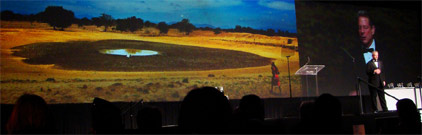
Al Gore at the Tech Awards. Photo courtesy godutchbaby on Flickr

Al Gore spoke at the Tech Awards gala. After a thirty minute speech not a single person could doubt his passion and commitment to the climate change cause, whether or not you agree with him. And hardly any mention of the intricacies of the science. This was a motivational speech if ever there was one. Somehow, if he’d focused on the mechanics I doubt he’d have had half the impact. Al Gore has taken a complex subject and made it accessible, and that has to be one of his major achievements.

We need to do the same with entrepreneurship, social entrepreneurship, technology and innovation. These subjects need to be demystified, and we need to put passion back where it belongs. And, in my mind, that’s ahead of just about everything else – business models, graphs and metrics included.

[Related post: “Enabling the inspiration generation“]
Social mobile gets its own “roadmap”

After three workshops on three continents, conversations and meetings with countless NGOs, academics, researchers and technologists, and many hours of conference calls, W3C this week released their “Mobile Web for Social Development Roadmap”, a comprehensive document which sits at the heart of the wider work of the Mobile Web for Development Interest Group (MW4D).
According to the Roadmap document, its purpose is to help:
“… understand the current challenges of deploying development-oriented services on mobile phones, evaluate existing technologies, and identify the most promising directions to lower the barriers of developing, deploying and accessing services on mobile phones and thereby creating an enabling environment for more social-oriented services to appear”
The Roadmap is split into two distinct sections. The first covers challenges and issues in developing mobile tools for social development, and the second looks specifically at technology options. The primary audience are individuals, organisations and entrepreneurs interested in social mobile; the mobile industry itself; academics; international organisations and, finally, policy makers and regulatory bodies.
The Roadmap is very much a work-in-progress, and the MW4D Interest Group welcomes comments, recommendations and suggestions to help shape it as the work moves forward.

After three workshops on three continents, conversations and meetings with countless NGOs, academics, researchers and technologists, and many hours of conference calls, W3C this week released their “Mobile Web for Social Development Roadmap”, a comprehensive document which sits at the heart of the wider work of the Mobile Web for Development Interest Group (MW4D).

According to the Roadmap document, its purpose is to help:

“… understand the current challenges of deploying development-oriented services on mobile phones, evaluate existing technologies, and identify the most promising directions to lower the barriers of developing, deploying and accessing services on mobile phones and thereby creating an enabling environment for more social-oriented services to appear”

The Roadmap is split into two distinct sections. The first covers challenges and issues in developing mobile tools for social development, and the second looks specifically at technology options. The primary audience are individuals, organisations and entrepreneurs interested in social mobile; the mobile industry itself; academics; international organisations and, finally, policy makers and regulatory bodies.

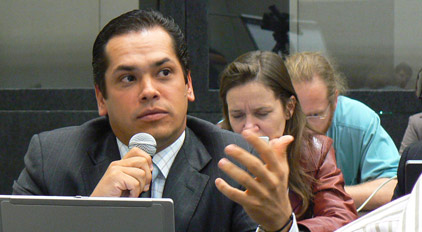
Question time in Sao Paulo (2008). Other meetings were held in Bangalore (India) in 2006, and Maputo (Mozambique) in 2009. Photo: Ken Banks, kiwanja.net

The Roadmap is very much a work-in-progress, and the MW4D Interest Group welcomes comments, recommendations and suggestions to help shape it as the work moves forward.

SMS tackles farmer literacy in Niger

In this, the sixteenth in our series of FrontlineSMS guest posts, Joshua Haynes – a Masters student at The Fletcher School at Tufts University – describes their application of the software to help improve the lives of farmers in Niger, West Africa

Projet Alphabétisation de Base par Cellulaire (ABC), conceived of and spearheaded by FrontlineSMS’s newest Advisory Board member Jenny Aker, uses mobile phones as tools to aid in adult literacy acquisition in rural Niger. This project is funded by UC Davis, Oxford University, Tufts University and Catholic Relief Services (CRS) and housed at and managed by CRS/Niger.

Adult literacy in rural areas faces an inherent problem. In Niger, for example, there are no novels, newspapers or journals in native languages like Hausa or Zarma. The 20% of Nigériens who are literate are literate in French. The vast majority of rural villagers have struggled to maintain their livelihoods since time immemorial without ever knowing how to read a single word. What’s the point of literacy if there is no need for written materials?

Mamadou Issoufou, like 80% of people who live in rural areas, has access to a couple of different weekly markets where he can buy and sell his millet. One market, Dogon Kirya, is 11 kilometers away and the other, Doubélma, is 15 kilometers away. As Dogon Kirya is closer, he usually travels there, but he knows that sometimes he can get a better price when he goes to Doubélma. If a fellow villager who traveled to Doubélma the previous week indicates that prices were better there than in Dogon Kirya, then Mamadou might decide to go the extra four kilometers, but he’s not sure he’ll get the same prices this week, too. He leaves it up to chance.

On Wednesdays, the Service d’Information sur les Marchés Agricoles (SIMA) sends radio broadcasts on the prices of the most important staples like millet and sorghum for the largest markets in the country. Unfortunately, Mamadou, like most rural farmers, doesn’t have access to the broadcast, and if he did, his two main markets aren’t large enough to be covered by SIMA. Even if they were large enough, Dogon Kirya’s market is held on Tuesdays, so any information from the radio would be six days old.

Farmer, Niger. Photo courtesy Joshua Haynes

If Mamadou had access to some sort of real-time, demand-driven information, he could make better choices on where to buy and sell his goods. The mobile phone is a perfect device for transmitting information, but even though Mamadou may have access to a phone, he can’t read. The point of literacy in rural areas is increase access to information, and this is where FrontlineSMS plays an important role.

This past summer, between my first and second year as a graduate student at The Fletcher School at Tufts University, I was fortunate to work with Jenny, the amazing staff at CRS and SIMA, including Djibou Alzouma, Aïchatou Bety, Sadou Djibrilla, Scott Isbrandt and Ousseïni Sountalma, to develop a system called IMAC – Information sur les Marchés Agricoles par Cellulaire. IMAC – pronounce ‘ee-mak’ – allows users to query for farmgate and market prices of agriculture products in a number of markets in four languages. It is built to work as one of the Projet ABC components, but can be used in areas with higher literacy levels.

Mobile training, Niger. Photo courtesy Joshua Haynes

In addition to the querying functionality, we added the ability for SIMA-trained CRS agents to update the crop prices by sending IMAC a specially formatted SMS. The prices are quickly checked for errors in Niamey, the capital, and then are live for all to use. Before, it could take up to three weeks for market prices to get recorded, go through a number of different administrative stages and finally end up in the database in the capital, but now it takes a matter of seconds before the data can be accessed.

Although the data is stored and updated in the database, FrontlineSMS is the primary access point which captures the message, sends it to the database for processing, waits eagerly for the response, and speedily sends the response to the waiting villager. By exploiting FrontlineSMS’ HTMLRequest functionality, we were able to access a backend system and turn FrontlineSMS into a demand-driven automatic information dissemination tool.

I was fortunate to return to Niger in October (2009) to not only see how well the system was still working – a big relief for developers – but to be surprised by the number of new markets and products that had been added to the system. Thanks to FrontlineSMS, CRS and SIMA, these additional markets will allow even more villagers, once at least semi-literate, to obtain information that will better help them make more informed decisions about their economic resources.

Joshua Haynes
Candidate, Masters of International Business, 2010
The Fletcher School
Tufts University
http://fletcher.tufts.edu

FrontlineSMS welcome video

We’ve been planning for some time to create a cool (possibly animated) introductory film for people interested in the FrontlineSMS basics, but haven’t managed to get round to it yet. So, as a stop-gap, yesterday I put together this quick eight minute welcome video, which covers most of the more frequently asked questions.

This video, and others, can be found on the FrontlineSMS Community. The “Quick Start Guide” mentioned towards the end can be downloaded from here (PDF, 1Mb).