The depth and range of discussion generated by my last post on “the cloud” and “appropriate technology” may have come as something of a surprise, but one thing is clear. There’s a great deal of misunderstanding around the topic, particularly with people who are either developing or promoting tools based on the very technology I was challenging. The only way to avoid this kind of confusion is to spell out our positions clearly, and I made this point in that very same post. So how do we move on from here?
Well, we need to set out our positions clearly as a marker in the sand for future discussion. So, let me go first. To clear up any present and future confusion, here’s the official FrontlineSMS / kiwanja.net position on what I consider five key “mobile tools for development” areas – location in the “long tail”, scaling, replication and growth, open sourcing and access to “the cloud”.
1. Who are your target audience?
Some time ago I butchered Chris Anderson’s “long tail” concept and adapted it for mobile. It seemed like the best way of categorising the different focus areas for mobile tools – high-end for larger organisations down to low-end for small grassroots ones. Here’s what I came up with.
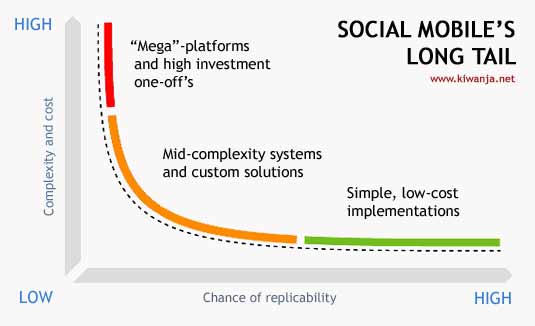
The basic rationale behind the diagram is this. Tools in the red area are technically and financially out-of-reach of many grassroots NGOs, many of whom sit in the green space. Tools at the higher end of the graph are generally more complex, server-based systems which require a high degree of technical competence, and often the Internet, to set up and use. Tools in the lower end are simple, low-cost, need few technical skills, work on easily available hardware, don’t require the Internet, and are easy to install and run. Tools in the green space can be quickly adopted and replicated – within hours – whereas tools at the other end need much more planning, i.e. more people and more lead time, and most likely a degree of training.
Note: There is no right or wrong or good or bad place on the tail. There are just different places
From its early beginnings in South Africa in 2004, FrontlineSMS has been totally focused on grassroots NGOs in the green space, an area which I believed back then was heavily underserved (and to a large degree still is). We’re not particularly interested in big users such as international NGOs or government departments. So if our tool isn’t considered right for the kinds of big projects they’re likely to be running, then that’s fine with us.
I wonder where the other social mobile tools would place themselves on the tail?
2. What is your position on scaling?
Believe it or not, not everyone wants to build tools that can grow into large centralised solutions, which is how many people seem to define scale. No one is ever going to run a nationwide election monitoring campaign running into millions of text messages using a single laptop, cable and mobile phone. FrontlineSMS is based on “horizontal scaling”, gained by an increase in the numbers of individual users with their own systems. In other words, a hundred systems in a hundred clinics serving 10,000 people each, rather than one system adapted and “scaled up” to serve a million. We’re happy and comfortable with this approach, as are our target audience of grassroots NGOs.
3. How does it replicate and grow?
Growth is based on patience, and a “pull” rather than “push” approach, i.e. awareness-raising and then letting NGOs decide if they want to try out the tool or not. Those that do then go and request it from the website. Everything is driven by the end user, who needs to be independently motivated to download and use the tool. There is no need for us to be involved at any stage, so no-one flies anywhere and no-one does any training – note that the approaches of FrontlineSMS:Medic and FrontlineSMS:Credit may be different – and no-one tries to “sell” FrontlineSMS to anyone. The solution is designed to allow users to do everything themselves. No core FrontlineSMS implementations are driven by us, and none are our projects. Use is replicated by users sharing experiences, talking about their use of the tool to others, and growing numbers of champions who are either building their own solutions around FrontlineSMS, or bloggers and researchers who write about its use and impact.
4. What is your position on open sourcing?
Again, from the very beginning we have been unashamedly focused on our end user – NGOs in developing countries seeking easy-to-deploy mobile tools. Our end users are not programmers, coders or technical developers, and few if any of our FrontlineSMS user base would have any idea what to do with source code. We decided that we would focus on the open source community once we believed we had something worth working with, and that time is about now. In between working on everything else, we plan to launch a developer community soon. That all said, there are already a number of developers bolting on new functionality to the core FrontlineSMS platform, and 90% of the code is already available online and accessible through SourceForge.
5. Does access to “the cloud” matter?

FrontlineSMS only came about four years ago because of a critical lack of tools that allowed for group messaging without the need for the Internet. Building a tool which is able to operate in Internet-free zones has therefore been central to our thinking since the very beginning, and continues to this day. Beyond basic messaging, FrontlineSMS can make use of an Internet connection when and where available – messages can be forwarded via email, or posted to websites, for example (that’s the functionality Ushahidi takes advantage of) – but no Internet is not a show stopper for us. And as time moves on and connectivity does improve, we’ll be ready. We’re adding picture messaging in the next couple of months (for example), and other web-based features are in the pipeline. We are not anti-Internet, but realistic when it comes to its availability and reliability.
So, that’s our line in the sand. If anyone else has a mobile tool – or is working on a mobile tool – I’d encourage them to clear up any possible confusion and write a post outlining their thinking in these five areas. The alternative is more confusion, and more false arguments and comparisons.
I know I’d love to know the thinking behind more social mobile tools, and going by the reaction earlier this week, it looks like I’m not the only one. Now is a good-a-time as any to join the conversation.
Read responses and “lines in the sand” from:
FrontlineSMS:Credit
FrontlineSMS:Medic
(As of 20th December, no other mobile tools providers have responded, which is a shame. May the confusion and misrepresentation continue…)

 Larry Diamond is based at Stanford University and is a senior fellow at the Hoover Institution and at the Freeman Spogli Institute for International Studies, where he also directs the Center for Democracy, Development, and the Rule of Law. During the first three months of 2004, Larry served as a senior adviser on governance to the Coalition Provisional Authority in Baghdad. Since then, he has lectured and written extensively on U.S. policy in Iraq and the wider challenges of post-conflict stabilization and reconstruction, and was one of the advisors to the Iraq Study Group.
 Jenny
Jenny  Due to this serious situation, and the necessity to improve the collection of information, TSF, in collaboration with PATH (an international non-profit organisation that aims at enabling communities worldwide to break longstanding cycle of poor health) is reinforcing SILAIS’ capacities in Information and Communications Technologies.