
 Over the past couple of years there has been increasing debate in the West on the role of “China in Africa”. There are even several books out on the subject. I haven’t heard too much from Africans themselves, except for the odd comment by the man on the street that Chinese goods are swamping their markets, something not considered a good thing. So when I saw this headline in the East Africa Times last month, it made me laugh…
Tag: Africa
Saving Africa from us
There are often times when things I feel particularly strong about are better put in words by other people. This article, by Uzodinma Iweala (author of Beasts of No Nation, a novel about child soldiers), is no exception. Originally published in The Washington Post a few weeks ago, it’s particularly poignant coming at a time when more and more celebrity attention and more and more glossy magazine centre-spreads are focussing on the ‘dark continent’. I regularly struggle with my own involvement on the continent, particularly when I’m out in the field (as I am now, helping with a Grameen project in Uganda).
 Uzodinma believes that most Africans don’t want saving. Instead they’d rather just be given a fair chance. Since my first visit – to northern Zambia way back in 1993 – I’ve been intrigued by how you create an environment where ordinary, everyday Africans are able to make the most of that chance, assuming one ever comes their way. The more work I do, the more countries I visit and the more people I meet, the more I believe that creating this environment is morally and practically the right thing to do. It would be hard, if not impossible, to argue otherwise. Yet the Western model of development prevails, built on the view of Africa as a hopeless and impoverished place in desperate need of ‘our’ help. Help is delivered in the form of money and sympathy. Forty years of handouts has failed to change that view, just like it has largely failed to make a significant positive impact on the root cause of the problem.
Whatever we say or do, whatever message we choose to convey through the glossy innards of top-notch magazines or the clever visuals of a website, it will be Africans who will ‘save Africa’. Let’s stop pretending it will be anybody else.
“Stop Trying to ‘Save’ Africa”
Last fall, shortly after I returned from Nigeria, I was accosted by a perky blond college student whose blue eyes seemed to match the ‘African’ beads around her wrists.
“Save Darfur!” she shouted from behind a table covered with pamphlets urging students to “TAKE ACTION NOW! STOP GENOCIDE IN DARFUR!”
My aversion to college kids jumping onto fashionable social causes nearly caused me to walk on, but her next shout stopped me.
“Don’t you want to help us save Africa?” she yelled.
It seems that these days, wracked by guilt at the humanitarian crisis it has created in the Middle East, the West has turned to Africa for redemption. Idealistic college students, celebrities such as Bob Geldof and politicians such as Tony Blair have all made bringing light to the dark continent their mission. They fly in for internships and fact-finding missions or to pick out children to adopt in much the same way my friends and I in New York take the subway to take adopted stray dogs to the pound.
This is the West’s new image of itself: a sexy, politically active generation whose preferred means of spreading the word are magazine spreads with celebrities pictured in the foreground, forlorn Africans in the back. Never mind that the stars sent to bring succour to the natives often are, willingly, as emaciated as those they want to help.
Perhaps most interesting is the language used to describe the Africa being saved. For example, the Keep a Child Alive/”I am African” ad campaign features portraits of primarily white, Western celebrities with painted “tribal markings” on their faces above “I AM AFRICAN” in bold letters. Below, smaller print says, “help us stop the dying”. Such campaigns, however well intentioned, promote the stereotype of Africa as a black hole of disease and death. News reports constantly focus on the continents corrupt leaders, warlords, “tribal” conflicts, child labourers, and women disfigured by abuse and genital mutilation. These descriptions run under headlines like “Can Bono Save Africa?” or “Will Brangelina Save Africa?”. The relationship between the West and Africa is no longer based on openly racist beliefs, but such articles are reminiscent of reports from the heyday of European colonialism, when missionaries were sent to Africa to introduce us to education, Jesus Christ and “civilization”.
There is no African, myself included, who does not appreciate the help of the wider world, but we do question whether aid is genuine or given in the spirit of affirming one’s cultural superiority. My mood is dampened every time I attend a benefit whose host runs through a litany of African disasters before presenting a (usually) wealthy, white person, who often proceeds to list the things he or she has done for the poor, starving Africans. Every time a well-meaning college student speaks of villagers dancing because they were so grateful for her help, I cringe. Every time a Hollywood director shoots a film about Africa that features a Western protagonist, I shake my head – because Africans, real people though we may be, are used as props in the West’s fantasy of itself. And not only do such depictions tend to ignore the West’s prominent role in creating many of the unfortunate situations on the continent, they also ignore the incredible work Africans have done and continue to do to fix those problems.
Why do the media frequently refer to African countries as having been “granted independence from their colonial masters” as opposed to having fought and shed blood for their freedom? Why do Angelina Jolie and Bono receive overwhelming attention for their work in Africa while Nwankwo Kanu or Dikembe Mutombo, Africans both, are hardly ever mentioned? How is it that a former mid-level U.S. diplomat receives more attention for his cowboy antics in Sudan than do the numerous African Union countries that have sent food and troops and spent countless hours trying to negotiate a settlement among all parties in that crisis?
Two years ago I worked in a camp for internally displaced people in Nigeria, survivors of an uprising that killed about 1,000 people and displaced 200,000. True to form, the Western media reported on the violence but not on the humanitarian work the state and local governments – without much international help – did for the survivors. Social workers spent their time and in many cases their own salaries to care for their compatriots. These are the people saving Africa, and others like them across the continent get no credit for their work.
Last month the G8 industrialized nations and a host of celebrities met in Germany to discuss, among other things, how to save Africa. Before the next such summit, I hope people will realize Africa doesn’t want to be saved. Africa wants the world to acknowledge that through fair partnerships with other members of the global community, we ourselves are capable of unprecedented growth.
Courtesy of The Washington Post
One of our continents is missing
I’ve just returned from the 16th International World Wide Web Conference in Banff, Canada. As you’d expect from such a prestigious annual event, no expense was spared in making the experience as productive and pleasurable as possible for the thousands of delegates who attended. With the beautiful Rocky Mountains as a backdrop, what better place to network, make new friends and talk about the future of the web? Life can be hard…
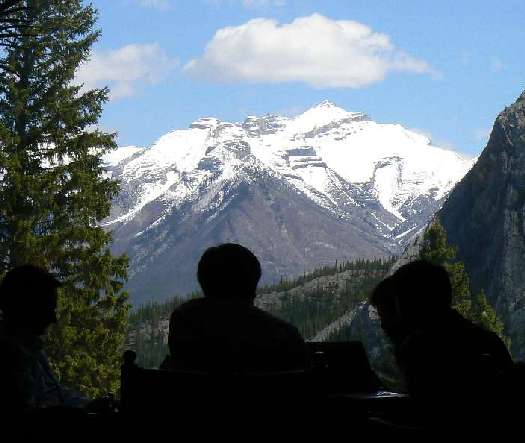 The 16th International World Wide Web Conference was interesting for a number of reasons. For a start, the world wide web isn’t really world-wide quite yet, and this was one of the reasons I was invited to attend. On Tuesday I presented a paper on the Mobile Web in Developing Countries, and the day after sat on a panel discussing Web Delivery Models for Developing Regions. I enjoy attending these kinds of events – not only does it give me a chance to see what other people are doing in this emerging ’emerging market’ area, but I also get to profile my own work to a wider audience. After many years working alone in darkened rooms, this is new and refreshing. Fortunately my message is always well received, and seems to strike a chord with most people. It still makes me smile seeing kiwanja.net (“Who?”, I hear all the delegates asking!) muscle in on the big guys – Microsoft, MIT, IIT, IBM and so on. Power to the people!
 On the downside, the notable lack of African presenters and delegates at the event – the “missing continent” – was rather disappointing (if not unexpected), particularly considering the amount of interest in emerging markets right now, and the drive to connect the last couple of billion people at the bottom of that pyramid. The reasons for this? Well, I doubt that it’s down to a lack of interest from African developers. No doubt they’d jump at the chance to attend something like this. I’d put it down to issues of cost and lack of funding, lack of awareness in both camps, a general lack of focus on the African continent (and why should there be, I guess?) and the fact that not many Africans got invited to this thing. There was, as you’d expect, a strong North American and European contingent, along with plenty of others from Asia. We seem to be creating a continental divide to add to our already well-established digital one.
On a more positive note, over the past few months I’ve come into contact with many people with professional and personal interest in the uses of technology in Africa for positive social and environmental change. Many have been from Africa. Change is in the air…
ICTs: Prescribing the right medicine…
The argument that drugs widely available in Western countries (many at greatly reduced cost via public and national health programmes) should also be made available – at preferential rates – to other not-so-well-off developing countries is not new. Indeed, medicines such as those which block the transmission of HIV from mother to unborn child are widely used in Europe and the United States but, despite their huge success, aren’t always available to the millions in developing countries who need them just as much. Perhaps even more.
You’d have thought that campaigning for life-saving drugs was a bit of a no-brainer. People here are unnecessarily dieing from a disease which has a cure there. Sadly, things are never that simple.
 I’ve often wondered if the same concept could be applied to ICTs. Over the past two or three years the emergence of information and communication technologies as a means of enabling economic empowerment in third world communities has grown into something of a phenomenon. Report after report reveals the wide-ranging benefits of mobile telephony in particular, from improved communication between family members through to the creation of small businesses and the provision of valuable news and other information via SMS.
As with the pharmaceutical model, cost, for many, is something of a barrier. After all, getting hold of a phone is just the half of it – without a SIM and regular top-ups it’s not much use to anyone. A mixture of entrepreneurial skills and outright resourcefulness often solves some, if not all, of these problems. But if the mobile is such an economic enabler, and if it is able to spread its influence across multiple disciplines such as health, education and communication (to name just three), then shouldn’t we be looking to remove these cost barriers? As with the medicine model, shouldn’t we be fighting for cheaper and wider access to mobile services?
At the NGO level, those with the vision and will to embrace the mobile revolution regularly stumble across the same barrier. Hitting a few hundred phones with a targeted health message is not only technically challenging for some of these organisations, but it can also be costly. Again, if the benefits are so clear then why don’t we campaign for cheaper, more open access to the networks?
The mobile revolution has not only empowered many third world citizens and communities. It’s also making some people very, very rich. It’s the perfect business model. Wouldn’t it be great if a provider could set up a mobile virtual network operator (MVNO) for exclusive use by the NGO community – conservation and development organisations alike working for the greater good? The infrastructure is already there. I don’t think it would be too much work. But it would reduce their bottom line a little. Maybe that’s the problem…
I can’t somehow see this happening anytime soon, but an NGO mobile network throughout continents such as Africa? Now, wouldn’t that be something?