Anthropology: Taking it mobile

Anyone taking more than a passing glance at the kiwanja.net website shouldn’t need long to figure out my four key areas of interest. I’ve always maintained that if your ideal job doesn’t exist then you have to create it, and being able to combine my passions for technology, anthropology, conservation and development is for me – through kiwanja.net – that dream job.

Saying that, it doesn’t go without its challenges. Putting aside the difficulties faced by the global conservation and development communities, most of my thinking today centres around the sometimes uncomfortable tension between appropriate technology and the mobile phone, and the potential role of applied anthropology in helping us understand what on earth is going on out there. We can’t always rely on Indiana Jones, Hollywood’s answer to anthropology, to get us all the answers.

Last month in the May/June edition of World Watch Magazine, John Mulrow wrote one of the best articles to date on mobile phones and appropriate technology, and this month an anthropology-focused article came to my attention via a Tweet from John Postill, a Media Anthropologist from Sheffield Hallam University in the UK. The role of anthropologists in mobile happens to be the second thing that challenges me, not because I don’t think they have a role – I’ve long argued they do – but because of the difficulties in finding both solid anthropological studies and meaningful numbers of anthropologists working in the field.

Although I majored in anthropology at Sussex University, I’m never quite sure what “doing anthropology” really looks like, and what you need to do to “become” an anthropologist. I don’t think just having studied it at university is enough. I’ve had numerous discussions with anthropologists at a number of universities on how my anthropology training may or may not influence my work, and was recently interviewed for a forthcoming book on the role of anthropologists in the ICT4D field. I’m really looking forward to reading more when that comes out, and I’ll no doubt blog about it, too.

So it was with great interest – and relief – that I came across a post on the wonderful “Mobile Livelihoods” blog last week which had taken a long, hard look at what anthropologists are doing in the mobile/phone field, and what they’re researching/writing about. I’m regularly contacted by students asking for help, and this makes everyone’s life so much easier. Kudos to Francisco and John for putting the hours in. You can read their post – which contains a list of 96 journal articles and details of how they categorised them – here.

Three articles of particular interest are available here (all in PDF format). Thanks to Francisco for kindly selecting them and sending them over:

  • Horst, H., & Miller, D. (2005). From Kinship to Link-Up: Cell phones and Social Networking in Jamaica. Current Anthropology, 6(5), 755-778
  • Tenhunen, S. (2008). Mobile Technology in the Village : ICTs, culture, and social logistics in India. Journal of the Royal Anthropological Institute(14), 515-534
  • Barendregt, B. (2008). Sex, Cannibals, and the Language of Cool: Indonesian tales of the phone and modernity. The Information Society, 24(3), 160-170

One thing that surprised me was the number of papers they found written by ‘professional’ anthropologists, which totalled just six (three of those are above). I guess that’s another challenge within the wider challenge – defining what a professional anthropologist is in the context of the mobile/technology field. Maybe we’ll tackle that another time…

Some useful/interesting anthropology resources:

Discover Anthropology [Website]
worldwise development [Website]
Mobile Livelihoods [Blog]
Anthropologist About Town
[Blog]
media/anthropology [Blog]
EASA Media Anthropology Network [Website, Mailing list]
The Cellphone: An Anthropology of Communication [Book]
Anthropology’s Technology-driven Renaissance [Article]

Please post a comment, or get in touch with your own favourites, and I’ll add them to the list (thanks to those who already have!).

CNN on anthropology and innovation

CNN

“As trained observers of how people in a society live, ethnographers can help companies figure out what people need and then work with designers to meet those needs with new (or more often tweaked) products and services. In a world in which ever more people are using technology products on a daily basis, such skills are increasingly in demand. For ethnographers, anthropologists, and other social scientists, the upshot can be intriguing work around the globe”

Read more about the role of field-based research and anthropology in the identification and design of mobile tools, products and services in this latest CNN article. There’s more in our PC World column, published last July. And an interesting new course in Digital Anthropology at University College London in the UK.

Interesting times. Get out in the field, or study anthropology. That seems to be the message.

Bones for mobile phones

What on earth are anthropologists doing playing with mobile phones? The answer may be a little more obvious than you think

Anthropology is an age-old, at times complex discipline, and like many others it suffers from its fair share of in-fighting and disagreement. It’s also a discipline shrouded in a certain mystery. Few people seem to know what anthropology really is, or what anthropologists really do, and a general unwillingness to ask simply fuels the mystery further. Few people ever question, for example, what a discipline better (but often incorrectly) ‘known’ for poking around with dinosaur bones is doing playing with mobile phones and other electronic gadgets.

Indiana Jones, image courtesy Daily Mail Online

In today’s high tech world, anthropologists are as visible as engineers and software developers. In some projects, they’re all that’s visible. The public face of anthropology likely sits somewhere close to an Indiana Jones-type character, a dashing figure in khaki dress poking around with ancient relics while they try to unpick ancient puzzles and mysteries, or a bearded old man working with a leather-bound notepad in a dusty, dimly lit inaccessible room at the back of a museum building. If people were to be believed, anthropologists would be studying everything from human remains to dinosaur bones, old pots and pans, ants and roads. Yes, some people even think anthropologists study roads. Is there even such a discipline?

Despite the mystery, in recent years anthropology has witnessed something of a mini renaissance. As our lives become exposed to more and more technology, and companies become more and more interested in how technology affects us and how we interface with it, anthropologists have found themselves in increasing demand. When Genevieve Bell turned her back on academia and started working with Intel in the late 1990’s, she was accused of “selling out”. Today, anthropologists jump at the chance to help influence future innovation and, for many, working in industry has become the thing to do.

So, if anthropology isn’t the study of ants or roads, what is it? Generally described as the scientific study of the origin, the behaviour, and the physical, social, and cultural development of humans, anthropology is distinguished from other social sciences – such as sociology – by its emphasis on what’s called “cultural relativity“, the principle that an individuals’ beliefs and activities should be interpreted in terms of their own culture, not that of the anthropologist. Anthropology also offers an in-depth examination of context – the social and physical conditions under which different people live – and a focus on cross-cultural comparison. To you and me, that’s comparing one culture to another. In short, where a sociologist might put together a questionnaire to try and understand what people think of an object, an anthropologist would immerse themselves in the subject and try to understand it from ‘within’.

Anthropology has a number of sub-fields and, yes, one of those does involve poking round with old bones and relics. But for me, development anthropology has always been the most interesting sub-field because of the role it plays in the third world development arena. As a discipline it was borne out of severe criticism of the general development effort, with anthropologists regularly pointing out the failure of many agencies to analyse the consequences of their projects on a wider, human scale. Sadly, not a huge amount has changed since the 1970’s, making development anthropology as relevant today as it has ever been. Many academics – and practitioners, come to that – argue that anthropology should be a key component of the development process. In reality, in some projects it is, and in others it isn’t.

It’s widely recognised that projects can succeed or fail on the realisation of their relative impacts on target communities, and development anthropology is seen as an increasingly important element in determining these positive and negative impacts. In the ICT sector – particularly within emerging market divisions – it is now not uncommon to find anthropologists working within the corridors of hi-tech companies. Intel, Nokia and Microsoft are three such examples. Just as large development projects can fail if agencies fail to understand their target communities, commercial products can fail if companies fail to understand the very same people. In this case, these people go by a different name – customers.

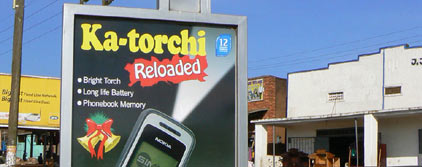
Image from kiwanja.net Mobile Gallery

The explosive growth of mobile ownership in the developing world is largely down to a vibrant recycling market and the arrival of cheap $20 phones, but is also down in part to the efforts of forward-thinking mobile manufacturers. Anthropologists working for companies such as Nokia spend increasing amounts of time trying to understand what people living at the so-called “bottom of the pyramid” might want from a phone. Mobiles with flashlights are just one example of a product that can emerge from this brand of user-centric design. Others include mobiles with multiple phone books, which allow more than one person to share a single phone, a practice largely unheard of in many developed markets.

My first taste of anthropology came a little by accident, primarily down to Sussex University‘s policy of students having to select a second degree subject to go with their Development Studies option (this was my key interest back in 1996). Social anthropology was one choice, and one which looked slightly more interesting than geography, Spanish or French (not that there’s anything wrong with those subjects). During the course of my degree I formed many key ideas and opinions around central pieces of work on the appropriate technology movement and the practical role of anthropology, particularly in global conservation and development work.

Today, handset giants such as Nokia and Motorola believe that mobile devices will “close the digital divide in a way the PC never could”. Industry bodies such as the GSM Association run their own “Bridging the Digital Divide” initiative, and international development agencies pump hundreds of millions dollars into economic, health and educational initiatives based around mobiles and mobile technology.

In order for the mobile phone to reach its full potential we’re going to need to understand what people in developing countries need from their mobile devices, and how they can be applied in a way which positively impacts on their lives. Sounds like the perfect job for an anthropologist to me.