The “Tweet. Recycle. Repeat” of ICT4D

During a rare, quiet, bored few minutes last week I looked through a few early blog posts from some of the longer standing members of the ICT4D community. Between around 2012 and now, many of the same statements, proclamations and questions have come up time and time and time again. The same tweets with the same outcome – usually nothing. Many have regularly appeared on my blog over the past seven or eight years, too, without making the slightest bit of difference.

I recently wrote about the need to stop just meeting up and repeating ourselves in the ICT4D echo chamber, which is what has been happening. But suffice to say it continues, and likely will, for as long as the discipline survives. The most obvious impact of all this activity are tweets and retweets of surprise every time something is said, even if it has been said for the past five years. If we’re looking to keep ourselves in a job and not fix anything, this isn’t a bad strategy, I suppose.

Here’s just a few of the things we’ve been saying over and over again for years.

kiwanja-trr-1

Okay, so no more pilots. Let’s put an end to ‘pilotitus’. Other than talking, what are we going to do about it, precisely? And how can we enforce it?
kiwanja-trr-2

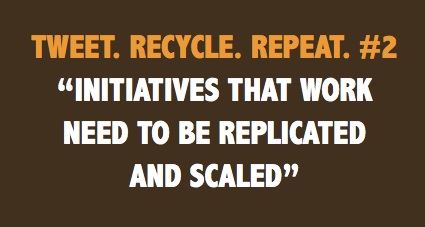
Okay, after decades of trying we have done some stuff right. So how do we identify the stuff that works and genuinely support that? Other than talking, what are we going to do about it, precisely? And how can we enforce it?
kiwanja-trr-3

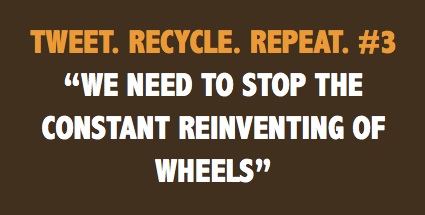
Yup. The world doesn’t need any more data collection tools or SMS gateways. So how do we put an end to this constant replication and reinvention? Other than talking, what are we going to do about it, precisely? And how can we enforce it?

kiwanja-trr-4

In many cases it’s still unclear who should pay to do monitoring and evaluation. Donors seem to think grantees should do it, and grantees only seem prepared to do it if the donor has given money for it. Other than talking, how are we going to fix this, precisely? And how can we enforce it?

kiwanja-trr-5

Hallelujah. After years of ignoring the end user we’re now entering an age (in ICT4D and global conservation and development, more broadly) where we think it’s a good idea to be consulting our end user. But it still doesn’t happen as much as it should. What are we going to do about it, precisely? And how can we enforce it?

kiwanja-trr-6

Everyone loves talking about appropriate technologies, but then they go off and build iPad apps for African farmers. We need to lead with the problem and the people, not the technology. But other than saying this, what are we going to do about it, precisely? And how can we enforce it?

When it comes to talking, blogging and tweeting ‘best practice’, I’m as guilty as the next person. We all do it, and we all rightly believe in what we’re saying. But talk is cheap if we do something very different on the ground (or do nothing at all). And after 12 years working in ICT4D/m4d I seem to keep seeing the same questions and issues raised over and over again. I’m sure I’m right when I say we all want to do the best we can for the people we serve. If we’re under performing then that’s something we all should naturally want to address.

Of course it’s pretty easy to rant about how bad things are, but that’s little use if you don’t offer any solutions. I’ve been trying to do more of that lately, publishing a book – The Rise of the Reluctant Innovator – to challenge conventional wisdom around how social innovation happens and should be done. I also launched the Donors Charter which seemed to stir up all sorts of trouble, breaking the SSIR commenting system in the process. Check out the Stanford Social Innovation Review post if you’ve got a couple of hours spare.

donorscharter

The Charter, in short, proposed (quite logically in my mind) that if donors largely control what gets funded, all they needed to do was ask potential grantees a few simple questions before they handed over their money. We could then put a stop to some of the repetitive bad practice that we see. Donors all sign up to the Charter, and enforce it among themselves.

Of course, whether anything like this gets adopted is out of my control. But at least it’s a possible solution, not a rant.

Passions often get fired up in these kinds of debate, and it’s wonderful to see so much of it around ICT4D and m4d, particularly on how we can move the disciplines forward. But if the people and organisations with teeth in the non-profit sector aren’t in the room, and don’t act, then nothing will ever change. Perhaps everyone is too comfortable with how things are, and perhaps people don’t really want change.

Or perhaps we’re only comfortable with disruption as long as it doesn’t happen to us. Tweet that.

How “Designing with the end user” undermines ICT4D best practice

After years of near-invisible end users, it’s promising to see the beginnings of ‘end-user recognition’ in much of ICT4D‘s emerging best practice. It looks like we’ve made a big stride forward, but we’re not where we need to be yet, despite making all the right noises. To a great extent, we’re still saying one thing and doing another.

The international development sector, which includes the ICT4D community, is famously uncoordinated. That’s no surprise to many of the people who work in it. You would hope that, at least if the wrong things were being done they’d be being done in a coordinated way, but that’s rarely the case. Haiti is a great case in point, where “a confused aid effort‘ has only added to the difficulties. You’d be right to ask why so many people continue to live in tents nearly five years after the earthquake.

Very recently, the Narrative Project – which I blogged about here – included a call for “a co-ordinated development sector”. It also made the point that independence and self-reliance, i.e. people in the developing world solving their own problems, should be key development objectives. And that people need to believe they can make a difference. This is good to hear, but they’re empty words if ‘best’ practice continues to undermine it.

You could argue that “designing with the user” is a sensible approach – it’s certainly better than designing without them – but is it taking us closer to an end-game of “people in the developing world solving their own problems”? It may if you’re working with them to build a tool or platform which they, and other communities elsewhere, can then take and subsequently deploy on their own terms to solve whatever problem they see fit, in whatever way they decide, without the ‘solution’ provider needing to be involved.

To me, “Design with the user” makes more sense to a local solutions developer, who can simply jump on a bus to go and work with them. But it doesn’t for the overseas solutions developer, for example the student group designing an ICT4D intervention as part of their design thinking course. Local empowerment can only genuinely happen if it’s local people helping local people. So what we need to do is work towards a place where that can happen. “Allowing the user to design” is that place.

The truth of the matter is that far too many ICT4D projects are still initiated from the outside. When I initially launched FrontlineSMS in 2005, the platform was squarely designed to allow local people to conceive, design and run their own projects. The only outside help they needed was for someone to provide something that allowed them to do that. It really isn’t rocket science.

Yet, despite its successes, it still seems to be a model, and an approach, in the minority.

I worry that people who read, study and follow the “Design with the end user” mantra might feel more than ever that they’re doing the right thing, but they’ll simply be reinforcing the outside-in, top down approach without realising it. “Design with the end user” is a step in the right direction, but it’s not the end of the journey, and we shouldn’t kid ourselves that it is.

Time for a Donor Funding Charter?

Innovation isn’t about green bean bags and whacky idea sessions. It is a long term business development strategy
Lucy Gower

Behind almost every good social entrepreneur you’ll find a donor. These donors come in all shapes and sizes – family members, friends, companies, CSR departments and sponsors are the most typical, increasingly followed by the crowd funders among us. While plenty of great things get funded, pretty crazy stuff does, too. Zack Danger Brown just raised $55,000 on Kickstarter to make a potato salad, for example.

More often than not, the really big bucks come from government and philanthropic foundations. The UK’s Department for International Development will hand out £10.765 billion this financial year, funding all manner of projects that help those in greatest need. The Bill and Melinda Gates Foundation, the biggest private foundation in the world, gave $3.6 billion last year. The world has plenty of problems – big problems – and these budgets reflect that. Donors get to choose which ones they fix, too. The Rockefeller Foundation, for example, currently focuses on resilient cities, digital jobs in Africa, food security, gender equality and universal health coverage, among a few others.

Donors also pay attention to what other donors do, and to what and who they fund. They love, for example, the idea of matched funding where two or more will put in an equal share of funds for a project. It spreads the risk, and gives them all comfort that they’ve not made a silly decision. If the project is good enough for someone else’s money, it’s good enough for theirs. Getting funded by one of the bigger foundations often makes it easier to get money from the others – a sort of shared due diligence, if you like.

Despite all the money and resources – and attempts to apply them to all manner of projects and initiatives – problems remain. During my “Rise of the Reluctant Innovator” book talks, I draw on some of the bigger challenges and failures of international development. Yes, a lot of good work has been done, but I often wonder if we’re getting value for money. Over the past 60 years, we’ve sure spent a huge amount of it.

Plenty of things have been tried, and continue to be tried. Much of the failure is put down to the people and projects (who in turn often blame the target communities), but in many cases responsibility also needs to fall on the people who backed them. Under pressure to support ‘innovative’ (often crazy) ideas, and often under pressure to spend their large budgets, Programme Officers often resort to funding projects they shouldn’t be going anywhere near.

What we end up with is a sector full of replication, small-scale (failed) pilots, secrecy and near-zero levels of collaboration. This negatively impacts not only other poorly-planned initiatives, but it also complicates things for the better ones. On top of all that, it confuses the end user who is expected to make sense of all 75 mobile data collection tools that end up on offer. The policy of funding many in the hope that the odd one shines through – the so-called “let a thousand flowers bloom” scenario – belongs to an earlier era. Today, we know enough about what works and what doesn’t to be far more targeted in what is funded and supported.

Given the vast majority of projects would never get started without some form of funding, donors are the ideal position to put this right. So here’s my proposal.

All major philanthropic foundations – and, where appropriate, government development/aid agencies – sign up to a Funding Charter which encourages much greater scrutiny of the technology projects they’re considering funding. This Charter will be available online, offering considerably more transparency for projects looking for money.

In the first instance, project owners will need to answer the following questions before their grant application is considered:

Preliminary questions

  1. Do you understand the problem? Have you seen, experienced or witnessed the problem? Why are you the one fixing it?
  2. Does anything else exist that might solve the problem? Have you searched for existing solutions?
  3. Could anything that you found be adapted to solve the problem?
  4. Have you spoken to anyone working on the same problem? Is collaboration possible? If not, why not?
  5. Is your solution economically, technically and culturally appropriate?

Implementation questions

  1. Have you carried out base research to understand the scale of the problem before you start?
  2. Will you be working with locally-based people and organisations to carry out your implementation? If not, why not?
  3. Are you making full use of the skills and experience of these local partners? How?

Evaluation and post-implementation questions

  1. How do you plan to measure your impact? How will you know if your project was a success or not?
  2. Do you plan to scale up or scale out that impact? If not, why not? If yes, how?
  3. What is your business/sustainability model?

Transparency questions

  1. Are you willing to have your summary project proposal, and any future summary progress reports, posted on the Donors Charter website for the benefit of transparency and more open sharing?

Not being able to answer these questions fully and reasonably needn’t be the difference between funding or no funding – donors would be allowed wildcards – but it would serve two purposes. First, it would force implementers to consider key issues before reaching out for support, resulting in a reinforcement of best practice. And second, it will help the donors themselves by focusing their resources and dollars on projects which are better thought out and less likely to fail.

The simple adoption of this kind of Charter might do more to solve many of the niggling problems we regularly write, talk, complain and moan about in the ICT4D sector. Any takers?

A more concise version of the proposal is available on the dedicated Donors Charter website.

m4d: The fun is over. Time to get tough?

I’m all for discussion and debate, and I’ve taken part in my fair share over the past eleven years. But I’m now beginning to wonder if, after all this time, everything we could have said has been said. The fact we’re still talking about the same handful of challenges and issues implies that very little, if anything, has changed where it matters – on the ground. Have we really made so little progress?

I’ve been thinking about this for a while, but it wasn’t until the recent Guardian Activate conference that the scale of the problem finally drove home.

It’s worth mentioning that I wasn’t at the event this year, but I did follow from a distance. To be honest, sometimes it’s better to listen and reflect from the outside, and as my train hurtled towards London it became increasingly obvious that much of the early conversation followed a similar pattern to many of the other technology-for-good conferences I’d attended over the years.

If, about a decade ago, we’d listed all of the questions, unknowns, problems and challenges faced by the ICT4D community, it would probably have looked something like this:

  • How do we replicate and scale?
  • How do we measure impact?
  • How do we stop the reinventing of wheels?
  • How do we avoid being ‘technology-lead’?
  • How do we break out of our silos?
  • What is our business/sustainability model?
  • Is open source a help or a hindrance?
  • How do we maximise the opportunity mobile brings?

If we made the same list today, it would probably look something like this:

  • How do we replicate and scale?
  • How do we measure impact?
  • How do we stop the reinventing of wheels?
  • How do we avoid being ‘technology-lead’?
  • How do we break out of our silos?
  • What is our business/sustainability model?
  • Is open source a help or a hindrance?
  • How do we make sense of the countless pilots taking place?

The only difference is the last one. We’ve gone from not really knowing what to do with mobile phones to a position of everyone everywhere trying to solve something with them, whether or not they’re the right tool for the job. It’s still a problem, but arguably a more serious one.

These questions – and many others like them – might keep academics in work, but they’re serious issues for practitioners, too. Project owners and tools developers are rarely clear on their positions on open source, or scale, or their interpretation of ‘appropriate technology’. Among other things this leads to confusion and unnecessary competition (yes, the non-profit world is competitive). I attempted to put a stop to some of this in a post called “Our “social mobile” line in the sand” way back in May 2009, without success. I wonder if the time is right for someone to try again?

None of us surely want to sit in yet another conference, gathering or workshop and hear the same things over and over again, but that’s often what we do. And more often than not we pay good money for the privilege. Messages I personally don’t want to hear again include:

“We need to stop talking in silos”
“Projects need to build for scale from the outset”
“We need to stop reinventing wheels”
“We need more collaboration”
“We need to become sustainable”
“We need to embrace failure”
“Mobile technology has huge potential”

Can’t the m4d community come together and fix some of this? Create a code of conduct, a directory of terms and meanings, a set of best practice? With the billions of dollars funding mobile projects the world over, can’t we siphon a little off and create an overarching set of guidelines that projects and donors adhere to? Almost everything we see out there has been funded by someone, so if only the donors seriously tried to grapple with the problem – and got strict with what they funded – we’d almost certainly make serious progress.

Some of this stuff isn’t difficult. Take the problem of silos. Most of the events where this comes up are silos themselves. How can someone stand up at a mobile health conference packed with only people who use mobile phones and only for health, and say we should stop talking in silos? How about a mobile health practitioner attending an agriculture conference, instead? Or one focussing on human rights? Don’t tell me mobile health projects can’t learn something from non-mobile agriculture? If, as we constantly hear, innovation and opportunity happen in unexpected places, we need to put ourselves in them a little more, as Tim Smit suggested at the Emerge Conference in 2010.

Perhaps as a sign of things to come, mentions of mPesa are increasingly banned at meetings I attend. If we have to use the same example of a successful mobile money project over and over again, doesn’t that say something about the state of mobile money?

I was recently asked what progress I thought we’d made since I wrote “Technology’s new chance to make a difference” for the Guardian in January 2012. In the areas of best practice, adopting more appropriate technology and mainstreaming ICT4D, sadly I had to admit very little. As I wrote three years earlier:

I spent the best part of my university years critiquing the efforts of those who went before me. Countless others have done the same. Looking to the future, how favourably will the students and academics of tomorrow reflect on our efforts? If the next thirty years aren’t to read like the last then we need to re-think our approach, and re-think it now

The development sector is hardly awash with success. The m4d community have a great chance to buck the trend. The big question is, will we?

Further reading
An inconvenient truth?