In many sectors of international development it’s hard to imagine how you’d have much impact if you weren’t out in the field. After all, teachers want to be in-class. Doctors want to be in-clinic. And conservationists want to be in-situ. There’s only so much any of them can do when they’re not. Getting ‘stuck in’ is largely what it’s all about.
So why are so many ICT4D professionals happy to work remotely? And why does much of the ICT4D sector not find that odd?
In an article due to be published this week on BBC Future, I write about how technology has ‘democratised development’ and that there are “likely more people working on solving social and environmental problems in the world today than ever before in human history”. The spread of mobile technology and the Internet has made all of this possible. These are exciting times, make no mistake.
But just because these tech-based opportunities have literally come to us in the comfort of our own homes, we mustn’t kid ourselves into believing that we don’t need to make any effort to lay the groundwork to our apps and ideas by getting out and spending time in the field. Just because the very technologies we use, by their very nature, allow us to work at-a-distance – remotely – that doesn’t mean we have to. If that doctor, or teacher, or conservationist could do their work without stepping into that Malawian clinic, or Lusaka classroom or Namibian national park, would they? I doubt it.
Last night I caught sight of a tweet from Tony Roberts. Although it sounds like something an anthropologist (or philosopher) might say, it perfectly describes an approach the ICT4D sector might like to adopt.
The beauty of the Internet, and the spread of mobile technology, is that anyone anywhere can quickly develop and distribute a mobile-based solution to a social or environmental problem, and start picking up users immediately. The technology is in place, and the distribution channel is there. All that’s needed are good, solid ideas and a drive and passion to fix a problem somewhere – and, let’s face it, there are plenty of those. All-in-all, the barriers to entry are lower than they’ve ever been.
But they’re so low we end up with a different problem.
For the doctor, teacher or conservationist, understanding the context of their patient, student or endangered species is critical for the work they do if they’re to do it well. With few exceptions, they can only get that by spending time in the field. This isn’t perceived to be the case for a programmer or coder. The result? A majority of apps written in isolation which have little chance of success.
Maybe that doesn’t matter. With the barriers to entry so low the cost of building and distributing these apps is minimal. The fact that so many people are taking an interest in fixing things should be encouraging enough. But there’s no doubt that spending time with your users, understanding their context, discussing what they need and then building a tool based on all of those things gives you the greatest chance of success.
While growing numbers of people in the development sector get increasingly excited at the potential of tablet computing for health, agriculture, education and other development activities, it’s the Amazon Kindle that’s been exciting me recently. The irony is, without really trying, Amazon have built something which more closely resembles an appropriate technology than other organisations who have specifically gone out to try and build one.
Remote delivery of books and materials (local wi-fi permitting)
Of course, I’m not the first person to notice this. A year or two ago the highlight of an ICT4D conference I attended was a short video showing children in West Africa using Amazon Kindles. I’ll never forget how they interacted with the devices, and what having access to one meant to them and their hopes of an education. Not many technologies give us these little glimpses of magic.
Imagine, all the books a child would ever need to see them through their basic education, all packed into a ~$100 device.
The people behind that video were from Worldreader.org, an organisation whose mission is to “make digital books available to all in the developing world, enabling millions of people to improve their lives”.
We often say in mobiles-for-development that today most people in the developing world will make their first phone call on a mobile, and have their first experience of the Internet on one, too. Perhaps children, in the not-too-distant future, will have their first experience of reading on an e-reader?
“Two weeks ago, I was staying at a working dairy farm sixty kilometers north of Bogotá, Colombia. I was fiddling around with my iPad when one of the kids that worked in the stables came up to me and started staring at it. He couldn’t have been more than six years old, and I’d bet dollars to donuts that he had never used a computer or even a cellular telephone before (Colombia has many attractions. The vast pool of illiterate poor is not one of them)
Curious, I handed him the device and a very small miracle happened. He started using it. I mean, really using it. Almost instantly, he was sliding around, opening and closing applications, playing a pinball game I had downloaded. All without a single word of instruction from me”
Two questions scream out at me when I read this. Firstly, what would happen if Apple turned a fraction of its attention to ICT4D? And secondly, why don’t Apple work in ICT4D? In a sector where so many tools and solutions seem to fail because they’re too complex, poorly designed, unusable or inappropriate, who better to show us how it should be done than the masters of usability and design?
The answer to the second question is a little easier to answer than the first. As Walter Isaacson pointed out in his recent biography, Steve Jobs felt he could contribute more to the world by ‘simply’ making brilliant products. He seemed to have little time for philanthropy, at least publicly, and his laser focus meant he saw almost everything other than Apple’s mission as a distraction. Ironically, had he decided to give away some of his ballooning wealth, he’d most likely have funded programmes working in nutrition and vegetarianism, not technology, according to Mark Vermilion (who Steve Jobs hired back in 1986 to run the Steven P. Jobs Foundation, which he was destined to shut down a year later).
Had Steve Jobs decided to pursue his Foundation, and had he decided to fund technology-based initiatives in the developing world, how well might he have done, and what might Apple have been able to contribute to our discipline?
Here’s five initial thoughts on where an Apple approach to ICT4D might be different – or problematic.
1. Consult the user
One of the central tenets of ICT4D is to consult the user before designing or building anything. In business, at least, Apple don’t do this. They certainly didn’t speak to Colombian farm children, yet they managed to intuitively build something that worked for the six year old Michael Noer met. As Steve Jobs famously said:
Our job is to figure out what users are going to want before they do. People don’t know what they want until you show it to them. That’s why I never rely on market research. Our task is to read things that are not yet on the page
An Apple ICT4D project would unlikely spend much time, if any, speaking with the target audience, an approach entirely at odds with the one we champion right now.
2. Customer vs. beneficiary
Apple would see people as customers, and they’d be carrying out what they’d see as a commercial transaction with them. This approach would mean they’d have to build something the customer wanted, and that worked (and worked well). Since it would have to sell, if successful it would by default be financially sustainable. Part of the problem with the largely subsidised ICT4D “give away technology” model is that no-one is ultimately accountable if things don’t work out, and regular business rules do not apply.
3. Open vs. closed
The ICT4D community is entrenched in an open source mindset, almost to the extent that closed solutions are scorned upon. Steve Jobs was a strong believer in controlling all aspects of the user experience, all the way from hardware through to software. To him, closed systems were better “integrated” and open systems “fragmented”:
What is best for the customer – integrated versus fragmented? We think this is a huge strength of our system versus Google’s. When selling to people who want their devices to just work, we think integrated wins every time. We are committed to the integrated approach. We are confident it will triumph over Google’s fragmented approach
There is no evidence in ICT4D, I don’t believe, which points towards more success for open solutions vs. closed (however you define success), yet open remains dominant. An early Apple success might give us pause for thought.
4. Time for the field
Although Paul Polak doesn’t work in ICT4D, he is one the biggest proponents of “getting out into the field to understand the needs of your customer”. In his long career he’s interviewed over 3,000 people earning a dollar or less a day to better understand their needs – and the market opportunity. In this short video he talks about the process of spending time in rural villages, talking in depth with villagers, and identifying opportunities for transformative impact.
Apple wouldn’t see the need to do this because they wouldn’t consider the needs of dollar-a-day customers as being any different to anyone else. They’d consider their intuitive design and user interface to be non-culturally specific. People, everywhere, want simple-to-use technologies that just work, regardless of who they are.
5. Appropriate technology
Apple’s product line hardly fits into the appropriate technology model – they’re expensive, power-hungry and the devices are reliant on a computer (via iTunes) as their central controlling “hub”. The systems are also closed, blocking any chance of local innovation around the platform. How Apple tackle this – yet maintain their standards of excellence in design and usability – would probably turn out to be their biggest challenge.
Although it hasn’t happened yet, a post-Steve Jobs Apple might yet develop a philanthropic streak. If they did they could easily turn to their friends at frog design (now branded Frog) for help. Frog, who worked closely with them in the early days of the Macintosh range, have recently worked with a number of ICT4D initiatives and organisations, including Project Masiluleke and UNICEF.
Apple have already reinvented the music and publishing industries. With the talent, capital and resources available I’d bet my bottom dollar on them reinventing ICT4D if they chose to. Steve Jobs liked to “live at the intersection of the humanities and technology”, and that’s exactly the place where ICT4D needs to be.
A couple of weeks ago I sent out an open invitation for people to contribute to the “ICT4D Postcards Project“. The idea was to gather a collection of postcards from people working in international development who had a technology theme – or influence – in their work. Postcards have been coming in since, and I thought it would be a good idea to post a few up here, ahead of the full collection which will be posted online in the coming weeks.
In short, a postcard consists of a photograph and short narrative which explains why the image is important – or how it relates – to that person’s work. The idea is to go beyond usual explanation and website narrative to reveal more personal insights and motivations of the people who work in our field.
Here’s a selection of five which have come in so far. In no particular order.
In 2003, mobile phones were just appearing in Rwanda. Penetration was just 1.5 per 100 people (1.5%) then. It is over 33% now. I organized some studies to ask microentrepreneurs about how they were using their new phones. Everyone was quite accommodating, letting us ask details about each of the last 10 calls recorded on the phones call log. Though we learned a lot about business processes and productivity, our data also demonstrated just how intertwined these phones had already become into daily life – two-thirds of the calls were with friends and family. I suspect these trends still hold. At this moment, the interviewer (Nicole K. Umutoni) was probably looking back at me and wondering why I was taking this picture. Now we know!
That your and my cultural sensibilities about what is appropriate is irrelevant. That there are many ways to extend the internet – and that those that make the effort to do so, show us where the value is. That everything can, and will eventually be remixed.
This picture is taken on top of a large rocky hill during a workshop in Ndop, Cameroon. I love the young man’s rasta hat and the delicate lavender colored felt flower in the girl’s hair, the tender manner that they are learning together to film, and how the camera helps them see themselves and their surroundings in new ways. Up on that rock in the middle of the fields, breeze blowing under the giant sky, watching two young people teach other; the reminder that I am transient in this line of work and do not matter much in the larger scheme of things was strong, beautiful and comforting.
“ICT4D” represents a mental roadblock. A term that brings as much baggage with it as a sea of white SUVs, representing the humanitarian industrial complex’s foray into the digital world. It means we’re trying to airlift in an infrastructure instead of investing in local technology solutions. Like the SUVs, it’s currently an import culture that will not last beyond the project’s funding and the personnel who parachuted in to do it.
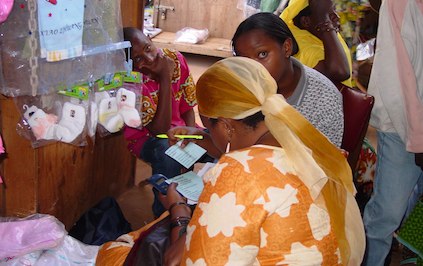
In August, 2011, I visited several health clinics in Kenya to determine the feasibility of using digital pen technology to enhance paper health forms. This photo was taken in a rural clinic in Mangalete. The woman using the digital pen is filling out a partograph – a paper tool used to monitor and detect prolonged or abnormal labors. She simply picked up the pen and started showing me how to properly fill out the form. When the pen’s audio suddenly informed her that she had crossed the alert line and should consider transferring the patient, her surprise and immediate understanding of the quality assurance and training benefits of this tool were incredibly gratifying. This interaction highlighted one of my core beliefs about ICT4D: big problems can often be addressed with simple solutions.
If you’re interested in taking part there’s still time. I’ll need the following:
1. A photo (high resolution if possible) – one you’ve taken, please. All it needs to qualify is to have a technology theme – radio, mobile phone, computer, solar lamp and so on. 2. Details of where it was taken and the year (if you remember). 3. A short description of what it is, and why it means something to you. Keep it short – think back of a postcard! We want personal stories – how you connect with the picture – not just a description of what it is. 4. A link to your website, blog or Twitter handle (or all three) so I can point people back to you and your work.


 It’s light, relatively rugged, and mobile
 The answer to the second question is a little easier to answer than the first. As Walter Isaacson pointed out in his recent