Keeping up the heat on climate change

As part of this years International Day of Climate Action on October 24th, 350.org – with support from Tactical Technology Collective – are planning a new and innovative text messaging campaign designed to mobilise citizens around the world

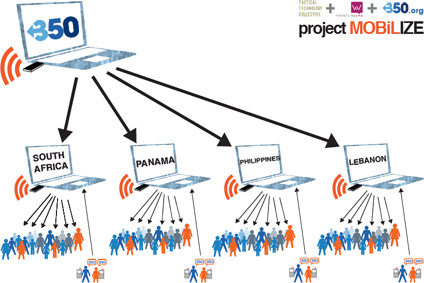
“Project MOBiLIZE” will use decentralised, country-specific FrontlineSMS servers to deliver targeted messaging blasts to 350.org supporters in over twenty countries. The project will also collect SMS reports after the October 24th main event and deliver them to world leaders via Twitter, web and projection at the UN Climate Talks due to take place in Copenhagen in December.
"Project MOBiLIZE"

This is how it works. To start things off, the 350.org central server sends out an SMS to each of the country nodes, taking into account timing, language and message. Cost is minimal – just 20 international messages, one per node. Once the message is received, the country nodes automatically blast it out to lists of in-country mobile numbers, sourced from 350.org and local partner organisations. Costs are approximately 5 cents per SMS. Cascading SMS this way reduces costs considerably, and allows better local control.

Country nodes can also collect new mobile numbers through the FrontlineSMS servers, using SMS keywords and by publicising country-specific phone numbers on the web and at events.

This is the first time FrontlineSMS has been used to ‘cascade’ messages to and from the local level through a chain of servers. It could also be a first for any grassroots global SMS campaign, and if it works could present an exciting new model for others to follow. Not only is the system cheaper to run but it presents the potential for considerably wider reach, and thanks to some neat work by Bobby – the brains behind it – the pre-configured software can be quickly adopted in any country.

If you are interested in taking part in this ground-breaking campaign, either as an in-country node or in any other capacity, post a comment here, check out Bobby’s post on the FrontlineSMS Community pages

NEWS UPDATE

The 350.org website has a post about the project
Tactical Tech also have a post here

ACCESS POINTS

New numbers are being added all the time. Here are the various local access points as at 12th October:

USA – 30644
Australia – 0411694094
Maldives – 9900350
Macedonia – 077594209
Philippines – 09088770350
Hong Kong – 85262757489
Panama – Coming Soon!
New Zealand – 0226070672
Israel Coming – Soon!
Malaysia – 0163050973
Cambodia – 081666120
Sweden – 0733185314
Germany – Coming Soon!
India – Coming Soon!
Lebanon – Coming Soon!

SMS registration for Maker Faire Africa

Attendees of next month’s Maker Faire Africa will be able to register their attendance by text message, thanks to a clever hack by  Henry Barnor and Henry Addo, two Ghanaian developers.

Maker Faire AfricaIn the true spirit of Maker Faire, the two Henry’s have built the system using a phone with a Zain SIM card connected to a laptop running FrontlineSMS. When the software receives an SMS it sends the data via HTTP to a python web application running on Google’s App Engine infrastructure, where it’s processed and a registration code sent out to the originating handset. It’s another great use of the software and kudos goes out to the guys behind it. You can read their full post here.

Maker Faire Africa (MFA), a celebration of African ingenuity, innovation and invention, will take place between August 14th and 16th at the Ghana-India Kofi Annan Centre of Excellence in ICT in Ghana’s capital, Accra. Wish I could be there.  🙁

Grameen’s AppLab comes of age

Today is a very exciting day for many colleagues in Uganda, a day which sees the launch of a suite of new services from Grameen’s AppLab project. I was fortunate enough to be involved in the very early stages of the initiative, spending a month on the ground studying a mixture of geography, culture, challenges, data availability and technologies in and around Kampala (and occasionally beyond).

One of the best times to be involved in something like this is at the very beginning – the time when everything is on the table, nothing is ruled out and there’s no such thing as a bad idea. Over the course of the month we came out with around fifty ideas for mobile services, based on our research of the Ugandan landscape, and the kinds of issues, gaps and concerns which potentially lend themselves to a mobile solution.

A large part of the fun is without doubt this multi-faceted research – understanding the landscape from multiple perspectives and sources. TV, radio, conversations with taxi drivers (who, regardless of where they drive seem to have answers to all the world’s problems), newspapers, villagers, village phone operators, waiters, children and eavesdropping conversations in bars, all of which helps build a picture of what matters to people and what doesn’t.

Vision, Uganda
Image: Understanding local and national issues is an essential starting point in the mobile applications development process

Although it’s vital to start with the need, figuring out how to meet it becomes the next big challenge. Rural communities aren’t just passive recipients of information, but content generators in their own right. Communities are rich with knowledge, but more often than not this knowledge – not to mention more official sources of information – are rarely stored in anything resembling digital-friendly. Finding out who has the information you need, who owns it, how often it gets updated and how it’s stored are all part of the ongoing puzzle.

One of the most interesting and exciting phases of the AppLab work was the rapid protoyping – getting out into the field (or the matatu [bus] stations, to be precise) and offering people the opportunity to text in agriculture- or health-based questions. Any questions. What seemed to them like a smart, fully-automated system was in fact a handful of health and agriculture students sitting at computers in the MTN/AppLab offices, manually reading incoming questions and formulating 160-character answers. Suffice to say, the data gathered over a few days gave the strongest indication yet of the need and perception of such a service to potential users. The value of this kind of work cannot be understated.

Rapid Prototying (Photo: AppLab)
Photo: Students respond to incoming queries using the early version of FrontlineSMS, which was set up to help gather the data

Going back to today’s announcement, out of the original fifty early-stage ideas, AppLab have launched an initial suite of five:

Health Tips
Provides sexual and reproductive health information, paired with Clinic Finder…

Clinic Finder
Helps locate nearby health clinics and their services

Farmer’s Friend
A searchable database with both agricultural advice and targeted weather forecasts

Photo courtesy AppLab

Google Trader
Matches buyers and sellers of agricultural produce and commodities as well as other products (Google explains how it works here)

As part of the initial research, we looked at a whole suite of technologies on which to base solutions, including J2ME, WAP, high-end smart phones, 3G and MMS. As is usually the case, however, SMS won through and all of the services launched today are, according to AppLab,  SMS-based and:

designed to work with basic mobile phones to reach the broadest possible audience. Users can access the services quickly and privately at the time of their choosing and search relevant content on-demand, like someone with access to the Internet

A lot of work continues to go into AppLab’s work in Uganda, and today hopefully marks the beginning of many new announcements (believe me, many other exciting initiatives are already in pilot stage). By working through existing structures in the country (principally MTN and the Grameen Village Phone network, not to forget Google’s growing influence), AppLab is well-placed to identify, build and deliver appropriate, relevant mobile-related services to local communities, and my congratulations go out to David, Eric and everyone who has worked so hard on the project over the past two years.

For a little more indepth analysis on today’s announcement, check out White African’s excellent blog post and the short Grameen video below. The official Press Release is available here.

Mobile meets plough in Cambodia

In this, the tenth in our series of FrontlineSMS guest posts, Dr. Robert Fitzgerald – Associate Dean of Research at the University of Canberra in Australia – explains their use of the software to provide agricultural data to farmers in Cambodia, and their plans to expand the service over the coming months

Background

“For the last three years I have been working with my colleague, John Spriggs, on agricultural development projects in Cambodia. John is an agricultural economist who has over the last few years been applying participatory action research methods to improving agricultural marketing systems in developing countries (Cambodia and Papua New Guinea). My background is in technology and education with an interest in the application of robust technologies to help users communicate and work together.

Originally, John invited me to join him on his project to explore ways we could use communications technologies to the improve the marketing system for maize and soy bean farmers in western Cambodia. From our early workshops in Battambang, Cambodia, we identified poor communications as one of the key constraints to improving the marketing system. At that time I had been developing an interest in mobile communications, particularly the application of SMS, and was following closely the work of the Pinoy Internet Farmers project.

Early workshop in 2006 with traders and farmers, Battambang, Cambodia (photo: Rob Fitzgerald)

Following an initial workshop we presented a proposal to the Australian Centre for International Agricultural Research (ACIAR) for a year’s extension to John’s project to develop the Electronic Marketing Communication System (EMCS). During that project we used a propriety system, Infotxt (developed in the Philippines) to run an SMS server from the Price Division of the Ministry of Commerce (MOC) in Phnom Penh. A price officer collected price data each week and used this to update the server.

The trial was very successful and the information on demand system allowed a user to text specific keywords and that would return price information. We conducted a number of training sessions in 2007 and later that year the Cambodian People’s Party endorsed the EMCS as a significant agricultural innovation in Cambodia.

During 2007 we worked closely with Pieter Ypma from CAMIS and for a number of months they used our EMCS system to SMS-enable their web-based price database. In early 2008 our project concluded and we handed the server across to the MOC.

A new project begins

In April 2008 we started a new project which focused on production and marketing problems faced by poor smallholder farmers in northwestern Cambodia. While still a comparatively fertile area, over the last ten years crop yields have been declining and soils are being degraded by excessive cultivation and burning. Much of the crop development has been largely driven by market demand in Thailand, however local farmers are disadvantaged by lack of market information, and inadequate post-harvest technology and transport infrastructure.

The overarching aim of the project is to improve the functioning of the production–marketing system for maize and soybean in north-western Cambodia as a key to increasing cash income, sustainable growth and poverty reduction for smallholder farmers. We have established eight village clusters, four in the district of Samlaut (a protected area containing the last remnants of tropical rainforest in Cambodia) and four in the municipality of Pailin (a previously heavily forested area known for its gem mining).

Local farmers at recent field day in Pailin (Photo: Rob Fitzgerald)

Farmer workshops have been investigating key socio-economic issues related to adoption of the improved crop technologies and improving land use. Village level workshops have worked on gross margin and partial budgets to examine return on investments for various production technologies and discussed access to marketing information.

FrontlineSMS

Building on the previous project we wanted to extend our SMS work to both the production and marketing system. After a number of months of evaluation we selected FrontlineSMS as the platform for our SMS work (previously covered on kiwanja’s blog here).

In February 2009 we set up two FrontlineSMS servers. The first was with the newly formed Northwest Agricultural Marketing Association (NAMA) in Pailin which had particular focus on the provision of information (rated top priority by members) and the exchange and sharing of silo association price and market information. A second server was installed with the Maddox Jolie Pitt Foundation (MJP) in Battambang with particular emphasis on basic market information and health alerts. Check out the Pitt-Jolie press release here.

In June 2009 we further refined the systems and NAMA is focusing on using FrontlineSMS to broadcast messages to members, to provide maize, soy bean and cassava price information, and to distribute seed and fertiliser (input) costs.

NAMA FrontlineSMS server: Robert Fitzgerald with Moul Sam who runs the server (Photo: Rob Fitzgerald)

MJP has developed three main knowledge areas/teams for its FrontlineSMS server:

  • Health – Health alerts and health-related information, and health communications (e.g. clinic reminders for pregnant women)
  • Farmer – Price information, buyer contacts, weather information and farmer communications (e.g. meeting reminders)
  • MJP Head Office Field Communication System – A field communication system to provide field worker contact and updates, emergency/disaster protocols via SMS, meeting reminders, etc.

Future SMS applications

While our SMS servers are still in the early days of use we are exploring other SMS-based information systems such as GeoChat from InSTEDD and mhits– an innovative SMS-based micro-payment system developed in Australia by Harold Dimpel.

Volunteer and Intern opportunities

In recent conversations with both MJP and InSTEDD we have been exploring the possibility of establishing intern programs to encourage volunteers work with us. Some good work is already underway by volunteers. Oum Vatharith from Phnom Penh is already working on a Khmer translation of FrontlineSMS and I have talked to him recently about the development of FrontlineSMS user manual in Khmer.

We will be looking for volunteers in the form of software developers and IT savvy community/education development folk who are interested in working with these leading NGOs to help ensure that we realise the potential of technology to make a difference to peoples lives. If you are interested in helping out, please leave a comment!

Thank you.”

Rob Fitzgerald
Associate Dean of Research, Faculty of Education
University of Canberra
www.mathetic.info