
Is the future of social mobile an empowered few, or an empowered many? Mobile tools in the hands of the masses presents great opportunity for NGO-led social change, but is that the future we’re creating?
In “The White Man’s Burden – Why the West’s Efforts to Aid the Rest Have Done So Much Ill and So Little Good”, William Easterly’s frustration at large-scale, top-down, bureaucracy-ridden development projects runs to an impressive 384 pages. While Easterly dedicates most of his book to markets, economics and the mechanics of international development itself, he talks little of information and communication technology (ICT). The index carries no reference to ‘computers’, ‘ICT’ or even plain old ‘technology’.
But there is an entry for ‘cell phones’.
 E. F. Schumacher, a fellow economist and the man widely recognized as the father of the appropriate technology movement, spent a little more time in his books studying technology issues. His seminal 1973 book – “Small is Beautiful – The Study of Economics as if People Mattered” – reacted to the imposition of alien development concepts on Third World countries, and he warned early of the dangers and difficulties of advocating the same technological practices in entirely different societies and environments. Although his earlier work focused more on agri-technology and large-scale infrastructure projects (dam building was a favorite ‘intervention’ at the time), his theories could easily have been applied to ICTs – as they were in later years.
Things have come a long way since 1973. For a start, many of us now have mobile phones, the most rapidly adopted technology in history. In what amounts to little more than the blink of an eye, mobiles have given us a glimpse of their potential to help us solve some of the most pressing problems of our time. With evidence mounting, I have one question: If mobiles truly are as revolutionary and empowering as they appear to be – particularly in the lives of some of the poorest members of society – then do we have a moral duty, in the ICT for Development (ICT4D) community at least, to see that they fulfill that potential?
You see, I’m a little worried. If we draw parallels between the concerns of Easterly and Schumacher and apply them to the application of mobile phones as a tool for social and economic development, there’s a danger that the development community may end up repeating the same mistakes of the past. We have a golden opportunity here that we can’t afford to miss.
But miss it we may. Since 2003 I’ve been working exclusively in the mobile space, and I’ve come to my own conclusions about where we need to be focusing more of our attention if we’re to take advantage of the opportunity ahead of us. Don’t get me wrong – we do need to be looking at the bigger picture – but there’s not room at the top for all of us. I, for one, am more than happy to be working at the bottom. Not only do I find grassroots NGOs particularly lean and efficient (often with the scarcest of funding and resources), but they also tend to get less bogged down with procedure, politics and egos, and are often able to react far more quickly to changing environments than their larger counterparts. Being local, they also tend to have much greater context for their environments, and in activism terms they’re more likely to be able to operate under the radar of dictatorial regimes, meaning they can often engage a local and national populace in ways where larger organizations might struggle.
So, waving my grassroots NGO flag, I see a central problem of focus in the mobile applications space. Let me explain. If we take the “Long Tail ” concept first talked about by Chris Anderson and apply it to the mobile space, we get something like this. I call it “Social Mobile’s Long Tail”.
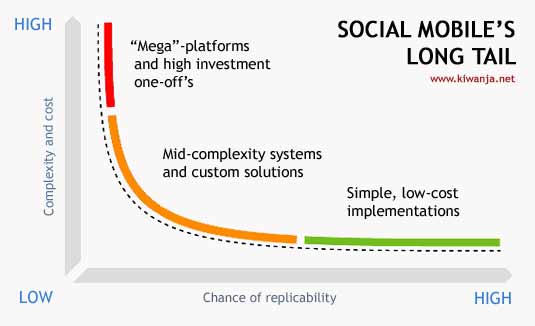
What it demonstrates is that our tendency to aim for sexy, large-scale, top-down, capital- and time-intensive mobile solutions simply results in the creation of tools which only the larger, more resource-rich NGOs are able to adopt and afford. Having worked with grassroots NGOs for over 15 years, I strongly believe that we need to seriously refocus some of our attention there to avoid developing our own NGO “digital divide”. To do this we need to think about low-end, simple, appropriate mobile technology solutions which are easy to obtain, affordable, require as little technical expertise as possible, and are easy to copy and replicate. This is something I regularly write about, and it’s a challenge I’m more than happy to throw down to the developer community.
Another key problem that we have emerges as a symptom of the first. Because larger international development agencies, by their very nature, tend to pre-occupy themselves with the bigger issues, they often inadvertently neglect the simple, easier-to-fix problems (the “low hanging fruit” as some people like to call it). The Millennium Development Goals (MDG’s) are good examples of the kinds of targets which are far easier to miss than hit.
In mobile terms, using the technology to enhance basic communications is a classic “low hanging fruit”. After all, that’s what mobile phones do, and communication is fundamental to all NGO activities, particularly those working in the kinds of infrastructure-challenged environments often found in the developing world. Despite this, there are few tools available that take advantage of one of the most prolific mobile communication channels available to grassroots NGOs – the text message (or SMS).
Much of my own work with FrontlineSMS has sought to solve this fundamental problem, and in places such as Malawi – where Josh Nesbit, FrontlineSMS, a laptop and one hundred recycled mobile phones has helped revolutionise healthcare delivery to 250,000 rural Malawians – the benefits are loud and clear. In other countries, where activities of international aid organizations may be challenged or restricted by oppressive, dictatorial regimes, grassroots NGOs often manage to maintain operations and often provide the only voice for the people. In Zimbabwe, Kubatana.net have been using FrontlineSMS extensively to engage a population not only starved of jobs, a meaningful currency and a functioning democracy, but also news and information. In Afghanistan, an international NGO is using FrontlineSMS to provide security alerts to their staff and fieldworkers. The software is seen as a crucial tool in helping keep people safe in one of the world’s most volatile environments. With a little will, what can be done in Zimbabwe and Afghanistan can be done anywhere where similar oppression exists.

In cases such as these – and there are many more – we need to stop simply talking about “what works” and start to get “what works” into the hands of the NGOs that need it the most. That’s a challenge that I’m happy to throw down to the ICT4D community. There’s only a certain amount of talking and critiquing we can, and should, do.
There are, of course, many issues and challenges – some technical, some cultural, others economic and geographical. The good news is that few are insurmountable, and we can remove many of them by simply empowering the very people we’re seeking to help. The emergence of home grown developer communities in an increasing number of African countries, for example, presents the greatest opportunity yet to unlock the social change potential of mobile technology. Small-scale, realistic, achievable, replicable, bottom-up development such as that championed by the likes of Easterly and Schumacher may hardly be revolutionary, but what would be is our acknowledgement of the mistakes of the past, and a co-ordinated effort to help us avoid making them all over again.
I spent the best part of my university years critiquing the efforts of those who went before me. Countless others have done the same. Looking to the future, how favourably will the students and academics of tomorrow reflect on our efforts? If the next thirty years aren’t to read like the last then we need to re-think our approach, and re-think it now.


 About a year ago I was asked to give an
  The decision to build a platform – and not a specific solution to a specific problem – has turned out to be one of the key strengths of the software. The new functionality we’ve added to the latest version takes this one step further allowing, for example,