
The following interview – “Solving eco challenges with grassroots messaging” – was given to the National Geographic website last autumn. It’s republished here after it turned out to be one of the most comprehensive to date – covering everything from the role of anthropology in mobiles-for-development, the environmental impact of mobile phones and the thinking behind FrontlineSMS. If you’re after a general overview of kiwanja’s work and work ethic, this is the best place to start.
“National Geographic Emerging Explorer Ken Banks is an anthropologist, conservationist, and mobile technology innovator who built a communications platform to empower grassroots organizations throughout the developing world. FrontlineSMS solves critical communication problems by enabling cell phone users to exchange mass message information without access to the internet – or even constant electricity.
His kiwanja.net organization strives to provide nonprofits around the globe with the mobile technology tools to enact meaningful change.
Ken Banks Interviewed by Brian Handwerk
How are anthropologists exploring the enormous impacts of technology in the developing world?
Today, with markets saturated in the ‘developed world’ – if we can call it that – manufacturers are increasingly turning their attention to the two billion or so consumers left on the planet who don’t yet own a phone. Many of these people sit at the “bottom of the pyramid” (BOP) as economists like to call it, and many have very different needs from a mobile phone.
Manufacturers looking to build devices for the BOP need to very carefully consider price, which is often a crucial factor for someone with very limited disposable income. They might also need to consider literacy levels, or technical ability, perhaps re-working the user interface on the phone to make it easier to use.
They might also need to consider building phones which can take multiple SIM cards, since many people in the developing world regularly switch between different networks before making calls to take advantage of special deals. And they might need to think about providing security and privacy features on the phone which allows it to be shared between family members, something else which is very common in developing countries.
Understanding what these users might need or want from a phone needs time in the field, and researchers need to immerse themselves in the consumer, their lives and their phone usage patterns. Often it’s simply a case of patient, participant observation rather than just going in asking a bunch of questions, and anthropologists are particularly well suited to this kind of work.
You’ve written about the environmental impact of four billion phones in “The Mobile Revolution’s Hidden Cost“. On the positive side, how can mobile technology help us find solutions to the world’s eco problems or help make our use of the world more sustainable?
Interestingly enough I started out my career in mobile working for a conservation organization -Fauna & Flora International – back in 2003. A couple of far-sighted individuals there were beginning to ask these very questions.
Mobile technology is proving increasingly useful to conservationists and environmentalists around the world. In addition to bringing down the cost of traditionally expensive animal tracking initiatives (which relied largely on satellite technology), mobile phones are also being used to provide alerts to communities living on the edges of national parks, helping mitigate against human/wildlife conflict. Phones and PDAs can be used in the field as data collection tools, replacing note pads and allowing teams of researchers to gather and share data simultaneously. Photos can be taken of incidences of poaching and transmitted to the Internet, or evidence of chemical or oil spills recorded with a specific location and then uploaded to a map.
On the consumer side of things, people can now check their carbon footprint or monitor their energy use via their mobile phone, or verify that products in shops are being produced sustainably. People can even look up details of a fish they’re about to order in a restaurant and check its conservation status. A project I worked on some years ago, called wildlive!, was designed to try to connect people with conservation projects through their phones, and provided images, animal sounds, conservation-themed games, and live news and field diaries to subscribers.
In short, mobile phones can have a positive impact both in the field in the hands of people doing the conservation work, or in the hands of the general public interested in keeping up-to-date and informed on environmental issues. But there’s a lot more we can do with the increasing numbers of always-on, always-connected mobile devices people are carrying around with them today.
What led to the birth of FrontlineSMS?
FrontlineSMS, which takes up the bulk of my time these days, was the first independent kiwanja.net initiative, and its roots are in conservation, funnily enough. I was working in Bushbuckridge, an area which straddles Kruger National Park in South Africa, helping with a Fauna & Flora International project.
One element of the Kruger work was to try and identify a system which South African National Parks (SANParks) could use to send text messages to Bushbuckridge community members. The authorities wanted to re-engage people into the conservation effort, keep them updated on park matters, ask their opinions on decisions which would impact them, arrange meetings, send wildlife alerts, and so on. Part of my role was to identify a system they could use to do this. After a considerable search, though, I could only find mass messaging tools which worked off the Internet. Back in 2004, it wasn’t possible to just jump on the Internet around Kruger National Park, so all of these solutions proved totally inappropriate.

Photo of women queuing for water in Bushbuckridge. By Ken Banks
It wasn’t until a year later that the idea of creating a mass messaging system which ran off a laptop computer and attached mobile phone came to me. By sending and receiving the messages through the phone, the need for the Internet was removed. It really is very simple, but at the time nothing like this existed. I had a hunch that there were likely many organizations out there that wanted to send messages to people in places where there was no Internet, so I raised a small amount of money and bought a laptop, some manuals, some phones and modems and cables, and spent five weeks over the summer of 2005 writing a prototype of FrontlineSMS on a kitchen table in Finland. I built a website for it, and in October that year released it to the world. What’s happened since has been pretty amazing.
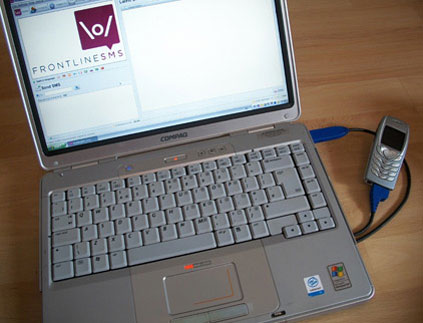
Photo of a typical FrontlineSMS set-up. By Ken Banks
You had thoughts about how people might use FrontlineSMS, but it’s designed as a tool for people to create their own applications. What cool things have people done that really surprised you?
When you consider its conservation roots, the number of different areas where NGOs have applied the software has been staggering.
In Aceh, UNDP and Mercy Corps have used FrontlineSMS to send market prices and other agricultural data to smallholder rural coffee farmers. In Iraq it is being used by the country’s first independent news agency – Aswat al Iraq – to disseminate news to eight countries, and in Afghanistan it is helping keep NGO fieldworkers safe through the distribution of security alerts. In Zimbabwe, the software has been used extensively by a number of human rights organizations including Kubatana.net, and in Nigeria and the Philippines it helped monitor national elections. In Malawi, FrontlineSMS has generated considerable interest in the m-health sector where a project started by Josh Nesbit, a Stanford University student, is helping run a rural healthcare network for 250,000 people. That project has since become an organization of its own, FrontlineSMS:Medic.
FrontlineSMS was used by bloggers in Pakistan during the recent state of emergency to get news safely out of the country, and in the recent Azerbaijani elections it helped mobilize the youth vote. It is being used in Kenya to report breakages in fences caused by elephants, and is now running the Overseas Filipino Workers (OFW-SOS) emergency help line, allowing workers to receive immediate assistance in case of personal emergency. It has also been deployed in the DRC as part of the Ushahidi platform to collect violence reports via SMS, and been used by Grameen Technology Centre in Uganda to communicate with the Village Phone network. Projects in Cambodia and El Salvador have used it to help create transparency in agricultural markets, and Survivors Connect is using it in a number of countries to run anti-trafficking reporting systems among vulnerable communities.
All of this activity is user-driven and user-dictated. FrontlineSMS provides the tools necessary for people to create their own projects that make a difference. It empowers innovators and organizers in the developing world to achieve their full potential through their own ingenuity.
Why the focus on small grassroots organizations? They lack funds, staff, and technology, but what are their advantages?
The majority of my early conservation and development work, going back to 1993, was with small, local NGOs. It became very clear to me that many were punching well above their weight in terms of how much they delivered versus the resources and funding they had. At the same time, much of this work was going largely unnoticed. Why, for example, would you ever get to hear about some community project in Zambia working to empower women?
For the past 17 years, I’ve lived and worked in many African countries, and remain focused on the grassroots side of things to this day. It’s a place where much of the latest high-tech gadgetry we develop and promote has little chance of working due to a lack of the Internet, funding, technical expertise, and so on.
If you asked me to describe them in general terms, I’d say most grassroots organizations are generally small, extremely dedicated, run low-cost high-impact interventions, work on local issues with relatively modest numbers of local people, and are staffed by community members who have first-hand experience of the problems they’re trying to solve. What they lack in tools, resources, and funds they more than make up with a deep understanding of the local landscape – not just geographically, but also the language, culture, and daily challenges of the people. This is crucially important and is something often overlooked.
Is your ultimate vision one of providing the tools to let one person make a positive change in his or her own corner of the world?
Absolutely. We need to build tools which allow anyone with a passion to see it out, to promote it and share it and make a success of it. Let’s not forget, global environmental and social issues aren’t just the concern of large (or small) non-profits or activist groups – we’re all concerned about them. If someone watches a National Geographic program in their bedroom on seal hunting and feels compelled to campaign against it, for example, they should have access to all the tools necessary to campaign and help put a stop to it. For that, we need to make media tools easy to use, accessible, low-cost, and so on.
When we talk about sustainability, we need to also think about human sustainability. If we’re to have any chance of ongoing success with some of the more pressing problems of our time, then we need to attract the brightest young minds to the field and give them all the support they need to keep them there. Empowerment isn’t just something we do in a distant land. There’s plenty we can be doing on our own doorstep. It’s a different kind of empowerment, but that doesn’t make it less valuable.”
Further information
Watch a 15 minute video of a presentation made at National Geographic in Washington DC (June 2010)

 “Over the next few months we will delve into the human stories behind the growth of mobile technology in the developing world. We’ll take a closer look at the background and thinking behind FrontlineSMS, and hear from a number of users applying it to very real social and environmental problems in their communities. We will also hear thoughts and insights from other key mobile innovators in the field, from anthropologists to technologists to local innovators.”

