Primates and people: Understanding local needs

Driven by a curiosity and a strong interest in primate conservation, late one night back in December 2001 I arrived in Nigeria to take up my post as Project Manager at a sanctuary in Calabar, Cross River State. The year I spent there – starting exactly ten years ago this month – turned out to be fascinating and frustrating in equal measure. Crucially, combined with my previous experiences working on the continent, it also helped shape my understanding of the needs of local people and local NGOs, a focus which remains a central pillar of my wider technology work today.

Chimp rescue, Lagos 2001

I wasn’t the only arrival that December day. A small baby chimpanzee had been confiscated (pictured) from a local market and was waiting to be collected from Lekki, a conservation and education centre in Lagos run by the Nigerian Conservation Foundation. Primate rescue was to be a theme of my time in Nigeria, as was a sense that a large part of the ‘conservation effort’ was really damage limitation and control. Rehabilitating orphaned primates was often the easier part – even though it was hugely challenging and distressing. Changing perceptions, overcoming local politics and trying to shift cultural mindsets turns out to be much harder. Not only that, it takes considerably longer, time that increasing numbers of species simply don’t have.

Primate conservation, bush meat hunting and deforestation are all inextricably linked. Tackling one without trying to address the others simply doesn’t work. In its simplest form, the whole thing goes something like this.

Loggers enter the forest and either blanket cut or selectively cut trees. To help get the logs out, paths and roads are opened up into areas which were previously difficult or impossible to access. Loggers need to eat, and many actively hunt for bush meat while working in the forest. Local hunters join in. As more trees are cut and more roads laid, hunters are able to penetrate deeper into the forest, reducing wildlife populations – primates included – yet further

If I were to summarise what I learnt about these complex issues from my time in southern Nigeria, I would break it down into the following categories.

The practical

Logging

Although large-scale logging is a significant problem – often carried out by larger (almost always foreign) companies – many poor local people are ‘recruited’ to help in the destruction. Equipped with chainsaws supplied by their employers, they enter community forests and national parks and selectively cut high-worth trees. Roads and paths are cut to remove the logs, which are sometimes cut into large planks before being shipped off. Forestry officials, many of whom haven’t been paid for months, stamp the trees as coming from a legitimate source. I will never forget the haunting sound of distant chainsaws as I walked through those forests.

The cultural
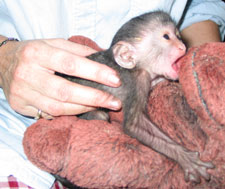
orphanSpeaking with the locals in Calabar, many find it inconceivable that people would ever eat primates. In many communities it’s simply taboo, but sadly the same can’t be said for killing them. As outsiders come in search of work, and as main roads open up alongside the fringes of rainforest, hunters from these communities will go in, track down wildlife – primates included – and sell them at the side of the the road. Bush meat is in great demand, and it’s a brisk trade. If a mother is killed then the infant will be sold as a pet – a double bounty for the hunter. Some of these orphans are incredibly young, and barely alive if they are lucky enough to be rescued, as this picture distressingly shows.

The perception

The many Nigerians I met believed that bush meat was much better for you than ‘farmed’ meat, and given the choice they’d rather eat something from the forest than a farm. This is a major challenge for conservation groups trying to ween people off bush meat and more towards livestock of various descriptions. As a case in point, some Nigerians living in London appear to be willing to pay significant amounts of money for illegally imported bush meat, despite the availability of almost any other kind of meat from legal, local sources such as London supermarkets (see this interesting story reported by the International Primate Protection League).

The response

Conservation groups on the ground spend huge amounts of time on education and alternative livelihoods and farming programmes. In the 1990’s there was considerable focus on the potential for “grasscutters” – a widely-distributed cane rat found in West and Central Africa – and how farming and breeding these could help reduce or replace reliance on bush meat for protein. I’m not sure how many of these projects were successful, although some research has been carried out and there has been some success by individuals in Ghana. From my own observations, keeping livestock of any kind (other than chickens or turkeys, which need little looking after) turned out to be a foreign concept to many people, and efforts to promote it largely failed.

The reality

Dead guenonSpeak with the hunters in almost any rural community and there is almost universal recognition that the wildlife is on the decline. Many fondly speak of overnight hunting expeditions with their fathers, and how they’d return the next morning with a healthy ‘catch’. Evidence of distant permanent overnight camps highlight today’s reality – longer trips, days in length, but ones which still don’t guarantee a single kill. Urban dwellers rarely see this reality. Ask them about conservation and wildlife, and their reaction is one of “the monkeys will never finish” (Nigerians often use the term “finish” to describe extinction). Nigerians clearly have much to learn from each other.

It would have been great to have ended my time in Nigeria with a solution to some of these problems, and even better to be able to outline a few of them in this post. But I didn’t, and I don’t.

What I can contribute, though, is this…

Things you can do

Firstly, take a little time to try and understand the problems – plural. It frustrates me to read blanket condemnation in the western media of local people in African countries cutting down forests and daring to kill cute chimpanzees. Yes, it’s sad and its destructive. I’ve seen at first hand the pain and distress of an orphaned primate who’s had to have an arm broken to release its grip on its dead mother, or the look in the eyes of exhausted villagers struggling to put a decent meal on the table for their children. The problems are complex, but they’re human and animal.

Secondly, join a local organisation working with local communities on the ground. If you’re interested in African primates in particular, a good place to start out is the Pan African Sanctuary Alliance (PASA), an organisation committed to the conservation and care of African primates through the support of in-situ sanctuaries.

Thirdly, if you’re the volunteering kind, check out the University of Wisconsin’s Primate Info Net, but bear in mind that volunteering is really only productive if the local organisation can’t find, or afford, a local version of you among the communities in which they work. If that’s the case, be sure you have a transferrable skill so you can train a local person to replace you when you leave. Sustainability isn’t always financial – it also has a human element to it, too.

Fourthly, find out about alternative conservation/human strategies such as direct conservation payments – different models do exist. Just as primate species are different, conservation strategies also need to be. One size rarely fits all, and this is true whether you’re an elephant, a forest, a primate or a local villager.

Finally, stay positive. Problems are many and working solutions are few. Something good will happen if enough people commit to conservation in Africa. Many people already have.

Appropriate technology: Lessons from nature

“Our life is half natural and half technological. Half-and-half is good. You cannot deny that high-tech is progress. We need it for jobs. Yet if you make only high-tech, you make war. So we must have a strong human element to keep modesty and natural life”

Nam June Paik, Artist (1932 – 2006)

There’s a saying in the technology world which asks “What would Google do?”. When I’m confronted with a problem, I’d rather ask “What would nature do?”. Why? Well, if you believe Google have the answer then you’re immediately assuming that modern technology – in some shape or form – is the solution. More often than not that’s the wrong place to start.

I recently sat on a panel at the Aspen Environment Forum which focused on the use of social media in the environmental movement. (You can watch the video here, or read my summary of whole the event here). Many people had already made their minds up that Facebook, Twitter, YouTube and so on were ‘the’ answer, before really thinking through what they were really trying to do, what their message was, or who the different audiences would be. That’s also the wrong place to start.

Asking what nature might do immediately pulls us away from looking for a modern, high-tech solution and more towards a simpler, low-tech (and potentially more appropriate and sustainable) one. It also encourages us to think entirely out-of-the-box.

So, if you were to ask “What might nature do?”, what kind of solutions might you come up with which you otherwise might not have?

1. Elephants

Some of my earliest mobile work back in 2003 was in Southern Africa where I was asked to help understand and apply modern communications technology to local conservation efforts. One of the bigger problems people were trying to tackle back then was human-elephant conflict – elephants ‘encroaching’ on farmland and destroying livelihoods literally overnight. In response, some farmers resorted to poisoning or shooting elephants. Not a good conservation outcome.

All kinds of modern technology solutions were proposed, and many trialled, to try and solve the problem. Electric fences, RFID tagging, sensors and live-GSM-tracking among them. Few proved as successful as hoped, or particularly replicable or affordable.

So, what might nature do?

It turns out that elephants run a mile when they encounter bees. According to this BBC article, early research in Kenya indicates hives can be a very effective barrier, so much so that 97% of attempted elephant raids were aborted. Where satellites, RFID tags and mobile phones failed, humble honey bees might just be the answer.

2. Pigeons

Each summer, as tennis players battle it out on the lawn courts at Wimbledon, the authorities do battle trying to stop pigeons interfering with play. All manner of modern technology is available to deter birds – lasers and radio controlled aircraft to gas guns and ultrasound emitters. Again, each have varying degrees of success and many can be expensive.

What would nature do?

Wimbledon’s answer doesn’t involve anything more high-tech than a bird of prey. A few laps by Rufus around the tennis courts are enough to scare the hardiest of pigeons away. No batteries – or lasers, or sound emitters – required. Simple, sustainable and replicable.

3. Wasps

You’d be forgiven for thinking that the grandly-named “Waspinator” was a little black box with wires, buttons and flashing lights. No doubt there have been attempts to develop high-tech wasp deterrents in the past, but the Waspinator isn’t one of them. In fact, if you saw one you’d likely be a little disappointed. This particular solution looks like nothing more than a brown paper bag. But don’t be fooled – nature has very much influenced its development.

According to the website:

The Waspinator is a fake wasps nest. Wasps are very territorial and will aggressively defend their nest against wasps from another colony. When a foraging wasp sees another wasps nest it will rapidly leave the area for fear of being attacked by the nest’s defenders.

Wasps have a very long range of vision and when they see a Waspinator they think it’s an enemy wasps nest and quickly leave the area for somewhere safer, leaving the area around the Waspinator completely free of wasps

It couldn’t be simpler. And no moving parts (if you exclude the wasps).

So, drawing on these examples, what five lessons does nature teach us?

1. Understand the context of your target audience/user.
2. Use locally available materials wherever possible.
3. Low-tech is not poor-tech.
4. Keep it simple.
5. The answer is likely already out there.

Next time we look to develop a technology solution to a problem, we might be best asking what nature might do before turning to the likes of Google, or any high-tech solution provider for that matter. Mother Nature usually knows best.

The Environmental Network

Date: Thursday 2nd June, 2011
Venue: Aspen Environment Forum, Aspen, Colorado
Chair: Ned Breslin
Speakers: Ken Banks, William Powers, Courtney Hight, Charles Porch

The Environmental Network

“Recent social movements in North Africa and the Middle East have shown the power of social media and mobile devices to accelerate change at the grassroots level. What lessons does that experience hold for the environmental movement? Can Facebook and Twitter somehow catalyze an environmental revolution as well – and is it happening already?”

Ken Banks is Founder of kiwanja.net/FrontlineSMS

William Powers is a prize-winning writer and author of the New York Times best-seller “Hamlets BlackBerry: Building a Good Life in the Digital Age”

Courtney Hight is the Co-Director of Energy Action Coalition and Power Shift

Charles Porch heads up Facebook’s efforts to help non-profits utilise the platform

Ned Breslin is CEO of Water for the People

The 2011 Aspen Environment Forum is presented by the Aspen Institute in partnership with National Geographic, and provides a critical framework for committed voices to address a significant milestone:  A global population of 7 billion and how to reconcile Earth’s finite resources with its ability to sustain our expanding human needs.

The Aspen Environment Forum. In tweets.

Last week I was fortunate to attend the three-day Aspen Environment Forum (#AEF2011) in Aspen, Colorado. It gave me the perfect opportunity to “leave the tech behind” and immerse myself in some of the bigger environmental issues and challenges facing the planet today.

The event boasted a fantastic line-up not only of speakers, but also delegates. Some of the smartest people in their field were there to discuss, debate, challenge and collaborate. One of the highlights was getting the chance to meet some of the people who featured heavily in my anthropology dissertation way back in 1999, which looked at the role – or lack of – anthropologists in the creation of national parks.

So, in the spirit of my “Tim Smit. In tweets” post last year, here’s a few highlights of the Forum in 140 character chunks.

Context: Talk of a crowded planet are often over-exaggerated. As this statement demonstrates, in reality it’s more an issue of resources, not a lack of space (even though seven billion is a big number).

Context: It’s not just the scientists and politicians we need to get onside in the climate change debate. There’s a general apathy among the general public, too. Engaging the man and woman on the street emerged as one of the key challenges at the Forum.

Context: Some people are willing to make lifestyle changes when they recognise a problem, but they’ve got to be simple, affordable and as least disruptive to their daily lives as possible.

Context: It’s easy to make demands if you’re never expected to deliver. As the green energy message gets louder, the day of judgement looms.

Context: Switzerland is the first country to pass a law encouraging the use of “living roofs” (also known as “green roofs“) on new buildings. Proven benefits are spiritual and social, as well as environmental.

Context: Dispelling a popular myth that cutting down trees is the only way of unlocking a forest’s value.

Context: Great quote on how we need to think more holistically about the value of our forests.

Context: Over consumption is a bad thing, regardless of what you eat.

Context: Conservation organisations need to start putting people back in nature. Some are – I was fortunate to work at Fauna & Flora International earlier in my career.

Context: One of the bigger surprises for me at the Forum was the increasing importance of urban agriculture. Growing food? In cities?

Context: Farmers don’t just grow food. They have a wider responsibility, something we – and they – need to recognise.

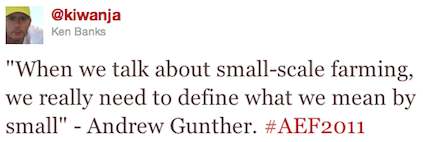
Context: Size is relative. A small farm in the US is not the same as a small farm in East Africa.

Context: If you thought food was expensive now, you’re in for a shock.

Context: Good friend Jerry Glover highlights the folly of littering the soil with fertiliser when most of the action happens much further down. More on Jerry’s work promoting more sustainable agriculture is available here.

Context: Farmers shouldn’t be paid for what governments want them to grow. Consumers – voting with their wallets – should be the ones to tell them.

Context: A sharp reminder that we’re heading down a rocky road with our mono-culture farming practices. Diversity isn’t just king. It’s common sense.

Context: One of the more eye-opening statements of the week. Taking into account the chemicals, machinery, storage, packaging and transport, large “high-tech” American farms aren’t much more productive than their smaller “low-tech” African counterparts.

Context: As Christian Aid once put it, “We believe in life before death”. Ultimately, feeding people should be more about quality than quantity.

Context: Factoring in drinking, cooking, showers, toilet breaks and the amount of water needed to produce the food they eat, average water consumption in America is staggering. Unsustainable on a global level? You bet.

Context: Busting the myth that a clean, tidy environment is something you only aspire to when you’re wealthy.

Context: Poverty – the root cause of much evil.

Context: Only one percent of our oceans are protected in any meaningful way. Amazing.

Context: The challenges may seem unsurmountable, but that’s not an excuse to do nothing.

Context: We need to reframe the renewable energy debate.

Context: If living within our means is a measure of development then we have much to learn from the ‘developing’ world. Let’s not kid ourselves that ‘we’ have all the answers.

More on the Aspen Environment Forum can be found on the Forum website, including videos of many of the Panels. A few photos from outside the Forum are available on my Flickr pages here.