International development: A problem of image, or a problem of substance?

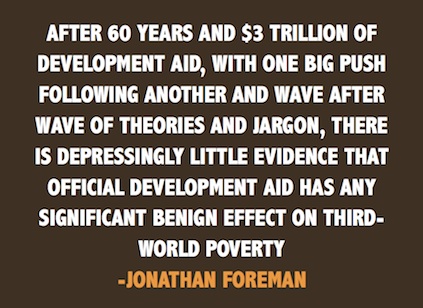
The world has problems. Big problems. They need big answers, ambitious projects and innovative solutions. And that costs money. Lots of it. Three trillion dollars over the past sixty years, if the research is to be believed. Fixing stuff is big business.

With these kinds of resources, what could go wrong? The problem is, many development initiatives have gone wrong, and continue to. Somewhere along the line development has lost it’s way. For many people it is so lost that it’s now become part of the problem.

While donors and other more senior professional development practitioners might disagree, many of the people I know who work in the various guises of ‘development’ admit that – on the whole – it’s not working, that resources are mis-focused, and that the majority of international aid initiatives are not fit for purpose. That’s not to question the motives of those who work to make the world a better place, it’s just that often they choose the wrong vehicle in which to do it. As Bill Easterly says:

The fondness for the Big Goal and the Big Plan is strikingly widespread. It’s part of the second tragedy that so much goodwill and hard work by rich people who care about the poor goes through channels that are ineffective

There’s no shortage of debate, of course. Many academics spend most of their waking hours disecting and analysing the big data on big aid, only to come up with different conclusions. The more practical among us choose to just get on with it, and choose to do it outside the system. Rather than taking jobs in large development structures, we go about it on our own terms. This is the approach featured in my recent book, “The Rise of the Reluctant Innovator“.

There’s no better example of big development than the Millenium Development Goals which, at the time of writing are about 450 days away from ‘maturing’. Progress has been sketchy. Given that it can sometimes take years to collect and analyse the kind of data needed to measure them, it may be some time beyond the 2015 deadline before we know how many were met. And then we’ll never really know whether it was development policies, or simple economic growth, that was responsible. As with most things development, few things are that clear cut. If they’re met it might not be clear who to thank, and if we fail we’ll not know who to blame, either.

That all said, it’s far easier for critics who sit on the sidelines and say how rubbish it all is. It’s much harder coming up with actual answers, and harder still acting on them. I, for one, have always tried to balance my criticism of the technology-for development (ICT4D) sector with suggestions, ideas and thoughts on how we might improve our effectiveness. Just last week I announced my Donors Charter, an attempt to bring some harmony to how technology-for-development projects get funded.

Going by a recent article in the Huffington Post, many donors are becoming increasingly concerned about how aid – and their work – is perceived outside the sector. That concern has lead to the birth of the Narrative Project, whose goal is “to reverse the decline of public support for our work” and to counteract “fatigue” among rank-and-file supporters of these charities, many of whom increasingly view aid as “a good idea, done badly”.

Reading between the lines it might appear that many of the donors involved believe that aid is fundamentally “a good idea, done well” and that the problem is simply one of PR. Let’s hope this isn’t the case. While aid definitely does have a PR problem, there’s also plenty wrong with how it’s executed – and we can only hope that those present at the meetings accept that, and have committed to addressing it, too.

The Narrative Project does include a call for “a co-ordinated development sector”, and donors hold many of the cards (as I argue with the Donors Charter). It also makes the point that independence and self-reliance, i.e. people in the developing world solving their own problems, should be key development objectives. And that people need to believe they can make a difference. None of this is new, but it’s refreshing to see it being discussed at such a high level.

One huge red flag, however, are the parties to the work. The UN Foundation, Bond, The Bill & Melinda Gates Foundation, ONE, Oxfam, Comic Relief and others. All large international players. Let’s hope that somewhere along the way they consulted smaller organisations, local organisations, local innovators, small projects and low-level grantees. We all know what happens when you talk in silos. And this looks like an international donor silo to me.

Like many colleagues and friends, I’ve grown increasingly despondent with the international development sector, and have only managed to stay positive thanks to my early decision to ‘go it alone’. Aid does do good, but it could do so much better if it got it’s house in order. And that’s the frustrating thing for me. In a career spanning 21 years, many of the bigger institutional problems persist, with no-one seemingly having the energy, the influence or the political will to fix any of it.

In my ICT4D world, there are some very simple (and I’d argue, obvious) things, for example.

  1. Focus more on enabling environments – genuine empowerment opportunities for those who own, or who are closest to, the problem.
  2. Seriously get behind, and support, projects that we know are working, or know have the best approach. Stop always looking for the next big thing.
  3. Have at least a few innovators on staff. Don’t head up innovation teams with people who have never built anything.
  4. Adopt best practice, along the lines of the Donors Charter.
  5. Give local innovators a voice.

The world needs a strong international development sector, particularly when it’s called to deliver emergency aid in times of greatest need. But beyond that it needs to work for the people it seeks to help, not in the interests of itself. It needs to be bold, be brave, and do things that might not always be in its best interests.

And it needs an exit strategy. Without one, how is anyone expected to have confidence that they’re doing the right thing, the right way?

Time for a Donor Funding Charter?

Innovation isn’t about green bean bags and whacky idea sessions. It is a long term business development strategy
Lucy Gower

Behind almost every good social entrepreneur you’ll find a donor. These donors come in all shapes and sizes – family members, friends, companies, CSR departments and sponsors are the most typical, increasingly followed by the crowd funders among us. While plenty of great things get funded, pretty crazy stuff does, too. Zack Danger Brown just raised $55,000 on Kickstarter to make a potato salad, for example.

More often than not, the really big bucks come from government and philanthropic foundations. The UK’s Department for International Development will hand out £10.765 billion this financial year, funding all manner of projects that help those in greatest need. The Bill and Melinda Gates Foundation, the biggest private foundation in the world, gave $3.6 billion last year. The world has plenty of problems – big problems – and these budgets reflect that. Donors get to choose which ones they fix, too. The Rockefeller Foundation, for example, currently focuses on resilient cities, digital jobs in Africa, food security, gender equality and universal health coverage, among a few others.

Donors also pay attention to what other donors do, and to what and who they fund. They love, for example, the idea of matched funding where two or more will put in an equal share of funds for a project. It spreads the risk, and gives them all comfort that they’ve not made a silly decision. If the project is good enough for someone else’s money, it’s good enough for theirs. Getting funded by one of the bigger foundations often makes it easier to get money from the others – a sort of shared due diligence, if you like.

Despite all the money and resources – and attempts to apply them to all manner of projects and initiatives – problems remain. During my “Rise of the Reluctant Innovator” book talks, I draw on some of the bigger challenges and failures of international development. Yes, a lot of good work has been done, but I often wonder if we’re getting value for money. Over the past 60 years, we’ve sure spent a huge amount of it.

Plenty of things have been tried, and continue to be tried. Much of the failure is put down to the people and projects (who in turn often blame the target communities), but in many cases responsibility also needs to fall on the people who backed them. Under pressure to support ‘innovative’ (often crazy) ideas, and often under pressure to spend their large budgets, Programme Officers often resort to funding projects they shouldn’t be going anywhere near.

What we end up with is a sector full of replication, small-scale (failed) pilots, secrecy and near-zero levels of collaboration. This negatively impacts not only other poorly-planned initiatives, but it also complicates things for the better ones. On top of all that, it confuses the end user who is expected to make sense of all 75 mobile data collection tools that end up on offer. The policy of funding many in the hope that the odd one shines through – the so-called “let a thousand flowers bloom” scenario – belongs to an earlier era. Today, we know enough about what works and what doesn’t to be far more targeted in what is funded and supported.

Given the vast majority of projects would never get started without some form of funding, donors are the ideal position to put this right. So here’s my proposal.

All major philanthropic foundations – and, where appropriate, government development/aid agencies – sign up to a Funding Charter which encourages much greater scrutiny of the technology projects they’re considering funding. This Charter will be available online, offering considerably more transparency for projects looking for money.

In the first instance, project owners will need to answer the following questions before their grant application is considered:

Preliminary questions

  1. Do you understand the problem? Have you seen, experienced or witnessed the problem? Why are you the one fixing it?
  2. Does anything else exist that might solve the problem? Have you searched for existing solutions?
  3. Could anything that you found be adapted to solve the problem?
  4. Have you spoken to anyone working on the same problem? Is collaboration possible? If not, why not?
  5. Is your solution economically, technically and culturally appropriate?

Implementation questions

  1. Have you carried out base research to understand the scale of the problem before you start?
  2. Will you be working with locally-based people and organisations to carry out your implementation? If not, why not?
  3. Are you making full use of the skills and experience of these local partners? How?

Evaluation and post-implementation questions

  1. How do you plan to measure your impact? How will you know if your project was a success or not?
  2. Do you plan to scale up or scale out that impact? If not, why not? If yes, how?
  3. What is your business/sustainability model?

Transparency questions

  1. Are you willing to have your summary project proposal, and any future summary progress reports, posted on the Donors Charter website for the benefit of transparency and more open sharing?

Not being able to answer these questions fully and reasonably needn’t be the difference between funding or no funding – donors would be allowed wildcards – but it would serve two purposes. First, it would force implementers to consider key issues before reaching out for support, resulting in a reinforcement of best practice. And second, it will help the donors themselves by focusing their resources and dollars on projects which are better thought out and less likely to fail.

The simple adoption of this kind of Charter might do more to solve many of the niggling problems we regularly write, talk, complain and moan about in the ICT4D sector. Any takers?

A more concise version of the proposal is available on the dedicated Donors Charter website.

Reflections on two days in a ‘media silo’

I’m sitting in the old German parliament building listening to a plenary discussion on activism. It’s my second day at the Deutsche Welle Global Media Forum, and I’m in Bonn to help mentor Ashoka Fellows as part of their Globalizer programme, to speak on an Ashoka panel on social entrepreneurship, and to take part in a Vodafone Institute for Society and Communications discussion on how mobile technology is changing society.

Photo: Ken Banks

It’s been a busy three days, and I’ve had to regularly remind myself that I’m at a media-focused event.

We’ve had discussions on the future of journalism, new business models for the media, big media vs. social media, how to communicate in disasters, community building, social entrepreneurship, the Arab Spring, mobile connectivity, technology in Africa, democracy building, governance, digital security and privacy, surveillance, big data and how to engage youth in development. While media has been a thread running through much of the agenda, the conference has spent the majority of its time dealing with broader development issues.

I can’t help but wonder if the tendency to run events by sector, which has historically been the case, means we fail to make the most of the opportunity. I know many people working in health, agriculture, human rights and social innovation – and many others – who would have benefitted greatly had they been here. But it’s unlike any would have thought it worthwhile given the headline of the event. After thinking I’d find little to spark my interest, it turns out there were more relevant panels and sessions than I could have ever hoped to take part in.

In another event a few years ago, Tim Smit encouraged us to attend at least one conference a year on a topic that had no obvious relevance to us or our work. Although it’s probably too much of an ask for most people, the point he was making was that we could learn a lot from other disciplines, but we rarely take the time to jump silos. Health experts go to health conferences and agriculture experts go to agriculture conferences, and so on. To make it worse, people who use mobiles in each of those go to separate events entirely – mHealth and mAgri. Despite speakers at almost every event we go to criticising silos and encouraging us to break them down whenever we can, the current system persists. It’s far easier to say it and get a few tweets than to actually get something done.

Instead, could we build events around specific challenges? The discussion here yesterday on business models was fascinating, and much that was said would have been of relevance to the wider social sector. Yet the majority of people listening – and all of them on the panel – were from the media. Why not hold an event on business models and invite everyone. Who’s to say that a health project can’t learn something from one working in agriculture, or human rights?

If we’re serious about breaking down silos then we could start by holding fewer sector-specific events, and running more on issues and challenges – and other common themes running through the ‘for good’ sector. Who knows, at the end of the two days delegates may even leave with genuine solutions to their problems, and action plans to take forward.

In other words, making the move from talk to action. Now, wouldn’t that be something? In the meantime, if you’re interested in cross-cultural issues in international development, ignore the word ‘media’ and come to Bonn next year.

Enabling a future generation of writers

This post was written by Rebecca Leege from World Vision.

When children are acquiring reading skills, good teaching is critical. But just as critical is the opportunity to practice reading. Practice allows children to apply skills learned in class and to expand their vocabulary and content knowledge through reading.

Unfortunately, children’s reading materials are rare in developing countries. When they do exist, they are usually in languages most children do not understand or are at a level far too difficult for primary school students. There are many reasons for this dearth of appropriate materials, but one vital cause is that local publishers and authors lack a simple and efficient way of producing multiple titles in mother tongue languages that are suitable for and interesting to children in early primary school.

This is why (ACR GCD), established in 2011 as a partnership between USAID, World Vision and the Australian Government, is hosting Enabling Writers, a $100,000 prize competition aimed at finding technology-based solutions to improve reading skills for children in developing countries.. The global competition seeks to spur the development of software solutions that allow authors to easily create and export texts in mother tongue languages to help early-grade students to read. The Enabling Writers challenge, powered by InnoCentive, a global leader in crowdsourcing innovation problems, is one of several technology-for-literacy competitions being launched throughout Round 2 of ACR GCD.

Photo copyright Muhammad Ali/World Vision (2012)

After the submission period closes on 1st October 2014, three finalists will receive awards of $12,000 each. They will receive feedback from our judging panel and their innovations will then be piloted and reviewed in three countries with ACR GCD partner programs. The highest performing software will win a grand prize of $100,000.

Solvers’ software should provide the two types of reading materials that early primary school children need:

1. Decodable readers for the earliest stages of reading acquisition that employ words using only the sounds and letters children have already learned.

2. Levelled readers that are controlled for vocabulary, word length, sentence length and other characteristics.

Photo copyright Aklilu Kassaye/World Vision (2013)

Both types of materials can be fiction and non-fiction. Successful software will allow writers to use an easy step-by-step process on a computer or mobile device and create texts that follow tested early-grade reading instruction methodologies. The software should:

  • Work for writers who know a story they want to write or a subject matter they want to present but also provide less prepared writers with existing stories and nonfiction text that they could adapt for their audiences
  • Ensure writers are kept within technical boundaries appropriate for the target reader and reading level
  • Provide directions and prompts in a common national language but allow authors to write in both national and local languages.

For further information about All Children Reading: A Grand Challenge for Development, please visit or follow us @ReadingGCD on Twitter.

Rebecca Chandler Leege is World Vision’s Project Director for their partnership in All Children Reading: A Grand Challenge for Development. Prior to this, she was World Vision US’s Director for Child Development and Protection since 2007. Rebecca also worked with World Relief for four years, initially based in Kigali, Rwanda as their Director of Programs before relocating to their headquarters in Baltimore, Maryland USA as Director of Global Program Operations. She has lived and worked throughout Africa and Asia for over 10 years. Rebecca also spent six years working in the private sector in international human resources.