Social innovation: Celebrating the unpolished

“I finished my first book seventy-six years ago. I offered it to every publisher on the English-speaking earth I had ever heard of. Their refusals were unanimous, and it did not get into print until, fifty years later, publishers would publish anything that had my name on it”
George Bernard Shaw (1856 – 1950)

Late last year The Rise of the Reluctant Innovator hit the shelves. It was my first taste of publishing, and if I’m honest it really started off as something of an experiment. It wasn’t until Archbishop Desmond Tutu agreed to get involved, the Curry Stone Foundation provided much-needed financial support, and my publisher pushed me to take it up a level, did I begin to let it take over my life. And for about three months that’s precisely what it did.

For most of us, publishing our first book is the epitome of thinking on our feet. Everything was new, and I had to take on every role imaginable. Publishing brings with it all the challenges of bigger, bolder projects – funding, timing, collaboration, design, messaging and outreach – all in one neat little package. Scale, for a change, is an easy one – it’s simply how many books you sell. If you’re keen for a taste of what life as an entrepreneur is like, publish a book.

Since its release, The Rise of the Reluctant Innovator has bounced around the Amazon charts, peaking on one occasion at the #1 spot in the “Development Studies” category. Bookshops around the UK began to stock it, including Waterstones. For a while it was also on the coveted “Best new releases” shelf in my local Heffers store. Nothing beats walking into a bookshop and seeing your own book sandwiched between the likes of Malcolm Gladwell and Seth Godin.
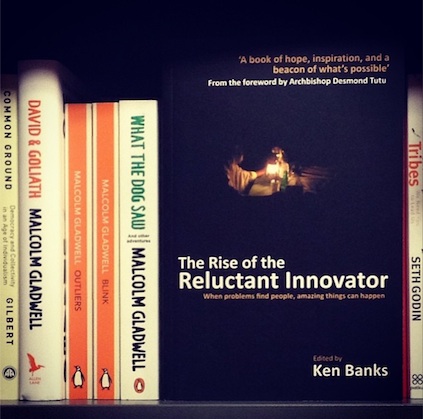
Getting the book out there is one thing. A big thing, in fact. But then comes the public reaction. While some authors aren’t too bothered, it was important to me. The general public were among my key audience, as were students and colleges/universities. The book, after all, seeks to democratise social innovation. So it was hugely gratifying to find this review posted on Amazon one morning:

Stories for every college campus

Ken Banks has collected a volume of stories here that need to be told on every college campus. College campuses are at this moment unique seedbeds of opportunity. Populated with “Millennial Searchers” who, in increasing numbers, tell us they define life success in terms of meaning, purpose, and making a difference, and shaped by the larger movements of social entrepreneurship and sustainability, college curricula have begun shifting towards educating students to become agents for change.

What our change agents need above all right now is not more information, but stories – stories that the move them from paralysis and despair in the face of social disintegration and ecological loss to actions shaped by courage, humor, and hope. These stories do this. And because they inject so much of the raw, the uncertain, and the unformed portion of reality into their tales they are stories on which students will clamber for in the face of the challenges of their generation.

These stories speak eloquently about power – the power of connections, the power in confronting power structures for the sake of the marginal, the power of serendipity, the power of the human spirit to overcome immense challenges and work towards transformation and justice. In doing so, they function as a calling to that part of ourselves that will recreate and restore human and natural communities, that bears witness to our capacity for both good and ill, and that remembers the full range of ingenuity and wisdom we possess individually and as a species.

Wendy Petersen Boring, co-editor, “Teaching Sustainability: Perspectives from the Humanities and Social Sciences”

The book was also written in such a way to avoid ‘sell-by date syndrome’. The stories of the ten innovators, and their solutions, will never age, and neither will their advice. And this was important, because I knew the book was unlikely to set the world on fire when it launched, and that it would most likely slowly find its way into colleges and universities where it could be that book of “the raw, the uncertain, and the unformed portion of reality” that younger people seek. Santa Clara University in the USA, and Goldsmiths College in London, are among a growing number seeing this value and adopting the book. It’s going to take time, but it’s happening.

Another thing I’ve learnt is to not listen to experts. Except perhaps, when they tell you not to do something – then you’ll know that you should. During a conversation with a US book agent late last year, I was told by the expert he consulted – ‘someone who knew about these things’ – that:

I’d want to work with him to substantially transform the book from a set of stories into something more analytical and practical in terms of really going about starting one of these organisations, and that would take some real time. But even then I’m not confident about the book because there have been many published already that tell stories as good as those he’s got, as well as some that are a good deal more substantial in terms of the hands-on advice

It’s something of a revelation to me that the book I published is the polar opposite of the book I was told I should publish. If I had sought advice earlier, and taken it, my book would have been no different to the hundreds of others on the shelves. It would have focused on theory, cold analysis, expert opinion, five year plans, process, how to measure stuff and the odd third party case study. I’d never publish a book like that, not only because it’s not how I work, but also because I don’t think it in any way advances the cause. Sometimes self-publishing has its benefits – you can do anything you want, however you want. Kevin Starr nailed it when he shared his thoughts on the book recently:

These real – occasionally raw – stories do more to capture the life of the committed social entrepreneur than anything else I’ve read. Inspiring, yes, but even better, it works as a real world case-based manual for how to create change for the better

The book tries to buck the trend of ‘social innovation as a discipline’, in other words as something you need to study or learn before you can do anything. Its purpose is to create belief in talented young people with a vision to do good that meaningful change is possible, even without skills and resources. It’s not about who’s smartest – it’s about who cares the most, and who’s willing to go all the way to make that change happen.

Nor is it just a detailed analysis or unpicking of the ‘market opportunity or problem’, either, that students need – that perhaps comes later. Instead, what much of the book tries to give them is the inside line on what and how the entrepreneur was feeling when they encountered a life-changing problem. How it made them feel at a deeper level, and in turn how that passion and commitment drove them to dedicate much (if not all) of their time to solving it, and how it got them through huge obstacles and barriers. There are plenty of books that don’t do this, that don’t give the raw, unedited, deeply personal accounts of how these people and projects got started. Social innovators are rarely the hero figures we make them out to be, and people need to be able to resonate with their stories at every level.

And resonating is what they seem to be doing. From the emails and tweets I’ve received over the past three months, many people have found themselves deeply moved by some of the stories. Some have even cried on trains. Five year plans rarely do that.

Further details, including a list of endorsements and chapter contributions, and how to buy, are available from the official book website. You can also download a sample PDF which includes the cover, full foreword, introduction and endorsements, and the first two pages of each chapter, here.

Reluctant innovators are go!

It’s been a busy few months as our new book – “The Rise of the Reluctant Innovator” – has been taking shape. We’ve been finalising chapter contributions, working on the introduction, sorting out cover and chapter designs, doing last minute copy-editing, building a new website, keeping Kickstarter supporters up-to-date, and pulling in book endorsements. We got 24 of those in the end, all glowing and hugely supportive. You’ll find all of them on the inside cover of the book, or on the website (click here for a full PDF version).

All that said, everything has been delivered on time, with the new website set live on the eve of the book launch. And everything has been well worth the effort. The books look incredible.

“The Rise of the Reluctant Innovator” is aimed at a general audience, although we’re hoping it will particularly appeal to younger people interested in social innovation and social entrepreneurship, and schools, colleges and universities teaching the subject. It fills a much-needed gap in the market, one which is currently dominated by books which – often at no fault of their own – give the impression that meaningful change is only possible if you’re an MBA, or a geek, or have money or influence, or a carefully laid out five-year master plan, or all five. Let’s be honest – you don’t need qualifications to change the world.

By highlighting the stories of ten ordinary yet remarkable individuals, and the impact their work is collectively having on hundreds of millions of people around the world, “The Rise of the Reluctant Innovator” shows us that anything is possible, planning isn’t everything, and that anyone anywhere can change their world for the better.

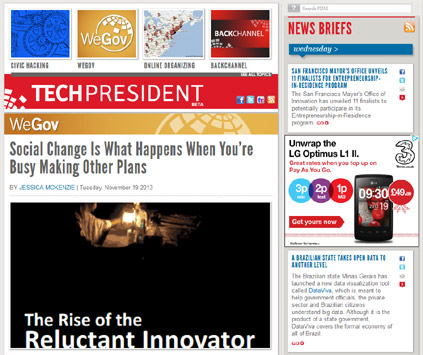
To coincide with the book launch we’ve given a limited number of interviews, with articles going out via PopTech, National Geographic, TechPresident and the Unreasonable Group. Feel free to click on any of the images below to read them.

Finally, why not check out the book website, and if you like what you see feel free to share details with your own networks. We believe this book has an important story to tell, and would love you to help us tell it.

m4d: The fun is over. Time to get tough?

I’m all for discussion and debate, and I’ve taken part in my fair share over the past eleven years. But I’m now beginning to wonder if, after all this time, everything we could have said has been said. The fact we’re still talking about the same handful of challenges and issues implies that very little, if anything, has changed where it matters – on the ground. Have we really made so little progress?

I’ve been thinking about this for a while, but it wasn’t until the recent Guardian Activate conference that the scale of the problem finally drove home.

It’s worth mentioning that I wasn’t at the event this year, but I did follow from a distance. To be honest, sometimes it’s better to listen and reflect from the outside, and as my train hurtled towards London it became increasingly obvious that much of the early conversation followed a similar pattern to many of the other technology-for-good conferences I’d attended over the years.

If, about a decade ago, we’d listed all of the questions, unknowns, problems and challenges faced by the ICT4D community, it would probably have looked something like this:

  • How do we replicate and scale?
  • How do we measure impact?
  • How do we stop the reinventing of wheels?
  • How do we avoid being ‘technology-lead’?
  • How do we break out of our silos?
  • What is our business/sustainability model?
  • Is open source a help or a hindrance?
  • How do we maximise the opportunity mobile brings?

If we made the same list today, it would probably look something like this:

  • How do we replicate and scale?
  • How do we measure impact?
  • How do we stop the reinventing of wheels?
  • How do we avoid being ‘technology-lead’?
  • How do we break out of our silos?
  • What is our business/sustainability model?
  • Is open source a help or a hindrance?
  • How do we make sense of the countless pilots taking place?

The only difference is the last one. We’ve gone from not really knowing what to do with mobile phones to a position of everyone everywhere trying to solve something with them, whether or not they’re the right tool for the job. It’s still a problem, but arguably a more serious one.

These questions – and many others like them – might keep academics in work, but they’re serious issues for practitioners, too. Project owners and tools developers are rarely clear on their positions on open source, or scale, or their interpretation of ‘appropriate technology’. Among other things this leads to confusion and unnecessary competition (yes, the non-profit world is competitive). I attempted to put a stop to some of this in a post called “Our “social mobile” line in the sand” way back in May 2009, without success. I wonder if the time is right for someone to try again?

None of us surely want to sit in yet another conference, gathering or workshop and hear the same things over and over again, but that’s often what we do. And more often than not we pay good money for the privilege. Messages I personally don’t want to hear again include:

“We need to stop talking in silos”
“Projects need to build for scale from the outset”
“We need to stop reinventing wheels”
“We need more collaboration”
“We need to become sustainable”
“We need to embrace failure”
“Mobile technology has huge potential”

Can’t the m4d community come together and fix some of this? Create a code of conduct, a directory of terms and meanings, a set of best practice? With the billions of dollars funding mobile projects the world over, can’t we siphon a little off and create an overarching set of guidelines that projects and donors adhere to? Almost everything we see out there has been funded by someone, so if only the donors seriously tried to grapple with the problem – and got strict with what they funded – we’d almost certainly make serious progress.

Some of this stuff isn’t difficult. Take the problem of silos. Most of the events where this comes up are silos themselves. How can someone stand up at a mobile health conference packed with only people who use mobile phones and only for health, and say we should stop talking in silos? How about a mobile health practitioner attending an agriculture conference, instead? Or one focussing on human rights? Don’t tell me mobile health projects can’t learn something from non-mobile agriculture? If, as we constantly hear, innovation and opportunity happen in unexpected places, we need to put ourselves in them a little more, as Tim Smit suggested at the Emerge Conference in 2010.

Perhaps as a sign of things to come, mentions of mPesa are increasingly banned at meetings I attend. If we have to use the same example of a successful mobile money project over and over again, doesn’t that say something about the state of mobile money?

I was recently asked what progress I thought we’d made since I wrote “Technology’s new chance to make a difference” for the Guardian in January 2012. In the areas of best practice, adopting more appropriate technology and mainstreaming ICT4D, sadly I had to admit very little. As I wrote three years earlier:

I spent the best part of my university years critiquing the efforts of those who went before me. Countless others have done the same. Looking to the future, how favourably will the students and academics of tomorrow reflect on our efforts? If the next thirty years aren’t to read like the last then we need to re-think our approach, and re-think it now

The development sector is hardly awash with success. The m4d community have a great chance to buck the trend. The big question is, will we?

Further reading
An inconvenient truth?

Time to meet the real M-PESA?

m-Pesa? m-PESA? mPESA? MPESA? mpesa? Putting the actual spelling to one side for a moment, there can be few more talked about yet least understood mobile services than M-PESA (yes, that’s how you’re supposed to spell it. I think). Misunderstanding, misinformation and, in some cases urban myths abound – everything from its roots and implementation to the percentage of Kenyan GDP now passing through the service. Despite this, M-PESA has come to dominate discussions in the ICT4D and m4d communities (despite arguably not being a development tool at all. But that’s another debate).

M-PESA has become so dominant, in fact, that we’re now at the stage that in increasing numbers of meetings, workshops and conferences I attend, any talk of it is banned.

M-PESA is an undeniable Kenyan success story, but not for the reasons many people think. The technology component of M-PESA was developed far away in Cambridge, England (my home town) with UK Government and Vodafone money. M-PESA is not a Kenyan or African innovation if you measure it in technology terms. But technology is often the easy bit, and what does make M-PESA a Kenyan success story is its implementation. Key ingredients like graft, determination, luck, naivety and a receptive population starved of any meaningful access to bank accounts or financial services created a perfect storm for the launch of the service. A storm, let’s remember, which is yet to hit other countries with the same intensity, many of whom have struggled to adopt M-PESA or related platforms as successfully. So far, anyway.

The very idea for M-PESA is also disputed. Despite the technology being developed in the UK, some believe that it was indeed a Kenyan who had the original idea. This “Is M-Pesa really Kenyan or British?” post on humanipo goes into a little further detail. You could argue that none of this really matters, of course. Another debate.

On top of all that, barely a week goes by when my Twitter stream isn’t hit with a claim that 10%, 25% or even 50% of Kenya’s GDP passes through M-PESA. The number – whatever it is – is astonishing. The one I’ve quoted more recently is “50% by the end of 2013” – heard at a conference in Amsterdam last autumn. I have no idea whether it’s right or not, but going by the percentage range in the tweets very few other people are either.

If, like me, you think it’s time to debunk some of these myths and inaccuracies and get the inside story of how M-PESA came about, then we’re in luck.

A couple of weeks ago Chris Locke, Managing Director of the GSMA Development Fund, gave me a copy of a book I didn’t know existed. “Money, Real Quick: Kenya’s Disruptive Mobile Money Innovation” is a great read if you’re one of the few people new to M-PESA, or you’re one of the majority who thought you knew it. The book covers everything from the seed of the idea, the importance of the human network of M-PESA agents (often forgotten in the technology-dominated discussion), what mobile money means to Kenya’s finance and banking industry, it’s impact, and what the future may look like. The book also touches on innovation more broadly, and how M-PESA speaks of the new-found appetite for innovation in the country.

I’m not sure if this book did come out in 2012 as Amazon claims, but regardless it’s incredibly useful if you think, after six years, it’s time to meet the real M-PESA. If you do you can find it on Amazon here.