ICT4D postcards: The story so far

A couple of weeks ago I sent out an open invitation for people to contribute to the “ICT4D Postcards Project“. The idea was to gather a collection of postcards from people working in international development who had a technology theme – or influence – in their work. Postcards have been coming in since, and I thought it would be a good idea to post a few up here, ahead of the full collection which will be posted online in the coming weeks.

In short, a postcard consists of a photograph and short narrative which explains why the image is important – or how it relates – to that person’s work. The idea is to go beyond usual explanation and website narrative to reveal more personal insights and motivations of the people who work in our field.

Here’s a selection of five which have come in so far. In no particular order.

Jonathan Donner. Kigali, 2003 | Website | Twitter
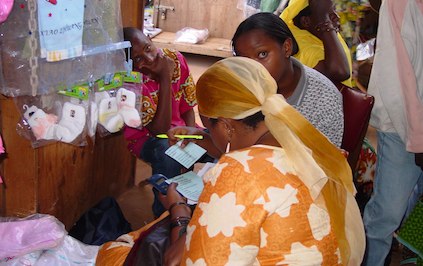
In 2003, mobile phones were just appearing in Rwanda. Penetration was just 1.5 per 100 people (1.5%) then. It is over 33% now. I organized some studies to ask microentrepreneurs about how they were using their new phones. Everyone was quite accommodating, letting us ask details about each of the last 10 calls recorded on the phones call log. Though we learned a lot about business processes and productivity, our data also demonstrated just how intertwined these phones had already become into daily life – two-thirds of the calls were with friends and family. I suspect these trends still hold.  At this moment, the interviewer (Nicole K. Umutoni) was probably looking back at me and wondering why I was taking this picture.  Now we know!

Jan Chipchase. Lagos, 2011 | Website | Twitter

That your and my cultural sensibilities about what is appropriate is irrelevant. That there are many ways to extend the internet – and that those that make the effort to do so, show us where the value is. That everything can, and will eventually be remixed.

Linda Raftree. Cameroon, June 2010 | Website | Twitter

This picture is taken on top of a large rocky hill during a workshop in Ndop, Cameroon. I love the young man’s rasta hat and the delicate lavender colored felt flower in the girl’s hair, the tender manner that they are learning together to film, and how the camera helps them see themselves and their surroundings in new ways. Up on that rock in the middle of the fields, breeze blowing under the giant sky, watching two young people teach other; the reminder that I am transient in this line of work and do not matter much in the larger scheme of things was strong, beautiful and comforting.

Erik Hersman. Liberia, 2009 | Website | Twitter

“ICT4D” represents a mental roadblock. A term that brings as much baggage with it as a sea of white SUVs, representing the humanitarian industrial complex’s foray into the digital world. It means we’re trying to airlift in an infrastructure instead of investing in local technology solutions. Like the SUVs, it’s currently an import culture that will not last beyond the project’s funding and the personnel who parachuted in to do it.

Heather Underwood. Kenya, 2011 | Website | Twitter

In August, 2011, I visited several health clinics in Kenya to determine the feasibility of using digital pen technology to enhance paper health forms. This photo was taken in a rural clinic in Mangalete. The woman using the digital pen is filling out a partograph – a paper tool used to monitor and detect prolonged or abnormal labors. She simply picked up the pen and started showing me how to properly fill out the form. When the pen’s audio suddenly informed her that she had crossed the alert line and should consider transferring the patient, her surprise and immediate understanding of the quality assurance and training benefits of this tool were incredibly gratifying. This interaction highlighted one of my core beliefs about ICT4D: big problems can often be addressed with simple solutions.

If you’re interested in taking part there’s still time. I’ll need the following:

1. A photo (high resolution if possible) – one you’ve taken, please. All it needs to qualify is to have a technology theme – radio, mobile phone, computer, solar lamp and so on.
2. Details of where it was taken and the year (if you remember).
3. A short description of what it is, and why it means something to you. Keep it short – think back of a postcard! We want personal stories – how you connect with the picture – not just a description of what it is.
4. A link to your website, blog or Twitter handle (or all three) so I can point people back to you and your work.

You can email all of this to postcards@kiwanja.net

ICT4D postcards

“Luxury Travel Stories is about the idea of connecting the world via ‘stories’ in postcard format. A photo with accompanying text no more than what would fit on the back of a postcard”.

Last month I was invited to contribute a postcard to the Luxury Travel Stories project, and chose the photo – and text – below. You can view the post, and those from other contributors, here. The whole site is based on the idea of “connecting the world via ‘stories’ in postcard format. A photo with accompanying text no more than what would fit on the back of a postcard”. Like “Dear Photograph” (which I blogged about here), it’s a simple but compelling idea.

It was 2004, and I was working on a project which took me to the intersection of technology and international development. Much to many people’s surprise, mobile phones were beginning to make their way into parts of rural Africa, including areas like that in the photo. This is Bushbuckridge – an area which straddles Kruger National Park in South Africa. These women spend most of their days queueing for water, and we pulled up one morning when I took this shot. I use it a lot in my work. It highlights the challenges we face in the development community, and challenges me to think hard about the role of technology – if any – in improving people’s lives.

One of the things I’ve always maintained is that we often know little about the background and motivation of people working in our field, and how they came to work in it. So, in part as a way to rectify this I thought it would be great to put together a slideshow of ICT4D-related postcards to share online.

If you’d like to take part I’ll need the following:

1. A photo (high resolution if possible) – one you’ve taken, please. All it needs to qualify is to have a technology theme – radio, mobile phone, computer, solar lamp and so on.
2. Details of where it was taken and the year (if you remember).
3. A short description of what it is, and why it means something to you. Keep it short – think back of a postcard! We want personal stories – how you connect with the picture – not just a description of what it is.
4. A link to your website, blog or Twitter handle (or all three) so I can point people back to you and your work.

You can email all of this to postcards@kiwanja.net

Once I have enough I’ll pull everything together and drop it into Slideshare. If enough people contribute it might be fun to map the photos, and stories, on Ushahidi.

Looking forward to seeing where this goes…

Predicting Africa’s multiple futures

“Amid all the uncertainty surrounding disruptive technologies, managers can always count on one thing: Expert forecasts will always be wrong. It is simply impossible to predict with any useful degree of precision how disruptive products will be used, or how large their markets will be”

“The Innovator’s Dilemma”, Clayton M. Christensen

Predicting the future of one of the most disruptive technologies of recent times – the mobile phone – was precisely what Rudy de Waele asked twenty-eight mobile technologists to do earlier this year. And to make things a little more interesting, these predictions were meant to focus on Africa alone. Good friend Erik Hersman and I were asked to help ensure that people we felt were best placed to contribute – African technologists, or people with considerable practical experience working with mobile technology on the continent – were represented.

The result is here.

As Clayton Christensen points out in his excellent book, predicting the future is never easy, and almost always ends in failure. During a workshop at Stanford University back in 2006, it became abundantly clear that one of the biggest challenges facing predictors was “breaking the shackles of current thinking”. 80% of people get caught out here, and to a large extent this is reflected in Rudy’s paper:

1. Pick a technology or service currently in use.
2. Predict that in xx years time there will be more of it.

The easiest way to obtain a “shackles-free” out-of-this-world prediction is to ask children, and you’ll find they have just as much chance of being right as an adult (or an expert). Quoting a PC World article I wrote on the subject a couple of years ago:

Ask people what that mobile future might look like, and we’ll likely get answers that take us in one of two directions. Adults will probably be constrained by the parameters of what they see around them today, so predictions on what a mobile phone might look like in, say, ten years, would most likely center around smaller, lighter and faster. Children, on the other hand, would probably let their imaginations run riot and talk about phones that are invisible, implanted in our brains, or both

One thing that particularly struck me about Rudy’s “Mobile Trends 2020 Africa” exercise lies in the title. Are we assuming that mobile technology in Africa will have a very different future to mobile technology in the rest of the world? Perhaps so – I’ve previously argued that “many future mobile innovations will be borne out of the realities of the developing world”.

If that were the case then that would be a future I could get excited about.

When in Rome. Or Africa.

Whenever I find myself in front of a group of students, or young people aspiring to work in development, I’m usually asked to share one piece of advice with them. I usually go with this: Get out there while you can and understand the context of the people you aspire to help. As you get older the reality is that it becomes harder to travel for extended periods, or to randomly go and live overseas.

In the early days of ICT4D and m4d – and development more broadly – it may have been seen as a luxury to understand the context of your target users (many solutions were seen as “universal”, after all). Today I’d say it’s become a necessity.

In my earlier days I did a lot of travel, mostly to and around Africa. (One thing I regret never managing to do was walk across the continent, something I started tentatively planning a few years ago). As our organisation has grown and my role within it changed, I spend more time today travelling to conferences giving talks than actually doing the work. My last major piece of extended fieldwork (i.e. longer than a week) was back in the summer of 2007 when I spent a month in Uganda consulting with Grameen’s fledgling AppLab.

There’s more to it, though, than just “getting out there”. What you learn, sense, pick up and appreciate about the place you’re in and the people you’re with largely depends on the kind of traveller you are. The truth of the matter is you’ll rarely get a real sense of a place staying for just a few days in the capital city behind the walls of a four or five star hotel. Quite often the more you get out of your comfort zone the more you learn.

I’ve been hugely fortunate to have lived and worked in many countries – mostly in Africa – since I set out to work in development almost twenty years ago. And during that time I’ve developed quite a few “travel habits” to help me get the most out of my time there.

Here’s my Top 15:

1. Stay in a locally-owned or run hotel (or even better, guest house).
2. Spend as much time as possible on foot. Draw a map.
3. Get out of the city.
4. Check out the best places to watch Premiership football.
5. Ignore health warnings (within reason) and eat in local cafes/markets.
6. Buy local papers, listen to local radio, watch local TV, visit local cinemas.
7. Use public transport. Avoid being ‘chauffeured’ around.
8. Take a camera. Take your time taking pictures.
9. Go for at least a month.
10. Visit villages on market days.
11. Spend time in local bookshops, libraries and antique/art shops.
12. Read up on the history and background of where you’re going. Buy a locally-written history and geography book.
13. Be sure to experience the city on foot, at night.
14. Wherever you are, get up for a sunrise stroll. It’s a different, fascinating (and cooler) time of day.
15. Don’t over-plan. Be open to unexpected opportunities.

Finally, if you’re looking for advice on what to take on a trip to Africa, good friend Erik Hersman (aka WhiteAfrican) has an excellent post here.

Additional suggestions

Rebecca Harrison (@rhrsn on Twitter):
16. Seize any opportunity to visit homes, especially at meal times.