NASA on Mars vs. Development in Africa?

Better late than never, I’m about to start reading “Dead Aid“, Dambisa Moyo’s much touted book. I’ve already read a few blog posts and reviews – some about her, some about her book – and the Guardian’s “An evening with Dambisa Moyo” seemed worth a look. In an otherwise downbeat review, one statement stood out a mile.

“Africa is to development what Mars is to NASA” – the ultimate development studies essay question. It certainly got me thinking. To what extent is Africa development’s playground, a place to ‘try things’, to experiment? Often with so little accountability – see Bill Easterly‘s “White Man’s Burden” – it’s easy to see why it’s thought of as an easy place to pilot, to test, to try out. “And if it goes wrong, well, let’s try something else, somewhere else”.

During a workshop at IDS a couple of weeks ago, I commented that the development sector in Africa was littered with the carcasses of failed projects, a kind of ‘elephant graveyard’ for the well-intended.

I’d love to see an ICT4D/African technology conference pick up on the “NASA, Mars, Development, Africa” theme. And I’d love to be in the audience. Any takers?

Mobile Design. Sans Frontieres.

Although I find myself intrigued by the convergence of computer science, human computer interaction (HCI) design and international development, it’s not often that I find myself in a room of experts. They’re just not places I tend to mix, most likely because I have no professional IT qualifications, let alone a computer science degree, and I’ve done most of my own software design off-the-cuff, much to the dismay of people who hoped there was a robust process behind it.

Last August I got my first taste of the very real challenges that the computer science world faces when it comes up against the equally real challenges of international development. The meeting – convened at UC Berkeley – was an eye-opener for me to say the least, and as I left I blogged about how thankful I was that it wasn’t me who had to come up with the answers. You can read that post here.

A little later in the year I was invited to speak at the First International Workshop on Expressive Interactions for Sustainability and Empowerment, held at one of Vodafone’s London offices. The topic of conversation was similar, but here the focus was on how to build mobile tools that work in difficult, challenging, ‘foreign’ environments. Following my talk I was invited by the Editor of Interfaces, John Knight, to contribute an article to the next edition of their magazine.

For the article I teamed up with Joel Selanikio, co-founder of DataDyne.org and the creator of the EpiSurveyor mobile data collection tool. It made sense working with Joel for a number of reasons. Not only have I known and admired him and his work for some time, but Joel is first and foremost a paediatrician. For him – like me – understanding the problem takes priority over the technology, consideration of which should always come last. FrontlineSMS and EpiSurveyor have both evolved from time spent in the field – observing, experiencing and understanding before designing, developing and building.

You can read our thoughts on the process – “Ten things you might want to know before building for mobile – in the current edition of Interfaces magazine (PDF, 2.5Mb).

For further posts on the subject see the “Mobile applications development” section of this blog, which includes a 10 minute video on the topic.

Social mobile gets its own “roadmap”

After three workshops on three continents, conversations and meetings with countless NGOs, academics, researchers and technologists, and many hours of conference calls, W3C this week released their “Mobile Web for Social Development Roadmap”, a comprehensive document which sits at the heart of the wider work of the Mobile Web for Development Interest Group (MW4D).
According to the Roadmap document, its purpose is to help:
“… understand the current challenges of deploying development-oriented services on mobile phones, evaluate existing technologies, and identify the most promising directions to lower the barriers of developing, deploying and accessing services on mobile phones and thereby creating an enabling environment for more social-oriented services to appear”
The Roadmap is split into two distinct sections. The first covers challenges and issues in developing mobile tools for social development, and the second looks specifically at technology options. The primary audience are individuals, organisations and entrepreneurs interested in social mobile; the mobile industry itself; academics; international organisations and, finally, policy makers and regulatory bodies.
The Roadmap is very much a work-in-progress, and the MW4D Interest Group welcomes comments, recommendations and suggestions to help shape it as the work moves forward.

After three workshops on three continents, conversations and meetings with countless NGOs, academics, researchers and technologists, and many hours of conference calls, W3C this week released their “Mobile Web for Social Development Roadmap”, a comprehensive document which sits at the heart of the wider work of the Mobile Web for Development Interest Group (MW4D).

According to the Roadmap document, its purpose is to help:

“… understand the current challenges of deploying development-oriented services on mobile phones, evaluate existing technologies, and identify the most promising directions to lower the barriers of developing, deploying and accessing services on mobile phones and thereby creating an enabling environment for more social-oriented services to appear”

The Roadmap is split into two distinct sections. The first covers challenges and issues in developing mobile tools for social development, and the second looks specifically at technology options. The primary audience are individuals, organisations and entrepreneurs interested in social mobile; the mobile industry itself; academics; international organisations and, finally, policy makers and regulatory bodies.

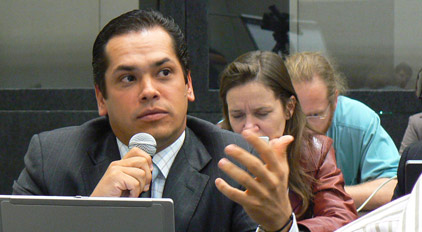
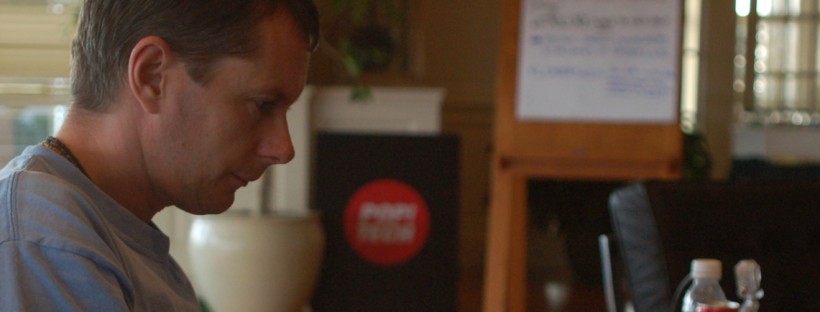
Question time in Sao Paulo (2008). Other meetings were held in Bangalore (India) in 2006, and Maputo (Mozambique) in 2009. Photo: Ken Banks, kiwanja.net

The Roadmap is very much a work-in-progress, and the MW4D Interest Group welcomes comments, recommendations and suggestions to help shape it as the work moves forward.