Mobile meets health on the margins

The timing of this article could not have been better, given the discussions last week on the merits of mobile-based “cloud computing” and the clarification of our position a couple of days later. Despite advances in mobile devices and data connectivity, the need for mobile tools to also be able to work in less than optimal conditions is still as strong and as relevant as ever, as this use of FrontlineSMS by Telecoms Sans Frontiers in Nicaragua shows us all too well.

TSF – No Bugs In This Software That Fights Disease
(re-printed with the kind permission of SatNews.com)
November 5th, 2009

“Since the beginning of October, Nicaragua is facing a huge rise of dengue cases, which has become a major public health concern in the country. The Health Ministry of the Central American nation (Minsa) has a crisis unit (SILAIS) which currently focuses its activities in response to both the dengue and H1N1 plagues. An Internet monitoring system has previously been set up to control the health situation in the country; nevertheless access to computer is often difficult in some regions where only few health centers are equipped.

TSF and FrontlineSMS TrainingDue to this serious situation, and the necessity to improve the collection of information, TSF, in collaboration with PATH (an international non-profit organisation that aims at enabling communities worldwide to break longstanding cycle of poor health) is reinforcing SILAIS’ capacities in Information and Communications Technologies.

In order to monitor the spread of the dengue in Managua and to conduct mobile health actions, TSF has been implementing for the first time a very innovative system based on a widespread, cheap and solid technology, GSM.

To set up the program, TSF uses FrontlineSMS software. Developed by a TSF partner NGO, FrontlineSMS is free, open source software that turns a laptop and a mobile phone into a central communications hub. Once installed, the program enables users to send and receive text messages with large groups of people through mobile phones. Thus, GSM technology is used to reach as many geographical zones as possible to control health issues in those areas. The server in SILAIS is connected with the 32 health units in Managua.

Each health unit has been delivered a mobile phone by TSF, so that they can send different kinds of information through SMS to the server. Hospital and health centers fill in predefined forms from their mobile phones and send them by SMS to SILAIS. Designed by PATH and the SILAIS, those forms provide data about the classic and hemorrhagic dengue cases, about the H1N1 2009 ones and the need for medicines when the stock nearly runs out. Once the forms received, the server stores information and puts them in databases in order to facilitate statistical analysis, on Excel format for example.

TSF provides two-way communication to health units enabling SILAIS to receive a daily report and gather messages from the health units and will have an updated situation in each center. At the meanwhile, SILAIS will also be able to communicate important information to them through SMS (such as an alert or a warning about coming meetings for example) or give them automatic answers to predefined questions sent by the health units.

Image courtesy Telecoms Sans Frontiers

By providing communication links between health structures and the SILAIS, TSF will allow the Health Ministry to have more accurate information about the diseases spread within Managua and quickly survey and assess the needs in affected areas. TSF helps health professionals use advanced methodologies such as smart phones and open-source software. Mobile devices are great tools to track and transmit crucial data in order to detect an epidemic threat at an appropriate time. Through this program, TSF participates in strengthening health systems in Nicaragua.

Following the installation of the system, on October 24th, TSF organized training for all the beneficiaries of the project. The health units and SILAIS staff were trained on the application’s functionalities and available services”.

For a related article on FrontlineForms, the FrontlineSMS data collection tool used by TSF for the project, go here.

Poverty, pain and the politics game

As a keen cyclist for most of my life, I’ve always been shocked at how little many car drivers care or care to understand the challenges of two wheels in heavy or fast moving traffic. This lack of respect is not only frustrating – it can also be dangerous. In my younger days I thought I had the answer. Force all learner drivers to spend a month on a push bike before issuing them their licence. There’s no better way than learning by experiencing, after all.

As I’ve got older I realise that my bike riding solution may not have been the most practical, but the “learning by experiencing” point is as strong and relevant as ever, particularly in the world of international development. You can’t beat experience. Pretty-much everyone I respect and turn to for guidance – both spiritual and practical – has got their hands dirty in the field at some stage. I feel at times that a stint in the field should be compulsory. How else can you truly understand the problem?

War DanceOne of the down-sides to a discipline which doesn’t insist on “compulsory” fieldwork is the rise of a culture of politics. Losing sight of the bigger picture and becoming embroiled in competitive, overly critical behaviour can be a huge distraction and hugely destructive. Development suddenly becomes a battle of “a versus b” or “x versus y” and not about the alleviation of poverty and suffering that it should be. I steer well clear at every available opportunity, and draw on much of what I’ve seen and experienced over the past sixteen years to do so.

I also have my “War Dance” DVD. One of the toughest films I’ve ever seen, “War Dance” – based in the camps of Northern Uganda – puts everything into perspective. For those of us who have seen this kind of suffering it’s a stark reminder – and a cry – to remain focused. Get a copy and watch it each time you need reminding why you’re doing what you doing. Politics has no place in a world like this.

It doesn’t have a place here, either. Whether you agree or disagree with the approach, this recent Medecins Sans Frontiers video drives home a message not a million miles away. It may be messy, it may be challenging, and it may be confrontational – but if this is the reality for everyone on the ground then we need to be having these conversations.

Be warned: It’s difficult to watch (well, listen to), as is “War Dance”. But it’s powerful, and it’s a reminder to all of us that we need to focus on what matters, where it matters. Poverty is not about politics, and should not be driven by it. It’s about people. Every single one of them.

Considering the future of development

“Our best decisions are made when we take not only our current needs into account, but when we consider how they will be affected by the state of the world in the future”. Or so says Gustavo Montes de Oca, an intern at London-based Forum for the Future. In this guest post, Gustavo takes us through four of his key ‘development future’ thoughts, and invites you to add more by joining their ongoing discussion

A development future...The global development community is particularly focused on the future (for example, the MDGs, or Millennium Development Goals) working to future targets of poverty reduction, health improvement and equality. But what are the factors working with or against these aims, and how will they pan out in the next 20 to 30 years?
Four trends which I think will play an important part in shaping the future of development are:

First, massive growth in ICT and applications: ICT has arguably already done more for Africa than aid. With the arrival of fibre optics this will continue. $100 dollar computers in every house eclipsed by device in every pocket, serving individual and group needs. (Further information on ICTs are available in this Database of mobile applications)

Second, the “Reaspora”: People whose origins, however defined, are in the countries of Africa and southeast Asia but who live in the West have seen where that model of development leads and are taking an interest in helping their countries and regions avoid the pitfalls – and seize on the opportunities – ahead. (See sites such as the Reaspora Blog and BarCamp Africa)

Third, South – South cooperation: Cooperation between people in different low-income regions is increasing. Since they live in the same context as each other it is easiest for them to come up with solutions, including the adaptation of technologies from the developed world

Fourth, Girl effect and women in power: A woman – or girl – will reinvest 90% of her income in her family. A man will reinvest 30% – 40%. This sense of stewardship combined with growing power (two-thirds of the Rwandan Parliament is made up of women) could see women play a growing part in leading their countries down alternative, more sustainable development paths

These are my four for starters. What am I missing?

Forum for the Future is a charity committed to sustainable development which focuses on the root causes and connections between big issues such as climate change, social inequality and environmental degradation. If you would like to find out more about their work, and join in with this (and many other) discussions, visit them online at www.forumforthefuture.org

Enabling the inspiration generation

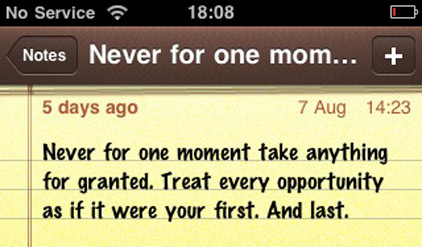
During one of my many epic walks around Palo Alto last week, I stopped and tapped this into my phone:

Note

Let me explain.

When I started out in mobile almost seven years ago, there were very few people working in the space, which meant there were very few people to turn to for support, guidance or advice. In fact, there were so few people with any meaningful experience I was offered my first major piece of mobile work based on my IT knowledge and conservation/development experience alone. Today, there would have been dozens – if not hundreds – of applicants for that job and it’s unlikely I’d have stood a chance.

But getting a chance is what it’s all about. When kiwanja.net officially came into being towards the end of 2003, it took me almost four years to get any serious traction, let alone funding. Emails went unanswered, requests for charity-rates at conferences were snubbed, begging letters to mobile operators and handset manufacturers were blanked. It may be hard at the top, but it’s harder at the bottom. That’s why, today, I never forget what it was like when I started out. And that’s why I never take anything for granted, and why I never forget to make time to help students, researchers, NGOs, organisations – anyone from all walks of life, in fact – who find themselves working their way off that first rung of the mobile ladder.

UN Youth AssemblyLast Friday I attended the UN Youth Assembly in New York. If there’s one thing I love – other than having my own name plate, of course – it’s talking to a room full of fearless students. I spent the best part of this morning following up on their emails, the fallout of my short talk on kiwanja.net and FrontlineSMS.

If we can help anyone on their journey, then we should. Whether that be giving advice or a positive critique on an idea, helping raise awareness through blog posts, giving tips on fundraising, making introductions to other projects and people with the same interests, or offering to be a future soundboard as their ideas grow and develop. These are all things I didn’t have when I started out, and using them productively now that I do is one of the biggest contributions I believe I can – and should – make to the future growth of our discipline. Our legacy shouldn’t be measured in the projects or tools we create, but in the people we serve and inspire.

In the mobile world we talk a lot about project sustainability, but little about human sustainability. If we’re to have any chance of ongoing success then we need to attract the brightest young minds to the “mobile for development” field, and then give them all the support they need to keep them there. Empowerment isn’t just something we do in a distant land. There’s plenty we can be doing on our own doorstep.

It’s a different kind of empowerment, but that doesn’t make it less valuable. If anything, it’s more so.