SMS tackles farmer literacy in Niger

In this, the sixteenth in our series of FrontlineSMS guest posts, Joshua Haynes – a Masters student at The Fletcher School at Tufts University – describes their application of the software to help improve the lives of farmers in Niger, West Africa

Projet Alphabétisation de Base par Cellulaire (ABC), conceived of and spearheaded by FrontlineSMS’s newest Advisory Board member Jenny Aker, uses mobile phones as tools to aid in adult literacy acquisition in rural Niger. This project is funded by UC Davis, Oxford University, Tufts University and Catholic Relief Services (CRS) and housed at and managed by CRS/Niger.

Adult literacy in rural areas faces an inherent problem. In Niger, for example, there are no novels, newspapers or journals in native languages like Hausa or Zarma. The 20% of Nigériens who are literate are literate in French. The vast majority of rural villagers have struggled to maintain their livelihoods since time immemorial without ever knowing how to read a single word. What’s the point of literacy if there is no need for written materials?

Mamadou Issoufou, like 80% of people who live in rural areas, has access to a couple of different weekly markets where he can buy and sell his millet. One market, Dogon Kirya, is 11 kilometers away and the other, Doubélma, is 15 kilometers away. As Dogon Kirya is closer, he usually travels there, but he knows that sometimes he can get a better price when he goes to Doubélma. If a fellow villager who traveled to Doubélma the previous week indicates that prices were better there than in Dogon Kirya, then Mamadou might decide to go the extra four kilometers, but he’s not sure he’ll get the same prices this week, too. He leaves it up to chance.

On Wednesdays, the Service d’Information sur les Marchés Agricoles (SIMA) sends radio broadcasts on the prices of the most important staples like millet and sorghum for the largest markets in the country. Unfortunately, Mamadou, like most rural farmers, doesn’t have access to the broadcast, and if he did, his two main markets aren’t large enough to be covered by SIMA. Even if they were large enough, Dogon Kirya’s market is held on Tuesdays, so any information from the radio would be six days old.

Farmer, Niger. Photo courtesy Joshua Haynes

If Mamadou had access to some sort of real-time, demand-driven information, he could make better choices on where to buy and sell his goods. The mobile phone is a perfect device for transmitting information, but even though Mamadou may have access to a phone, he can’t read. The point of literacy in rural areas is increase access to information, and this is where FrontlineSMS plays an important role.

This past summer, between my first and second year as a graduate student at The Fletcher School at Tufts University, I was fortunate to work with Jenny, the amazing staff at CRS and SIMA, including Djibou Alzouma, Aïchatou Bety, Sadou Djibrilla, Scott Isbrandt and Ousseïni Sountalma, to develop a system called IMAC – Information sur les Marchés Agricoles par Cellulaire. IMAC – pronounce ‘ee-mak’ – allows users to query for farmgate and market prices of agriculture products in a number of markets in four languages. It is built to work as one of the Projet ABC components, but can be used in areas with higher literacy levels.

Mobile training, Niger. Photo courtesy Joshua Haynes

In addition to the querying functionality, we added the ability for SIMA-trained CRS agents to update the crop prices by sending IMAC a specially formatted SMS. The prices are quickly checked for errors in Niamey, the capital, and then are live for all to use. Before, it could take up to three weeks for market prices to get recorded, go through a number of different administrative stages and finally end up in the database in the capital, but now it takes a matter of seconds before the data can be accessed.

Although the data is stored and updated in the database, FrontlineSMS is the primary access point which captures the message, sends it to the database for processing, waits eagerly for the response, and speedily sends the response to the waiting villager. By exploiting FrontlineSMS’ HTMLRequest functionality, we were able to access a backend system and turn FrontlineSMS into a demand-driven automatic information dissemination tool.

I was fortunate to return to Niger in October (2009) to not only see how well the system was still working – a big relief for developers – but to be surprised by the number of new markets and products that had been added to the system. Thanks to FrontlineSMS, CRS and SIMA, these additional markets will allow even more villagers, once at least semi-literate, to obtain information that will better help them make more informed decisions about their economic resources.

Joshua Haynes
Candidate, Masters of International Business, 2010
The Fletcher School
Tufts University
http://fletcher.tufts.edu

An SMS “kickstart” for Kenyan farmers

In this, the fifteenth in our series of FrontlineSMS guest posts, Rita Kiloo – Customer Care Executive at KickStart in Kenya – describes how their use of the software enables them to extend and improve their outreach efforts among rural farmers in the country

“KickStart’s mission is to help millions of people out of poverty. We do this by promoting sustainable economic growth and employment creation in Kenya and other countries, and by developing and promoting technologies that can be used by dynamic entrepreneurs to establish and run profitable small scale enterprises.

In 1998 we developed a line of manually operated MoneyMaker Irrigation Pumps that allow farmers to easily pull water from a river, pond or shallow well (as deep as 25 feet), pressurize it through a hose pipe (even up a hill) and irrigate up to two acres of land. Our pumps are easy to transport and install and retail between $35 and $95. They are easy to operate and, because they are pressurized, they allow farmers to direct water where it is needed. It is a very efficient use of water, and unlike flood irrigation, does not lead to the build up of salts in the soil.

Photo courtesy KickStart, Kenya

With irrigation, farmers can grow crops year-round. They can grow higher value crops like fruits and vegetables, get higher yields (the Food and Agriculture Organization reports that irrigation increases crop yield by 100-400%) and most importantly, they can produce crops in the dry seasons when food supplies dwindle and the market prices are high. Because of the long dry seasons and growing population, there is potential for many thousands of farmers to start irrigating without flooding the market. There are local, urban and even export markets for the new crops.

A few months ago we decided to start using text messaging as part of our outreach efforts to farmers, and had heard good things about FrontlineSMS. Basically, we now receive lists of mobile numbers of prospective clients from our sales teams – these are clients who have visited our dealer shops countrywide, and who have shown an interest in our irrigation pumps. They usually leave their contact details with the sales people at the shop.

At the end of every month I receive a copy of the contact lists from at least 70 sales people, which may total about 5,000 contacts. I randomly pick around 500 to 1,000 mobile numbers and put these into an Excel spreadsheet. Once this is done, the numbers are uploaded into FrontlineSMS and we send out a uniform SMS to prospective buyers of the pumps. Here is a sample of the kinds of messages we send out:

Kumbuka kununua pampu ya kunyunyiza mimea ya MoneyMaker. Kwa maelezo zaidi, piga simu kwa 0725-xxxxxx

(“Remember to buy the MoneyMaker pump for irrigating your crops. For more details, kindly call 0725-xxxxxx”)

The texts are scheduled for every week of the month, and are categorized into territories, allowing us to keep track of the areas where the interest is coming from. There are a number of advantages in using FrontlineSMS, one of the main ones being that I am able to reach more farmers through SMS than I would be able to by calling them one-by-one. We are also able to keep in more regular contact with interested farmers, and remind them about the pumps. Not all of them buy pumps straight away”.

Rita Kiloo
Customer Care Executive
KickStart Kenya Program
www.kickstart.org

Scale, FrontlineSMS and the local

What follows is the fourteenth in our series of FrontlineSMS guest posts. Here, Kelly Sponberg – a Project Manager at RANET – discusses the challenges of ‘local’ and ‘scale’, and the potential his organisation sees for FrontlineSMS in their work

“For about a decade now I have been fortunate enough to work on a small and niche-focused program called RANET (Radio And Internet for the Communication of Hydro-Meteorological Information for Rural Development). The program has a simply stated goal to make meteorological forecasts, warnings, and observations more readily available to rural and remote communities.  It does so through a variety of training, system development, and site deployment activities.

The technologies utilized by RANET have ranged from satellite broadcasts, to satellite telephony, to FM community radio, include HF e-mail networks, a variety of web based applications, and of course mobile phone messaging and data services. We recently began experimenting with and using FrontlineSMS to scratch a particular itch.  If you will bear with me, I’ll try to describe the challenge and problem FrontlineSMS uniquely addresses well.
RANETRANET began with the notion that rural communities are often most affected by and vulnerable to environmental changes and variability, yet the information products communities may find beneficial are not easily distributed outside of major cities in developing regions.  The quote that somewhat launched RANET came from an Algerian nomad who said when interviewed, “Just tell me where it has rained, and I’ll know what to do.”

A story about a nomad

Such a simple statement is loaded with insights and information.  Think of the challenge.  The nomad is constantly on the move in remote desert areas to shepherd his herd to food and water.  Under the best of circumstances, it is a difficult technical challenge to deliver information to this individual in a timely and sustainable manner.  Beyond the physical delivery of information, there are barriers related to language and perhaps literacy.  But moreover his statement counters assumptions about what information is valuable.  Most meteorological services try to improve forecast quality and generally the science behind weather products.  This hard work and dedication often leads to the conclusion that forecasts and newer products are the most valuable to an end user.  Indeed this is probably true for most end consumers of meteorological products and services.  In this application, however, the nomad wanted a simple observation of where it has rained as that is where there will be fresh water and new vegetation.  He cannot afford to follow a probabilistic forecast, no matter how accurate it might be.

The story of the nomad touches on the challenge of scale, which I suspect arises in all ICT4D programs.  Scale is the tension between macro and micro.  It is regional versus local.

What do I mean here?  If you abstract out why we do ICT4D projects, it comes down to solving ‘problems’ of information access and inequality, data management for efficiency, and letting individuals and communities speak in their own voice.  In the abstract, the development community, be they foreign or indigenous, wants to be able to replicate local successes across regions, countries, and continents where other people have similar needs.  Resources are simply too scarce to not strive for scalable solutions.

Scale vs. relevance

There are two major problems of scale here.  One is content, information, or the ‘byte’.  If you have a network that can distribute across a region, country, or even continent, the information distributed or shared often becomes less locally relevant and powerful the more widely distributed it is.  (The exception to this is of course sports scores.)  Certainly, technical or science based information does not change all that much.  Information on disease prevention is not going to change in substance from one locale to another, but it will necessarily need to transform how it is portrayed to fit within local cultural, religious, language, education/literacy, economic, and even political contexts.  To me the ‘what’ of information in ICT4D is perhaps the most challenging.

I work mostly on the ‘how’, which is simply the movement of information from point A to B in its most basic description.  Nonetheless, ‘how’ needs to be cognizant of the ‘what’, and as a result faces its own issues of scale.  Communication platforms that cover large geographic areas are often broadcast in nature, and therefore diminish the ability to target or carry information tailored to local needs. Of course broadcast systems are easier and more affordable to deploy than many networked systems, but with a broadcast you lose the ability to receive timely feedback or foster sharing / local production of information.   Many point-to-point or networked systems operating over large areas face regulatory challenges, are extremely expensive to operate, or require significant technical competence.  Community based systems, such as information centers and FM radio, require significant upfront investments and require considerable maintenance and training costs as well.   And these may not be connected such that local information and knowledge can benefit others.  When done right the results are clearly amazing, but the initial investment and time required to effectively establish such sites often prevents widespread deployment throughout a country; to say nothing across multiple countries.

All of this is to say its easy to find a communications solution that is sustainable and meets the needs of a small community or area.  Demonstrating success at this scale is easy.  Identifying something that suits local needs yet can be replicated elsewhere (often with an expectation of decreasing cost) is not so simple.

Image courtesy kiwanja Mobile Gallery

Enter the mobile

Mobile phone services offer a potentially interesting solution.  With rapid growth of networks in even the most remote of locations, there exists a standard and geographically expansive platform; even if operated by many different service providers.  Because of the point-to-point nature of the network, it manages to cater to local information needs and interests. In fact I would argue that in areas where the Internet has not penetrated, mobile phones change the expectation of how and what information is transmitted.  Even in comparison with a community FM station, a mobile device is inherently more local and simply intimate.  I believe this creates a new expectation for ever more tailored or individualized information.  And of course the basic economics of mobile, as well as the form factor, makes it ease to deploy.  Messages can be sent for mere cents, and as it is in the interest of commercial providers to make durable and easy to use devices, many deployment headaches are assuaged.

Clearly, mobile is not new.  There are hundreds of ICT4D projects out there utilizing mobile to collect and disseminate information.  But, there still remains a scale challenge I believe.  To process messages for collection of field data, reporting, or to distribute information beyond a small social circle or region of a country, you need some automation.  Creating these scripts and programs on a computer/server to interface with a mobile network is not always straight forward.  It requires expertise and funding to do so.  This unfortunately represents a barrier to scaling and replication.  If you examine many mobile messaging projects underway, many are either still pilots or very geographically limited.  At times it really is the content that limits scaling, but I also believe that as the technical basis for the local system is so highly tailored, it can’t be easily transferred without starting with a whole new reinvestment in setting up servers, programmer time, etc.

As a program working in multiple countries across Africa, Asia, Pacific, and recently Central America, RANET has been struggling with this issue for some time.  Do we help our country and community partners develop highly customized mobile messaging applications, but then be unable to transfer this effort to other countries?  Or, do we develop some generic data management and messaging interface that while feature reach is unwieldy or lacks the specific function needed in a local circumstance?  Frankly, we have experimented with both, and we have experience of success and failure with each approach.

FrontlineSMS and the local

In the last year I came across FrontlineSMS, which I believe represents an interesting genre of tool.  The desktop application prepackages most of the basic messaging features a small social group might want in order to exchange messages.  But the ease of use extends into more advanced applications.  The more RANET experimented with automation tasks and keywords in FrontlineSMS, the more amazed we frankly became.  Want to automatically collect field data and filter for keywords, users, etc.?  Not a problem. Want incoming messages to auto-respond?  Simple.  Have a database half way around the world you want to store incoming messages or use to feed an auto-response sent as SMS?  Easy.  Did I mention it is free?
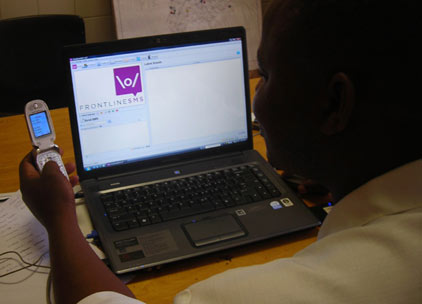
Image courtesy Josh Nesbit, FrontlineSMS:Medic

Many reading this have probably experimented with or used FrontlineSMS, so I don’t pretend this is news.  But, I have also used other commercial applications that cost thousands of dollars and have half the features.  Some applications are feature rich and enterprise in scope, but these then require considerable technical expertise to use and maintain.  The FrontlineSMS team has done the hard job of creating an easy to use application that can be used to meet local community needs, but it also performs well for scaled applications that at the end of the day connect and replicate successful local implementations.

RANET has only begun to introduce FrontlineSMS into its country programs, but I already see the possibilities.  To help showcase some of the capabilities, as well as provide our community with baseline training, a few tutorials/discussions were added to our relatively new ‘Weaver‘ series.  The articles on FrontlineSMS are available in English, French, and soon Portuguese.  In the near future we plan to add some video tutorials and discussions, and after that hope to start sharing some of our experiences on how FrontlineSMS has been used for collection of data, ‘broadcasting’ weather information, and even allowing on-demand and automated information requests.  We are looking forward to utilizing this application, as well as learning how others might be using it in earth science and services applications”.

Kelly Sponberg
Project Manager, International Extension and Public Alert Systems (IEPAS) / RANET
Joint Office of Science Support (JOSS)
University Corporation for Atmospheric Research (UCAR)
www.ranetproject.net

Outreach, health and SMS in Ukraine

Earlier this year, IATP Ukraine launched three pilot projects using FrontlineSMS. In this, the thirteenth in our series of FrontlineSMS guest posts, Yuriy Selyverstov – the Dnipropetrovsk Representative from the Internet Access and Training Program (IATP) – describes two of the projects

Tamarisk, a Ukrainian NGO,  plays the key role of resource center for local third sector organisations in the Dnipropetrovsk region. It organises and conducts training for NGOs, and hosts joint round table events for mass media, local authorities and other NGO representatives. Because of this it is important that Tamarisk be able to inform their target audiences about upcoming events. E-mail lists, a web portal for local NGOs, phone calls, and personal contacts have been traditionally used for this purpose.

Tamarisk NGO gathering. Photo: IREX

In March this year, Tamarisk – in co-operation with the IATP program – launched a pilot project that uses FrontlineSMS to disseminate information to target audiences via SMS. By June there were over a hundred NGO subscribers with additional numbers being added regularly. Subscribers are organised into several groups depending on the field of their activities, and since the start of the project over 300 messages have been sent. The effectiveness of SMS sending is well illustrated by the International Renaissance Foundation, who held a presentation at the Tamarisk offices in April. About 60% of the participants found out about the event via SMS.

The following conclusions were drawn after the first three months of using FrontlineSMS:

  • Almost all SMS messages were read compared to e-mail, which is not checked regularly by many NGOs
  • Bulk SMS sending saves time in comparison to phone calls or personal contact
  • SMS did not exclude other traditional tools for disseminating information, but complimented them very effectively

Tamarisk now plans to increase the use of FrontlineSMS in its work.

In the second project, “Doroga Zhizni” (Road of Life) applied FrontlineSMS in the field of HIV/AIDS and tuberculosis transmission prevention and treatment. The target audience are injecting drug users and former prison inmates.  “Doroga Zhizni” is part of the all-Ukrainian “Network of People Living with HIV/AIDS“.

"Doroga Zhizhi" Manager Iryna Pryhodko. Photo: IREX

For two months starting in March 2009, a pilot group of users with mixed HIV/TB diagnosis received scheduled text messages twice a day reminding them to take their pills. After the two months were up, feedback was collected from the group asking their opinion about the effectiveness of the service. In total, 90% of the group replied that SMS effectively helped them not to forget to take their pills, and that they wanted to receive SMS in the future. Only 10% said SMS was not helpful. Overall, 50% of the group noted positive psychological benefits – the messages made them feel that they were not alone and that somebody cared about them. The project concluded that FrontlineSMS was effective in improving patient adherence to prescribed treatment.

“Doroga Zhizhi” now plan to recommend using SMS reminders with all of its clients, starting this summer. To make this scaling possible they plan to request additional funding from their donor to cover the cost of the messages.

IATP is funded by the United States Agency for International Development (USAID) and implemented by IREX, an international nonprofit organisation that delivers cross-cutting programs to strengthen civil society, education, and media independence in more than 50 countries

Yuriy Selyverstov
Dnipropetrovsk Representative
Internet Access and Training Program (IATP)
www.ua.iatp.net