Missions look to SMS in Nigeria

This is the eighth in our series of FrontlineSMS guest posts. Here, Mike Blyth – Computer Systems Coordinator at Serving in Mission (SIM) – discusses their use of the software among missions operating in central Nigeria

Jos, Nigeria has been in the news recently because of riots in November that killed hundreds of people. This was the second such episode since 2001, and the situation remains tense. Besides this, violent crime has increased rapidly in the past four years, with frequent robberies by armed gangs of up to 20 or more men.

Part of our response as a group of missions in Jos has been to strengthen our communications network, and FrontlineSMS has become a key part of that network. The mobile phone is the basic means of communication in Jos, where there are few if any functioning land lines, and where Internet access is still expensive and spotty. During the November crisis, we noticed that voice calls on the mobile network rarely connected, probably because of congestion, while SMS messages got through well.

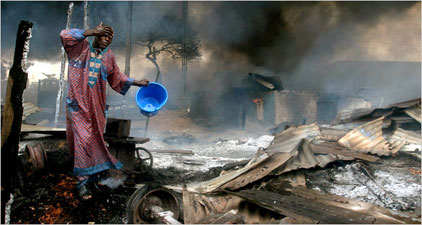
Jos, Nigeria - Courtesy New York Times

Our response

It was shortly after that we started experimenting with FrontlineSMS, and we have so far developed a system with a number of features.

First, anyone can text the system and receive a response with the current status message. In a crisis, this could contain warnings, instructions, announcements and so on. Besides this ‘on demand’ capability, we keep one list of users who receive broadcast alerts.

Anyone can join this “text alerts” group by sending the request as a text message to the system. We ask people to send the message “JOIN” followed by their name. At this point, FrontlineSMS cannot automatically include the name when the phone number is added to a group (only the number is added), but we hope that feature will be included in the future.

We maintain other user lists such as compound security leaders, crisis management teams, and so on. Anyone can broadcast a message to the crisis management team by prefixing a text message with a code that causes FrontlineSMS to forward the message to all team members.

Finally, we use FrontlineSMS to send outgoing SMS messages through the Internet when it is available. They’re sent via Clickatell, which routes them to the actual SMS network. Clickatell is very fast and inexpensive. We can send about 80 messages per minute this way, far more than is currently possible if we were to send messages directly via the mobile phone network.

acerfrontlinesms

Real life examples

Fortunately, we have not had actual rioting since we set up the system. However, there have been times when it has been very useful to send warnings and to raise the alert level. Here are some actual examples:

  • @Alerts: Jos is tense, please avoid downtown today
  • @Security: X and Y have been robbed tonight & report the robbers took their Toyota Land cruiser and muttered something about Hillcrest on the way out
  • @Alerts 20Feb 655pm. Serious rioting reported in Bauchi. No problems in Jos. Obey curfew, avoid areas that could be troublesome
  • 22 Feb 8am. *** Rioting on Friday Bauchi, churches & mosques burned. Now controlled. Keep on alert. Report signif news this num or ur security rep
  • SecGrp: Some rumors are going around about unrest planned for Friday, …. Email or txt me if you know more. –Mike

Effectiveness

The system has worked quite well. The most serious limitations to date have been problems with the modem and Internet, which have had a tendency to lock up, failing to receive messages, and have to be re-initialized manually. In addition, message delivery is sometimes delayed for hours, occasionally more than a day. This is a fault of the local network and has nothing to do with FrontlineSMS or Clickatell.

In summary, FrontlineSMS has served us very well as a way to communicate quickly by SMS. We would recommend it to others in similar situations.

Mike Blyth
Computer Systems Coordinator
Serving in Mission (SIM)
www.sim.org

Tackling domestic violence: An SMS SOS

This is the seventh in our series of FrontlineSMS guest posts. Here, Anthony Papillion – Founder of OpenEMR HQ – discusses his initial thoughts on being introduced to the software, and outlines his plans for its use in his Oklahoma home town to help women suffering domestic violence

“I only recently became involved with the FrontlineSMS project as an addition to a national project my company, OpenEMR HQ, is doing with a small African country. But, since discovering the software, I’ve been busily thinking of good ways it could be put to use by organizations in my own community and I’ve come up with a few I believe are viable. Today, I want to share one of those ideas and how we’re going to use FrontlineSMS as a tool to help combat violence against women in the United States, specifically, in the small community of Miami, Oklahoma.

Cause for concern

Every year, millions of American women face domestic violence at the hands of those that are supposed to love and protect them. These women often feel powerless and suffer continued abuse without ever reaching out because they either don’t know the resources are out there or because they’re scared nothing will be done to their abusers if they do come forward thereby encouraging even more abuse. Community crisis centers serve as a front line of defense in these situations often shuttling abused women out of dangerous situations and into safe houses, interfacing with police to make sure victims get the services and protection they need, and providing the much needed emotional support those who’ve escaped violent situations are so desperately in need of.

Domestic violence (http://www.helenjaques.co.uk)

Unfortunately, none of those things can be offered until the victim reaches out and getting abused women to take the first step can be a large part of the battle. Many women don’t think or have a safe way to catalog the abuse, don’t know how to report it, and don’t want calls to crisis numbers showing up on the mobile phone bill. The end result is the complete isolation of these women from any help at all.

Seeking solutions

As I’ve been playing around with FrontlineSMS, I’ve been thinking about ways it could be used to address these situations and I’m slowly starting to piece together a system called CPR that I hope to soon have deployed locally as a test bed for a larger, maybe statewide system.

The basic idea is to give women a quick, easy, and safe way to report and catalog abuse, and reach out for either police or crisis worker help, all without ever making a traceable phone call. Piecing together a system that consists of a laptop running FrontlineSMS, a mobile phone, and a few PHP scripts sitting on an Internet connection, I’m creating a system where women can send messages to various help authorities or just record instances of abuse for later use in court. For example:

C <A message that she wants to send to a crisis counselor>
P <A message she wants to send to a police officer>
R <A message she wants to be recorded for later use in court detailing an abusive incident>

FrontlineSMS keywordsUsing the CPR system, women in dangerous situations can quietly and safely reach out for help when a phone call simply isn’t possible. Using FrontlineSMS will allow both police and crisis agencies to have two way communication with the victim thereby ensuring the communication loop is never broken.

Building the vision

Since I’m still developing the system, I’ve not deployed an installation of it yet but I’ve been getting great feedback from various agencies I’ve spoken to. Eventually, I’d like to implement a way for victims to send pictures, video, and audio, and have it automatically attached to their case file within the CPR system for later use in court. That will come later and probably with some community help.

None of this would be possible without FrontlineSMS. While I am a professional software developer, I probably would never have developed a system like FrontlineSMS and the fact that it’s available as open source makes it incredibly accessible.

I’ll be sure to keep everyone up to date on how this project is coming along as it progresses. I’ll also be sure to blog about how we’re using FrontlineSMS in our Vision Africa project being launched very soon. Until then, feel free to send your feedback or make comments to this post. Thank you”.

Anthony Papillion
Founder
OpenEMR HQ
www.openemrhq.com

(This post originally appeared on Anthony’s “CajonTechie’s Mindstream” blog, and is republished with permission)

Human rights, SMS and the power of film

Tonight sees the screening of The Reckoning” – a film about the battle for the International Criminal Court – at The Soul of The New Machine human rights conference in Berkeley, California. In this – the sixth in our series of FrontlineSMS guest posts – Paco de Onis, the films’ Director, talks about how they plan to use FrontlineSMS as a way of engaging their audience as the film is shown around the world

"The Reckoning"The International Criminal Court (ICC) in The Hague represents the most ambitious attempt ever to apply the rule of law on a global scale to protect the most basic human rights. It emerged from and reflects a world where sovereign nations are increasingly interdependent and at risk. In order to increase awareness of the ICC and highlight the essential role that justice can play in moving societies from violent conflict to peace and stability, Skylight Pictures produced the feature-length documentary film The Reckoning.

To accompany the release of The Reckoning, Skylight Pictures and the International Center for Transitional Justice (ICTJ) are co-producing IJCentral, designed to be the core of a global grassroots social network and resource for the international movement to bring perpetrators of war crimes, crimes against humanity, and genocide to justice. IJCentral will implement a multi-platform strategy with online mapping technology to visualize the movement, aggregating blogs, news feeds, short films and media modules created for education and advocacy.

One of the most exciting features of IJCentral will be FrontlineSMS two-way “listening posts” that will allow us to hear from concerned citizens around the world using their mobile phones to join the global conversation about justice, and respond to calls to action coming from the IJCentral social network. These “listening posts” will be deployed through the global network of our strategic partner the Coalition for the International Criminal Court (CICC), an umbrella organization of 2,500 NGOs and civil society groups that has been at the forefront of the international justice movement since 1995.

IJ Central

A high school class in Indianapolis will be able to have a real-time SMS exchange with an Internally Displaced Persons (IDP) camp in Uganda, for example, or in a presentation to Congress the IJCentral map could light up with geolocated SMS messages calling for an effective international justice system. As it accumulates content from users engaged with international justice, IJCentral will become an invaluable database for defending human rights around the world, and a powerful action tool.

For more than 25 years Skylight Pictures has been committed to producing artistic, challenging and socially relevant independent documentary films on issues of human rights and the quest for justice. Through the use of film and digital technologies, we seek to engage, educate and increase understanding of human rights amongst the public at large and policy makers, contributing to informed decisions on issues of social change and the public good. We see FrontlineSMS as a hugely valuable tool in enabling us to open the debate further, and to include individuals and communities who may have otherwise been excluded.

The International Center for Transitional Justice assists countries pursuing accountability for past mass atrocity or human rights abuse. The Center works in societies emerging from repressive rule or armed conflict, as well as in established democracies where historical injustices or systemic abuse remain unresolved.

Thank you. You can also follow our work on Twitter via @pacony and @IJCentral

Paco de Onis
Director, “The Reckoning”
www.thereckoningfilm.com

Farmer to farmer. Phone to phone.

In this – the fifth in our series of FrontlineSMS guest posts – Gary Garriott, Innovation Program Officer in the “Digital Futures for Development Program” at Winrock International, talks about their implementation of FrontlineSMS as part of a wider agriculture-based initiative in El Salvador

Background

Winrock International is a social enterprise which describes itself as a “mission-driven, nonprofit business”. Winrock works with people in the United States and around the world to increase economic opportunity, sustain natural resources and protect the environment.

Winrock InternationalDerived from the international philanthropic tradition of the Rockefeller family, Winrock International (named for Winthrop Rockefeller, governor of Arkansas) and its predecessor organizations have acquired more than 50 years of development experience. Winrock has distinguished itself over this period by promoting capacity development for local entrepreneurship and community-based businesses in the areas of smallholder agriculture, environmental management, clean/renewable energy, and information and communications technologies.

Through its ‘Farmer to Farmer’ program, Winrock has been active in El Salvador in recent years providing volunteer technical assistance to smallholder farmers, especially to increase productivity and profitability in the horticulture and dairy subsectors. Sustainable approaches to achieve this objective are to strengthen agricultural sector institutions and improve sustainable use of natural resources. Both strategies tend to strengthen national trade institutions.

In this context Winrock works closely with FIAGRO, the Agricultural Technology Innovation Foundation – a local Salvadoran nonprofit – whose mission is to promote innovative technology for improving the competitive advantage of the agricultural sector. Through its Farmer to Farmer staff and Digital Futures for Development Program, Winrock provided an internal grant to FIAGRO to promote the use of cellular phones as a device to encourage buyers and sellers of agricultural products to exchange information and strengthen market linkages.

Mobile/SMS training with partners and staff (photo courtesy Winrock International)

Mission link and rationale

Forty-six percent of of El Salvador’s population live in rural areas and earn incomes from agriculture-related activities. Even though the Internet has become an important worldwide diffusion media promoting the democratization of information and knowledge, farmers in El Salvador continue to be isolated from the new Information and Communications Technologies (ICT’s) that could help them access local markets and develop business opportunities. A valuable alternative to computer-based information for farmers is the use of more affordable mobile phones, which are very popular even in rural areas. National statistics reveal that there are 55 mobile lines for every 100 inhabitants, representing an opportunity to use mobile lines as a real-time agribusiness information tool to promote products and services, and to establish real-time market links between producers and buyers and/or final consumers.

The Project

The aim of the project is to help Salvadoran agricultural and agro-industrial producers sell their products in local markets for better prices and to obtain better profit margins, thus mitigating the effect of intermediaries or middlemen. A primary target is better marketing of vegetables and garden crops.

Similarly, many of the SMEs that process grains and other agricultural feedstocks also depend on intermediaries and traders who tend to speculate and inflate prices during times of shortage, generating negative impacts on the profitability of these small companies.

The system envisioned by this project will allow producers and buyers to post buy/sell offers through SMS messaging directly to mobile phones or through a call center managed by the project where operators will log information obtained from semi-literate or illiterate farmers. Then summaries of these “classifieds ads” will be sent through SMS and e-mail to service subscribers. Additionally, communities of buyers/sellers with Internet access will be able to see these offers on a project web site as well as through RSS feeds via other web sites. Thus producers and buyers will be able to interchange information and directly develop commercial activities without total reliance on intermediaries.

While this system uses multiple channels to create an information exchange network, it focuses on the cell phones since mobile technology is nearly ubiquitous as the most pervasive channel with the most penetration in rural areas.

The FrontlineSMS application

FrontlineSMS testing (Photo courtesy Winrock International)

Originally, the project envisioned working directly with a Salvadoran mobile operator that had offered to provide software interfaces as well as billing capabilities. While these discussions continue and will hopefully be successful, FrontlineSMS provides a more than adequate platform to move this project into operational mode and will likely provide service well beyond the pilot stage.

FrontlineSMS has, in short, saved the project from becoming trapped in a slow-moving bureaucratic process and allows projects results to be obtained during the time-critical pilot implementation in order to justify Winrock’s internal investment as well as the institutional commitment made by FIAGRO.

The pilot implementation manages and posts buy/sell offers from buyers and sellers. If sellers (usually smallholder farmers) are not comfortable using SMS, they can call a small call center managed by FIAGRO and an operator requests all the information needed to produce a ‘classified ad’ ready for posting through multiple channels. A daily summary is sent via SMS to the users of the pilot system as a digest of all the offers published during the previous 24 hours, divided into various categories. FrontlineSMS in combination Clickatell is used to send and receive SMS messages among large numbers of users. Through the call center, the user can also call to get specific information about products geographically close to a particular market or urban center and in the same way can request information about buyers for specific products.

Through FrontlineSMS, the functionality to directly publish offers through SMS over the Internet is being added too, where the users write a keyword, either to Buy or Sell, followed by the product information such as name, amount, sell or buy price, and product location. All this information will be added to the pilot system and available when the users contact the call center.

The pilot will accommodate approximately 600 users with technological resources currently available; however, to scale to a larger user group and expand it to a regional or even national level, further investment is required for additional technological and human resources, such as software development, computer and communications equipments and collaborators that support project operation through national mobile operators. The system will be sustained based on per call charges made to the call center as well as charges for SMS reception. Users will be charged only for the information they receive or request and with the frequency desired; the user can cancel the subscription at any time.

We believe this to be the first FrontlineSMS trading application in the agricultural space in El Salvador and possibly the first anywhere in Central America. Further information is available on the short video below.

Sadly this video is no longer available on the FrontlineSMS website

Thank you FrontlineSMS!”

Gary Garriott
Digital Futures for Development Program
Winrock International
www.winrock.org

Other staff involved in the project include:

Ricardo Hernández Auerbach, Regional Director, Farmer to Farmer Program, Winrock International
Juan Carlos Hidalgo,
Executive Director, FIAGRO (Fundación para la Innovación Tecnológica Agropecuaria)
Raúl Corleto, ICT Coordinator,  FIAGRO (Fundación para la Innovación Tecnológica Agropecuaria)