2013: The end of sustainability?

One of the most interesting comments I’ve read for while came in this article by Andrew Zolli for the New York Times, written in the aftermath of Hurricane Sandy late last year:

Today, precisely because the world is so increasingly out of balance, the sustainability regime is being quietly challenged, not from without, but from within. Among a growing number of scientists, social innovators, community leaders, nongovernmental organisations, philanthropies, governments and corporations, a new dialogue is emerging around a new idea, resilience: How to help vulnerable people, organisations and systems persist, perhaps even thrive, amid unforeseeable disruptions. Where sustainability aims to put the world back into balance, resilience looks for ways to manage in an imbalanced world.

Having spent a large part of my career working in and around environmentalism and conservation (see an earlier post on lessons learnt in primate conservation), a reality-check of ‘sustainability’ is something I’ve had on my mind for a while. With its arch enemy – population growth – driving ever-upward, I’ve often wondered whether we’re just stalling for time or delaying the inevitable. The problem with this school of thought, of course, is that it’s considered by many to be defeatist, particularly by those in the actual business of conservation and environmental protection.

Technology allows us to stretch the limits of what’s possible – grow significantly more food per acre, or live in climates we were never meant to live in – all activities which make us feel comfortable about the world and the places we live within it. Much of this technology has become invisible. We no longer think about the innovations that allow us to grow more, or healthier, food. Or those that get electricity to our homes, or the satellites that help get cars and planes from A to B. It’s only when we don’t have access to these things that we suddenly realise how exposed and dependent we are on them. Surviving technological meltdown is the subject of a wide number of books, including the aptly-titled “When Technology Fails” by Matthew Stein.

The environmental movement (which is to all intents and purposes linked to sustainability) is around forty years old. Its birth is widely linked to the publication of Rachel Carson’s “Silent Spring“, her seminal book which argued against the increasing use of pesticides in farming. Unsurprisingly, it wasn’t hugely popular within the ranks of the chemical industry, but it did spur the birth of grassroots environmentalism which in turn lead to the creation of the US Environmental Protection Agency (EPA). If pesticide use continued, Carson argued, Springs of the future would be void of bird life, amongst others (hence the title).

In another of my favourite books, “Collapse: How Societies Choose to Fail or Succeed“, Jared Diamond graphically illustrates what happens to communities and civilisations which live beyond their means. We can learn a lot from history, but today not enough of us are listening. Our world population of over seven billion is already two to three times higher than what’s sustainable and, according to the World Population Balance website, recent studies have shown that the Earth’s resources are enough to sustain only about two billion people at most European’s current standard of living. In short, we’re in trouble.

During a recent talk at Pop!Tech I highlighted two things that I thought needed to change. First, we need to get people to listen and take interest, but not in the way the wider non-profit movement has historically tried to get us to (i.e. guilt-based education). Second, we need to rethink our relationships with local business, local resources, and each other. You can watch that ten minute talk below, and find out more of what we’ll be up to on the soon-to-launch Means of Exchange website.

As I admit at the start of my talk, I have more questions than answers right now. But I do know that, with the current economic climate, conditions are better than they’ve ever been to get people to rethink their relationship with money, resources and each other. These may not directly impact the environmental or sustainability agenda, but the secondary benefit of people making better use of the human, social, financial and environmental capital around them almost certainly will.

Means of Exchange at Pop!Tech

Last month I returned to the US for one of my favourite annual events – Pop!Tech. It’s generally an opportunity to be re-inspired, meet old friends and help out as a Faculty member on the Social Innovation Fellows Program. This year I had the added opportunity of giving the first public talk on my latest project, Means of Exchange.

You can watch the eleven-minute talk here, or on the Pop!Tech website.

For further details, and to receive updates as we roll the project out, check out the Means of Exchange website, like us on Facebook, or follow us on Twitter.

You can watch more talks and listen to a selection of radio interviews on the kiwanja.net website.

Smart mobs, flash mobs. Meet cash mobs.

A couple of months ago I wrote about my new initiative – Means of Exchange – which focuses on how emerging, everyday technologies can be used to democratise opportunities for economic self-sufficiency, rebuild local communities and promote a return to local resource use. It’s been a busy few months, culminating in the launch of our first project this week. And here it is.

You’ve probably heard of smart mobs, or at least flash mobs. Welcome to the brave new world of cash mobs.

Cash mobbing takes its name from “flash mobbing”, a craze which started way back in 2003 in Manhattan, New York. In a flash mob, a group of people mobilise over social media and arrange to meet in a predetermined place. According to Wikipedia, when they get there they “perform an unusual and seemingly pointless act for a brief time, then disperse, often for the purposes of entertainment, satire, and artistic expression”. Flash mobs were themselves inspired by “smart mobs”, a term coined by Howard Rheingold to describe a group that, contrary to the usual connotations of a mob, “behaves intelligently or efficiently because of its exponentially increasing network links”.

Continuing the theme, a “cash mob” takes place when a group of people arrange to meet at a local shop or store. When they get there, instead of dancing, singing or carrying out other “pointless acts”, they spend a predetermined amount of money. Cash mobs are generally organised by people who enjoy the fun, excitement and novelty of a cash mob, or others who are concerned about the plight of local businesses and want to do something to help.

A number of websites have sprung up over recent months encouraging people to cash mob their local stores, and a number of Facebook groups and Twitter feeds have been created to support their efforts. So far, people have either been given a few pointers and then told to go and figure out the social media bit for themselves, or they’ve been asked to propose local venues to local group ‘owners’ to choose from. We think people want to create their own cash mob, not settle for someone else’s, and they want to be able to seamlessly push it out through their existing social media, not fiddle around creating new accounts. So we built Cash Mobbers.

To coincide with the launch of the Cash Mobbers website we’ve organised what we believe to be London’s first cash mob at an independent bookshop in Hackney this Thursday (9th August).

Further details are available, naturally, on the Cash Mobbers website.

If the idea of driving business back to smaller, locally owned shops and stores is something that appeals to you, there’s a few things you can do:

1. Tweet about this post or the Cash Mobbers site to help spread the word
2. Follow @CashMobbers on Twitter
3. Tweet about the London cash mob, and “Like” the event
4. Let any friends in or around London know about it
5. Organise your own cash mob. Find full details and pointers here

My ethos with Means of Exchange remains the same as it has with much of my work over the years. The main objective is to build and gather a suite of engaging tools to help people help themselves, whenever they’re ready. Sometimes that can take a while, but I’m in no hurry. After all, build it, and they will come…

The death of a town centre.

The vast majority of my work over the past ten years has been focused specifically in the developing world. Various countries across Africa, in particular, were destinations for most of my travel and research. I’ve had an incredible time quenching a thirst for knowledge going all the way back to the early 1990’s when I first took an interest in international development.

Of course, if the target of your sole interest is overseas, and several thousand miles away at that, then it’s an obvious struggle to continually spend time in the field. Since the birth of Henry Banks last summer I’ve been spending less and less time away from home. This, fortunately for me, has coincided with a recent transition from day-to-day involvement in FrontlineSMS, and a move to a new project which I’ve been slowly working on for a couple of years – Means of Exchange – which has roots much closer to home.

This has a few advantages, the main one being that the fundamental problem I’m hoping to address – how we build tools to promote economic resilience among local communities – is (sadly) everywhere around me.

Even when I’m on holiday.

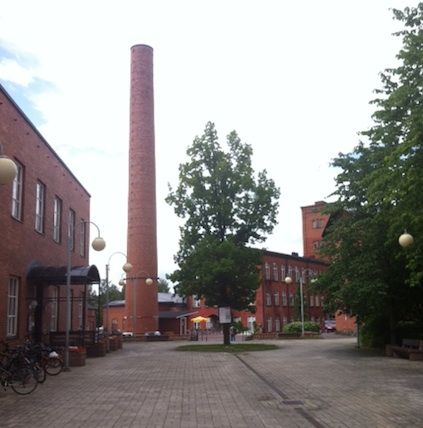
The small Finnish town close to where we’re staying is not alone in experiencing something similar to many other towns around the world – the death of the High Street. This has nothing to do with the current economic crisis and more to do with town planning, but the effects are devastating on local shops and the sense of community. Only on market days do the streets now come alive. The ‘action’ is now a mile down the road in not one, but two mega-shopping centres.

There’s something quite strange about walking through a town centre on a fine, early afternoon and being one of only a handful of people around. Locals do see what’s happening, but for many it’s too late. For the town centre to come alive again, and for people to begin supporting local shops again, and meeting up in the square again, people are going to have to mobilise and, more importantly, want it to happen. A community-lead revival – and this is what that needs – must be lead by the community.

It remains to be seen what will happen here, but many people back home in the UK do have the drive, passion, desire and commitment to rebuild their local communities, and my belief is that appropriate technologies can play a major part in promoting that revival.

I’m in if you are.