Smart mobs, flash mobs. Meet cash mobs.

A couple of months ago I wrote about my new initiative – Means of Exchange – which focuses on how emerging, everyday technologies can be used to democratise opportunities for economic self-sufficiency, rebuild local communities and promote a return to local resource use. It’s been a busy few months, culminating in the launch of our first project this week. And here it is.

You’ve probably heard of smart mobs, or at least flash mobs. Welcome to the brave new world of cash mobs.

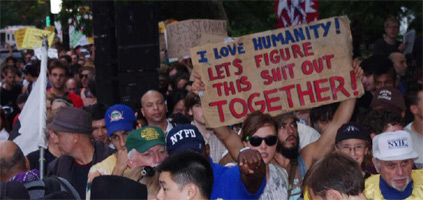
Cash mobbing takes its name from “flash mobbing”, a craze which started way back in 2003 in Manhattan, New York. In a flash mob, a group of people mobilise over social media and arrange to meet in a predetermined place. According to Wikipedia, when they get there they “perform an unusual and seemingly pointless act for a brief time, then disperse, often for the purposes of entertainment, satire, and artistic expression”. Flash mobs were themselves inspired by “smart mobs”, a term coined by Howard Rheingold to describe a group that, contrary to the usual connotations of a mob, “behaves intelligently or efficiently because of its exponentially increasing network links”.

Continuing the theme, a “cash mob” takes place when a group of people arrange to meet at a local shop or store. When they get there, instead of dancing, singing or carrying out other “pointless acts”, they spend a predetermined amount of money. Cash mobs are generally organised by people who enjoy the fun, excitement and novelty of a cash mob, or others who are concerned about the plight of local businesses and want to do something to help.

A number of websites have sprung up over recent months encouraging people to cash mob their local stores, and a number of Facebook groups and Twitter feeds have been created to support their efforts. So far, people have either been given a few pointers and then told to go and figure out the social media bit for themselves, or they’ve been asked to propose local venues to local group ‘owners’ to choose from. We think people want to create their own cash mob, not settle for someone else’s, and they want to be able to seamlessly push it out through their existing social media, not fiddle around creating new accounts. So we built Cash Mobbers.

To coincide with the launch of the Cash Mobbers website we’ve organised what we believe to be London’s first cash mob at an independent bookshop in Hackney this Thursday (9th August).

Further details are available, naturally, on the Cash Mobbers website.

If the idea of driving business back to smaller, locally owned shops and stores is something that appeals to you, there’s a few things you can do:

1. Tweet about this post or the Cash Mobbers site to help spread the word
2. Follow @CashMobbers on Twitter
3. Tweet about the London cash mob, and “Like” the event
4. Let any friends in or around London know about it
5. Organise your own cash mob. Find full details and pointers here

My ethos with Means of Exchange remains the same as it has with much of my work over the years. The main objective is to build and gather a suite of engaging tools to help people help themselves, whenever they’re ready. Sometimes that can take a while, but I’m in no hurry. After all, build it, and they will come…
From text messaging to economic resilience

Three weeks ago we announced that I was stepping down from day-to-day operations at FrontlineSMS to hand over to a new senior management team. It’s clear from the success of the global launch of version 2 of the software over the past week that FrontlineSMS is in safe hands, and the reworked software, outreach and launch were all handled by the team with little involvement from me. It was great to see all their hard work come together, and I congratulate everyone on a job extremely well done. \o/

Photo: Laura W Hudson

As I mentioned in my recent post, I’ll remain involved with the project and will continue to support innovation and entrepreneurship in the developing (and developed) world, will continue to write about technology and Africa, and will continue with mentoring and speaking. The ICT4D and social innovation fields continue to fascinate and inspire me as much as they did all those years ago when I started out, and I’ll remain involved as long as I continue to add value.

Introducing “Means of Exchange”

So, what else will I be working on? Well, for the past two years I’ve been taking an increasing interest in economic resilience, particularly how technology might help buffer local communities from global economic downturns. Ironically, since I started my research the world has entered a period of growing economic uncertainty. The causes – although fascinating – don’t so much interest me, more the response at local, grassroots level.

As we all know, in times of hardship people tend to become increasingly innovative. As Greeks have found themselves with less and less cash in their pockets, many have turned to bartering. It’s how communities react to economic shocks that I’ll be focussing on, and how tools like bartering, swapping, LETS schemes and local currencies are applied and deployed in response.

We pay too little attention to the reserve power of the people to take care of themselves. We are too solicitous for government intervention, on the theory, first, that the people themselves are helpless, and second, that the government has superior capacity for action. Often times both of these conclusions are wrong

Calvin Coolidge

It’s only when things go wrong that we question the systems which regulate, control and dominate our lives. We enter 2012 at a time of great economic uncertainty. Millions of people around the world have lost jobs, homes, businesses, independence and purpose. Millions more face growing uncertainty and insecurity. Many hard working people have been hard hit. In the greater scheme of things they’re simply collateral damage in the rebalancing of a larger, broken world economic system.

While it’s impossible for most of us to remove ourselves entirely from the world economic system, there is a lot we can do to lessen our dependence on it. Funnily enough it’s something our ancestors managed to do pretty well. It’s called self-sufficiency.

For the majority of people, self-sufficiency conjures up images of grow-your-own vegetables on village allotments, but more meaningful economic self-sufficiency is possible if people are creative in how they earn, trade and share with one another. As money has taken over as our primary means of exchange, other more traditional methods have been lost.

What we’ve been left with is an economic system we have little control over, a loss of community and a drift away from the consumption of locally produced goods and services.

But all is not lost. This can be halted, and by using the very technologies which enable us to take part in a globalised society, it can be reversed. If you’re interested in learning more about methods of economic self-sufficiency, or you’re interested in tools and resources to make it happen, then Means of Exchange is for you.

Firstly, the website will focus on how emerging, everyday technologies can be used to democratise opportunities for economic self-sufficiency, rebuild local communities and promote a return to local resource use.

Secondly, if they don’t already exist, we’ll build you the tools so you can make it happen wherever you are. Our first flagship “app” will be released within the next few weeks.

To keep up-to-date with new releases and latest news, check us out via:

See you on the other side.

Closing mobile’s data divide

Good mobile data is hard to come by. Much is either speculative, out of date or – if based on more recent research – expensive. And what is freely available is often spread far and wide across the Web. If you’re into mobiles for development then today your life is set to become a lot easier with the launch of “Mobile and Development Intelligence” (MDI), a new open data platform from the GSM Association which aims to “educate and unite all who want to harness the power of mobile for good”.

A key objective of MDI is to help increase investment and activity in the mobile for development field, and in turn amplify the social, economic and environmental benefits the technology can bring. That positive impact has already touched a wide range of development sectors from education and health to financial services, government transparency and democracy, and agriculture. With mobile phones now in the hands of the very people the development community have historically tried to help – billions of them, and counting – exciting new opportunities have emerged. According to the GSMA:

The mobile phone’s ubiquity is uniquely well-placed to drive economic and social development in emerging markets. Investments in the mobile and development sectors are rising yet there is limited data on which to base these decisions. MDI is designed to bridge this information gap.

These gaps include:

  • The lack of data for business cases, product strategies and programmes
  • Limited visibility of organisations and communities
  • Limited understanding of the impact of mobiles on development
  • Fragmentation of platforms and limited cross-sector convergence

In line with these challenges, MDI aims to provide:

A freely accessible, online repository of data and analysis
MDI will aggregate, cleanse and categorise data from multiple internal and external sources into a single, centralised data repository. Users will have the ability to manipulate, visualise and export the datasets (below: the ratio of total mobile connections to total population, 2009-2011).

Visibility of organisations, products and services and community
MDI will provide an online directory where users can access information about organisations and their products, services and initiatives. It will provide the “who, what, where and how”.

Clarify the impact of mobile on development
Develop impact pathways for each specific sector to find and map evidence of socio-economic benefit, and host impact metrics from other GSMA departments e.g. the impact of mobile on GDP.

Thought leadership on technology convergence
Working outwards from user needs to design common platforms to deliver them.

Future functionality will include an investor hub, document repository, online community and coverage maps making MDI a one-stop shop for NGOs, international NGOs, government departments and the private sector interested in leveraging the power of mobile technology for development.

You can visit the MDI site here.

Congratulations to the GSMA team, partners ThoughtWorks and PwC, and investor the Omidyar Network.

Back at National Geographic

I was no different to many other children my age, taking every opportunity to get my hands on a National Geographic magazine and flicking through each colourful page in wonder and amazement. I’d get most of mine cheap from jumble sales back then – I can afford to buy them full price these days – but that sense of fascination remains.

Thirty years on and I find myself back in Washington DC attending my second National Geographic Explorers Symposium. I’ve packed quite a lot in over those thirty years – school building in Zambia, hospital building in Uganda, a degree in Social Anthropology, carrying out biodiversity surveys in Uganda, running a primate sanctuary in Nigeria, various trips and visits to a host of other countries, most on the African continent and, of course, the development of FrontlineSMS.

It was 2003 that my career took its most significant turn when I started working in mobile, and until very recently FrontlineSMS took up most of my time. It was that work which caught the eye of the panel at the National Geographic Society, culminating in my Award in 2010. I’m back again this year to moderate a panel, help mentor the 2012 Class of Emerging Explorers, and share news of my growing relationship with the Society.

It’s not every day that you find yourself randomly sharing a lift with people behind some of the most famous discoveries of our time. This is a very special place, and it’s always a huge honour to be here. If you’d told me thirty years ago that I’d be walking these corridors today, I’d never have believed you.