
One day.
Two walks.
Three photos.


A nurse has recorded the most common regrets of the dying, and among the top ones is “I wish I hadn’t worked so hard”. What would your biggest regret be if this was your last day of life?
Earlier this week I tweeted a link to this soberingly-titled Guardian article on the “Top Five Regrets of the Dying“. Since then I’ve had several conversations with people on the subject. For me, the line between ‘work’ and ‘life’ has become increasingly blurred over the past twenty years. Back in the early 1990’s when I first started thinking about the intersection of technology, people, conservation and development there wasn’t a job anywhere where I’d have been able to blend all those skills and interests. My ideal job didn’t exist, so I had to create it. This long-standing quote on the kiwanja website sums up pretty well where I’ve ended up today.

Of course, I’m one of the lucky ones. That said, like everyone I have regrets, but if anyone had told me twenty years ago – even nine years ago when I started out in mobile – that I’d be where I am today I’d never have believed them. I met too many people in my banking days who were content to spend their lives doing jobs they didn’t like – hated even – so they could “enjoy their retirement” with a good pension. For me it’s always been about the journey, not the final destination. I still don’t know where I’m going to end up, truth be told.
In sharp contrast to death and regret, Paul Lamb from Man On a Mission Consulting sent me a random email two days after the Guardian article on the subject of happiness (happy life = fewer regrets?). Having a job you love may be one way to happiness (or fewer regrets), but not everyone is lucky enough to have one of those. So, for anyone who’s yet to figure out their purpose, journey or destination, here’s a few good “Happiness Resources” gleaned from Paul’s email.
Enjoy. And be happy.
The happy secret to better work
Shawn Achor, TED Talks (2011)
The habits of happiness
Matthieu Ricard, TED Talks (2004)
10 Ways to be happy
From the Happiness Project
Taking a Kindness Day off of work
Huffington Post (2011)
The Random Acts of Kindness Foundation
AOK.TV
The “social game for good”
The Greater Good Center
The “science for a meaningful life”, courtesy UC Berkeley
The Happy Movie
(In celebration of World Happiness Day on February 11th, 2012)
“Once in a while it really hits people that they don’t have to experience the world in the way they have been told to”
Alan Keightley
Sports players are always told they can “do better”. Even championship winning teams are told they can “play better”. A musician’s next album could always “sound better” and Little Johnny at school could always “try a little harder”. We seem to be in a constant state of attempted self-improvement. Are we ever happy with who we are or what we’ve achieved?
Survival is the main preoccupation for a vast majority of the world’s inhabitants. If it’s not yours then you’re one of the lucky ones, like me. Also, like me, you’re likely instead preoccupied with building a career, or “trying to make something of yourself” as people like to put it. We’re brought up to be ambitious and conscientious, to strive to be successful at whatever we choose to do. Society does what it can to equip us along the way. We’re in a hugely priviledged position.
Personally, I’ve always believed that I need to have fully developed at least three ideas before I consider myself a success. I have no idea why I think I need to be a success, or why I think I need to prove myself three times, or even who I’m trying to prove it all to. But I do know that I enjoy building and starting things, so each time I decide to go through the process it’s because I enjoy it.
Despite what we constantly hear, though, it’s not just the “taking part that counts”. Whatever we do has to succeed – or lead us on to something else that does – if we’re to “reach our potential”.

Many social entrepreneurs live in this world. Life is about taking the seed of an idea, building it into something meaningful, and then ideally doing it all over again. Do it just the once and it might be luck. Do it a few times and you’re smart. The problem with this approach is that you never quite know when you’re “there”. At what point do you stop pushing and settle for what you have? Surely it’s not possible to constantly self-improve?
As someone who’s constantly pushing themselves to improve, I think about this a lot. Looking at the Zen Habits website, I’m not alone. Quashing the Self-Improvement Urge is a wonderfully reflective post on the subject, and is well worth a read if you’re in the same boat. As Leo Babauta himself concludes:
Quash the urge to improve, to be better. It only makes you feel inadequate. And then explore the world of contentment. It’s a place of wonderment.
I wonder how well this approach would sit with today’s social entrepreneurs and innovators?
Driven by a curiosity and a strong interest in primate conservation, late one night back in December 2001 I arrived in Nigeria to take up my post as Project Manager at a sanctuary in Calabar, Cross River State. The year I spent there – starting exactly ten years ago this month – turned out to be fascinating and frustrating in equal measure. Crucially, combined with my previous experiences working on the continent, it also helped shape my understanding of the needs of local people and local NGOs, a focus which remains a central pillar of my wider technology work today.

I wasn’t the only arrival that December day. A small baby chimpanzee had been confiscated (pictured) from a local market and was waiting to be collected from Lekki, a conservation and education centre in Lagos run by the Nigerian Conservation Foundation. Primate rescue was to be a theme of my time in Nigeria, as was a sense that a large part of the ‘conservation effort’ was really damage limitation and control. Rehabilitating orphaned primates was often the easier part – even though it was hugely challenging and distressing. Changing perceptions, overcoming local politics and trying to shift cultural mindsets turns out to be much harder. Not only that, it takes considerably longer, time that increasing numbers of species simply don’t have.
Primate conservation, bush meat hunting and deforestation are all inextricably linked. Tackling one without trying to address the others simply doesn’t work. In its simplest form, the whole thing goes something like this.
Loggers enter the forest and either blanket cut or selectively cut trees. To help get the logs out, paths and roads are opened up into areas which were previously difficult or impossible to access. Loggers need to eat, and many actively hunt for bush meat while working in the forest. Local hunters join in. As more trees are cut and more roads laid, hunters are able to penetrate deeper into the forest, reducing wildlife populations – primates included – yet further
If I were to summarise what I learnt about these complex issues from my time in southern Nigeria, I would break it down into the following categories.
The practical

Although large-scale logging is a significant problem – often carried out by larger (almost always foreign) companies – many poor local people are ‘recruited’ to help in the destruction. Equipped with chainsaws supplied by their employers, they enter community forests and national parks and selectively cut high-worth trees. Roads and paths are cut to remove the logs, which are sometimes cut into large planks before being shipped off. Forestry officials, many of whom haven’t been paid for months, stamp the trees as coming from a legitimate source. I will never forget the haunting sound of distant chainsaws as I walked through those forests.
The cultural
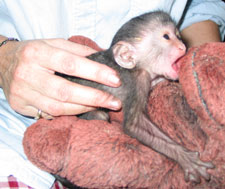 Speaking with the locals in Calabar, many find it inconceivable that people would ever eat primates. In many communities it’s simply taboo, but sadly the same can’t be said for killing them. As outsiders come in search of work, and as main roads open up alongside the fringes of rainforest, hunters from these communities will go in, track down wildlife – primates included – and sell them at the side of the the road. Bush meat is in great demand, and it’s a brisk trade. If a mother is killed then the infant will be sold as a pet – a double bounty for the hunter. Some of these orphans are incredibly young, and barely alive if they are lucky enough to be rescued, as this picture distressingly shows.
The perception
The many Nigerians I met believed that bush meat was much better for you than ‘farmed’ meat, and given the choice they’d rather eat something from the forest than a farm. This is a major challenge for conservation groups trying to ween people off bush meat and more towards livestock of various descriptions. As a case in point, some Nigerians living in London appear to be willing to pay significant amounts of money for illegally imported bush meat, despite the availability of almost any other kind of meat from legal, local sources such as London supermarkets (see this interesting story reported by the International Primate Protection League).
The response
Conservation groups on the ground spend huge amounts of time on education and alternative livelihoods and farming programmes. In the 1990’s there was considerable focus on the potential for “grasscutters” – a widely-distributed cane rat found in West and Central Africa – and how farming and breeding these could help reduce or replace reliance on bush meat for protein. I’m not sure how many of these projects were successful, although some research has been carried out and there has been some success by individuals in Ghana. From my own observations, keeping livestock of any kind (other than chickens or turkeys, which need little looking after) turned out to be a foreign concept to many people, and efforts to promote it largely failed.
The reality
 Speak with the hunters in almost any rural community and there is almost universal recognition that the wildlife is on the decline. Many fondly speak of overnight hunting expeditions with their fathers, and how they’d return the next morning with a healthy ‘catch’. Evidence of distant permanent overnight camps highlight today’s reality – longer trips, days in length, but ones which still don’t guarantee a single kill. Urban dwellers rarely see this reality. Ask them about conservation and wildlife, and their reaction is one of “the monkeys will never finish” (Nigerians often use the term “finish” to describe extinction). Nigerians clearly have much to learn from each other.
It would have been great to have ended my time in Nigeria with a solution to some of these problems, and even better to be able to outline a few of them in this post. But I didn’t, and I don’t.
What I can contribute, though, is this…
Things you can do
Firstly, take a little time to try and understand the problems – plural. It frustrates me to read blanket condemnation in the western media of local people in African countries cutting down forests and daring to kill cute chimpanzees. Yes, it’s sad and its destructive. I’ve seen at first hand the pain and distress of an orphaned primate who’s had to have an arm broken to release its grip on its dead mother, or the look in the eyes of exhausted villagers struggling to put a decent meal on the table for their children. The problems are complex, but they’re human and animal.
Secondly, join a local organisation working with local communities on the ground. If you’re interested in African primates in particular, a good place to start out is the Pan African Sanctuary Alliance (PASA), an organisation committed to the conservation and care of African primates through the support of in-situ sanctuaries.
Thirdly, if you’re the volunteering kind, check out the University of Wisconsin’s Primate Info Net, but bear in mind that volunteering is really only productive if the local organisation can’t find, or afford, a local version of you among the communities in which they work. If that’s the case, be sure you have a transferrable skill so you can train a local person to replace you when you leave. Sustainability isn’t always financial – it also has a human element to it, too.
Fourthly, find out about alternative conservation/human strategies such as direct conservation payments – different models do exist. Just as primate species are different, conservation strategies also need to be. One size rarely fits all, and this is true whether you’re an elephant, a forest, a primate or a local villager.
Finally, stay positive. Problems are many and working solutions are few. Something good will happen if enough people commit to conservation in Africa. Many people already have.