Delivering on your values

I’m just back from my first visit to Harvard University where FrontlineSMS was presented with the 2011 Curry Stone Design Prize. The award ceremony on Monday was followed by a seminar on Tuesday, co-hosted by Nicco Mele and Ethan Zuckerman.

Our beliefs, values and approach come out strongly in this five minute video, put together by the organisers. FrontlineSMS is more than just a piece of software, and I’m equally as proud of the roots and ethos of FrontlineSMS as I am of the tool itself. (You can also watch this video on our community site).

I’ve been involved in international development in one form or another for the past 18 years, and have seen at first hand things that have worked, and things that haven’t. There’s much that’s wrong in the sector, but also a lot that’s right, and for me personally FrontlineSMS embodies how appropriate and respectful ICT4D initiatives can be run, both on a personal and professional level. There’s very little I’d do differently if I started it all over again.

As I wrote earlier this month after news of our Curry Stone Design Prize broke:

Over the past few years FrontlineSMS has become so much more than just a piece of software. Our core values are hard-coded into how the software works, how it’s deployed, the things it can do, how users connect, and the way it allows all this to happen. We’ve worked hard to build a tool which anyone can take and, without us needing to get involved, be applied to any problem anywhere. How this is done is entirely up to the user, and it’s this flexibility that sits at the core of the platform. It’s also arguably at the heart of it’s success.

These core values, built up over six years, remain central to our work. Here’s just a few:

Each and every one is important to us: Putting users ahead – and at the heart – of everything we do, striving for a positive interaction with anyone who comes into contact with our work, aiming to inspire others whilst respecting a diversity of views, always reaching for better, fostering a positive “anything is possible” attitude, making sure we continue to put people – and their needs – ahead of the aspirations of the tech community, managing expectations both internally and for our users, and finally – constantly reminding ourselves why we do what we do.

As we continue to grow as an organisation, maintaining and reinforcing these values will be an increasingly important part of not only who we are, but who we become.
ICT4D postcards: The story so far

A couple of weeks ago I sent out an open invitation for people to contribute to the “ICT4D Postcards Project“. The idea was to gather a collection of postcards from people working in international development who had a technology theme – or influence – in their work. Postcards have been coming in since, and I thought it would be a good idea to post a few up here, ahead of the full collection which will be posted online in the coming weeks.

In short, a postcard consists of a photograph and short narrative which explains why the image is important – or how it relates – to that person’s work. The idea is to go beyond usual explanation and website narrative to reveal more personal insights and motivations of the people who work in our field.

Here’s a selection of five which have come in so far. In no particular order.

Jonathan Donner. Kigali, 2003 | Website | Twitter

In 2003, mobile phones were just appearing in Rwanda. Penetration was just 1.5 per 100 people (1.5%) then. It is over 33% now. I organized some studies to ask microentrepreneurs about how they were using their new phones. Everyone was quite accommodating, letting us ask details about each of the last 10 calls recorded on the phones call log. Though we learned a lot about business processes and productivity, our data also demonstrated just how intertwined these phones had already become into daily life – two-thirds of the calls were with friends and family. I suspect these trends still hold.  At this moment, the interviewer (Nicole K. Umutoni) was probably looking back at me and wondering why I was taking this picture.  Now we know!

Jan Chipchase. Lagos, 2011 | Website | Twitter

That your and my cultural sensibilities about what is appropriate is irrelevant. That there are many ways to extend the internet – and that those that make the effort to do so, show us where the value is. That everything can, and will eventually be remixed.

Linda Raftree. Cameroon, June 2010 | Website | Twitter

This picture is taken on top of a large rocky hill during a workshop in Ndop, Cameroon. I love the young man’s rasta hat and the delicate lavender colored felt flower in the girl’s hair, the tender manner that they are learning together to film, and how the camera helps them see themselves and their surroundings in new ways. Up on that rock in the middle of the fields, breeze blowing under the giant sky, watching two young people teach other; the reminder that I am transient in this line of work and do not matter much in the larger scheme of things was strong, beautiful and comforting.

Erik Hersman. Liberia, 2009 | Website | Twitter

“ICT4D” represents a mental roadblock. A term that brings as much baggage with it as a sea of white SUVs, representing the humanitarian industrial complex’s foray into the digital world. It means we’re trying to airlift in an infrastructure instead of investing in local technology solutions. Like the SUVs, it’s currently an import culture that will not last beyond the project’s funding and the personnel who parachuted in to do it.

Heather Underwood. Kenya, 2011 | Website | Twitter

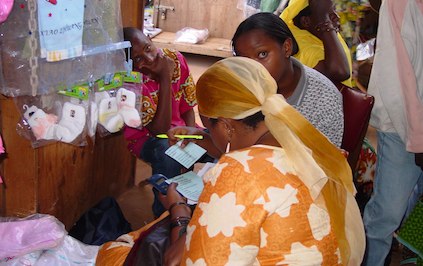
In August, 2011, I visited several health clinics in Kenya to determine the feasibility of using digital pen technology to enhance paper health forms. This photo was taken in a rural clinic in Mangalete. The woman using the digital pen is filling out a partograph – a paper tool used to monitor and detect prolonged or abnormal labors. She simply picked up the pen and started showing me how to properly fill out the form. When the pen’s audio suddenly informed her that she had crossed the alert line and should consider transferring the patient, her surprise and immediate understanding of the quality assurance and training benefits of this tool were incredibly gratifying. This interaction highlighted one of my core beliefs about ICT4D: big problems can often be addressed with simple solutions.

If you’re interested in taking part there’s still time. I’ll need the following:

1. A photo (high resolution if possible) – one you’ve taken, please. All it needs to qualify is to have a technology theme – radio, mobile phone, computer, solar lamp and so on.
2. Details of where it was taken and the year (if you remember).
3. A short description of what it is, and why it means something to you. Keep it short – think back of a postcard! We want personal stories – how you connect with the picture – not just a description of what it is.
4. A link to your website, blog or Twitter handle (or all three) so I can point people back to you and your work.

You can email all of this to postcards@kiwanja.net

ICT4D postcards

“Luxury Travel Stories is about the idea of connecting the world via ‘stories’ in postcard format. A photo with accompanying text no more than what would fit on the back of a postcard”.

Last month I was invited to contribute a postcard to the Luxury Travel Stories project, and chose the photo – and text – below. You can view the post, and those from other contributors, here. The whole site is based on the idea of “connecting the world via ‘stories’ in postcard format. A photo with accompanying text no more than what would fit on the back of a postcard”. Like “Dear Photograph” (which I blogged about here), it’s a simple but compelling idea.

It was 2004, and I was working on a project which took me to the intersection of technology and international development. Much to many people’s surprise, mobile phones were beginning to make their way into parts of rural Africa, including areas like that in the photo. This is Bushbuckridge – an area which straddles Kruger National Park in South Africa. These women spend most of their days queueing for water, and we pulled up one morning when I took this shot. I use it a lot in my work. It highlights the challenges we face in the development community, and challenges me to think hard about the role of technology – if any – in improving people’s lives.

One of the things I’ve always maintained is that we often know little about the background and motivation of people working in our field, and how they came to work in it. So, in part as a way to rectify this I thought it would be great to put together a slideshow of ICT4D-related postcards to share online.

If you’d like to take part I’ll need the following:

1. A photo (high resolution if possible) – one you’ve taken, please. All it needs to qualify is to have a technology theme – radio, mobile phone, computer, solar lamp and so on.
2. Details of where it was taken and the year (if you remember).
3. A short description of what it is, and why it means something to you. Keep it short – think back of a postcard! We want personal stories – how you connect with the picture – not just a description of what it is.
4. A link to your website, blog or Twitter handle (or all three) so I can point people back to you and your work.

You can email all of this to postcards@kiwanja.net

Once I have enough I’ll pull everything together and drop it into Slideshare. If enough people contribute it might be fun to map the photos, and stories, on Ushahidi.

Looking forward to seeing where this goes…

The inspiration at the heart of innovation

I couldn’t figure out last night, when I woke at 2am, why Twitter was over capacity. A few minutes later I got the answer. Steve Jobs had passed away. A quick visit to the BBC website confirmed the news. Ashton Kutcher (of all people) seemed to sum the mood up well:

Steve Jobs gave an address to students at Stanford University in June 2005. These seven quotes are the highlights for me, and give us a glimpse of the man – what drove him, what made him tick, his passion for what he did, and how he saw his place in the world.

Steve Jobs. 1955 – 2011.

“You can’t connect the dots looking forward; you can only connect them looking backwards. So you have to trust that the dots will somehow connect in your future. You have to trust in something — your gut, destiny, life, karma, whatever. This approach has never let me down, and it has made all the difference in my life”

“I didn’t see it then, but it turned out that getting fired from Apple was the best thing that could have ever happened to me. The heaviness of being successful was replaced by the lightness of being a beginner again, less sure about everything. It freed me to enter one of the most creative periods of my life”

“Sometimes life hits you in the head with a brick. Don’t lose faith. I’m convinced that the only thing that kept me going was that I loved what I did. You’ve got to find what you love. And that is as true for your work as it is for your lovers. Your work is going to fill a large part of your life, and the only way to be truly satisfied is to do what you believe is great work. And the only way to do great work is to love what you do. If you haven’t found it yet, keep looking. Don’t settle. As with all matters of the heart, you’ll know when you find it. And, like any great relationship, it just gets better and better as the years roll on. So keep looking until you find it. Don’t settle”

“When I was 17, I read a quote that went something like: “If you live each day as if it was your last, someday you’ll most certainly be right.” It made an impression on me, and since then, for the past 33 years, I have looked in the mirror every morning and asked myself: “If today were the last day of my life, would I want to do what I am about to do today?” And whenever the answer has been “No” for too many days in a row, I know I need to change something”

“Remembering that I’ll be dead soon is the most important tool I’ve ever encountered to help me make the big choices in life. Because almost everything — all external expectations, all pride, all fear of embarrassment or failure – these things just fall away in the face of death, leaving only what is truly important. Remembering that you are going to die is the best way I know to avoid the trap of thinking you have something to lose. You are already naked. There is no reason not to follow your heart”

“Death is the destination we all share. No one has ever escaped it. And that is as it should be, because Death is very likely the single best invention of Life. It is Life’s change agent. It clears out the old to make way for the new. Right now the new is you, but someday not too long from now, you will gradually become the old and be cleared away”

“Your time is limited, so don’t waste it living someone else’s life. Don’t be trapped by dogma – which is living with the results of other people’s thinking. Don’t let the noise of others’ opinions drown out your own inner voice. And most important, have the courage to follow your heart and intuition. They somehow already know what you truly want to become. Everything else is secondary”