Smart mobs, flash mobs. Meet cash mobs.

A couple of months ago I wrote about my new initiative – Means of Exchange – which focuses on how emerging, everyday technologies can be used to democratise opportunities for economic self-sufficiency, rebuild local communities and promote a return to local resource use. It’s been a busy few months, culminating in the launch of our first project this week. And here it is.

You’ve probably heard of smart mobs, or at least flash mobs. Welcome to the brave new world of cash mobs.

Cash mobbing takes its name from “flash mobbing”, a craze which started way back in 2003 in Manhattan, New York. In a flash mob, a group of people mobilise over social media and arrange to meet in a predetermined place. According to Wikipedia, when they get there they “perform an unusual and seemingly pointless act for a brief time, then disperse, often for the purposes of entertainment, satire, and artistic expression”. Flash mobs were themselves inspired by “smart mobs”, a term coined by Howard Rheingold to describe a group that, contrary to the usual connotations of a mob, “behaves intelligently or efficiently because of its exponentially increasing network links”.

Continuing the theme, a “cash mob” takes place when a group of people arrange to meet at a local shop or store. When they get there, instead of dancing, singing or carrying out other “pointless acts”, they spend a predetermined amount of money. Cash mobs are generally organised by people who enjoy the fun, excitement and novelty of a cash mob, or others who are concerned about the plight of local businesses and want to do something to help.

A number of websites have sprung up over recent months encouraging people to cash mob their local stores, and a number of Facebook groups and Twitter feeds have been created to support their efforts. So far, people have either been given a few pointers and then told to go and figure out the social media bit for themselves, or they’ve been asked to propose local venues to local group ‘owners’ to choose from. We think people want to create their own cash mob, not settle for someone else’s, and they want to be able to seamlessly push it out through their existing social media, not fiddle around creating new accounts. So we built Cash Mobbers.

To coincide with the launch of the Cash Mobbers website we’ve organised what we believe to be London’s first cash mob at an independent bookshop in Hackney this Thursday (9th August).

Further details are available, naturally, on the Cash Mobbers website.

If the idea of driving business back to smaller, locally owned shops and stores is something that appeals to you, there’s a few things you can do:

1. Tweet about this post or the Cash Mobbers site to help spread the word
2. Follow @CashMobbers on Twitter
3. Tweet about the London cash mob, and “Like” the event
4. Let any friends in or around London know about it
5. Organise your own cash mob. Find full details and pointers here

My ethos with Means of Exchange remains the same as it has with much of my work over the years. The main objective is to build and gather a suite of engaging tools to help people help themselves, whenever they’re ready. Sometimes that can take a while, but I’m in no hurry. After all, build it, and they will come…

In numbers: A decade of mobile

January 2013 will be my ten year anniversary in “mobiles for development”. To say a lot has changed is something of an understatement. Back in those early pre-m4d-community days I would often get asked “Do they have mobile phone networks in Africa?”, or “How do people in Africa afford phones?”, or “Why are you wasting your time looking at the use of mobile phones in development?”.

Silly questions today, but not so silly back then, perhaps. Mobile phone ownership and penetration were largely in their infancy, and I only began looking at the conservation and development potential of this ’emerging’ technology thanks to the incredible vision of a team at Fauna & Flora International in Cambridge, UK. A year after we started work we’d not only developed a groundbreaking project – wildlive! – but pulled together what was likely the first comprehensive report on the development potential of mobile phones. With so little actual data to go on, most of our research was based on anecdotal evidence. Ironically, solid data – even ten years on – is still a little tricky to come by.

(The full report is available in the kiwanja Mobile Database here).

Over the past nine years the conversation – and the technology – have moved on considerably, and today few people would argue that mobiles have had a transformative effect in the developing world. Quite where things are headed is a little unclear, but infographics such as this two-pager from the World Bank can help remind us how far we’ve come, and how exciting this sector is to work in.

Click for a larger (readable) version of page one here and page two here.

I would say “Here’s to the next ten years”, but with the pace of change we’ve seen so far we’re probably best not looking that far ahead.

Good idea, bad idea or no idea?

For every one of our failures we had spreadsheets that looked awesome

Scott Cook. Founder and Chairman, Intuit

One of the biggest privileges of working in the technology sector for so long are the number of young entrepreneurs and innovators who approach me for thoughts on their big idea. As I’ve written before, whenever I can add value to someone else’s work I’m more than happy to. Giving back is important.

There’s something of an assumed wisdom in the social entrepreneurship and innovation sectors that “ideas are cheap” and that what it’s really all about is execution. While that’s true to an extent (I’ve only put a few of my ideas over the years into practice) good ideas certainly aren’t cheap. It’s just that sometimes – most of the time, in fact – they’re frustratingly hard to spot. Just to complicate things further, ideas often evolve over time, so could well start off in the lower half of the score card but then rise to dizzying heights later.

We’ll never know what would have happened to the tens of thousands of product ideas Steve jobs famously turned down, but the ones he did pursue were clearly good calls (with the exception of Apple TV, perhaps). For the Apple CEO, turning down a great idea was a price worth paying to maintain his relentless focus on focus.

But focusing on ideas and execution doesn’t give us the whole picture. One of the most effective tools in an innovator’s toolbox is passion and, although it won’t turn a mediocre idea into a great one, being passionate about it will certainly impact positively on their ability to deliver.

Passion is easy to spot, but what about the potential of the idea being communicated? In a recent Co.Design article, Scott Anthony provided a few helpful tips. Before getting too far down the road, he says, ask yourself these five questions:

1. Is it targeting an important problem that customers can’t address because existing solutions are expensive or inconvenient?

2. Does it solve the problem in a simpler, more convenient, or more affordable way?

3. Is there a plausible hypothesis about an economically attractive, scalable business model? Don’t believe financial forecasts, but ensure that there’s at least a sensible story

4. Does the team have the right stuff to course-correct according to in-market learning? Avoid dogmatic teams that will keep trying to prove they are right in spite of mounting evidence to the contrary

5. Can early profitability be a choice? The sooner there is a line of sight to profits, the better. You might make a strategic decision to be unprofitable by investing in marketing, sales capability, and so on, but at least you know that the core part of the model works

One of the key lessons FrontlineSMS taught me was the importance of getting your idea out there as quickly as possible and letting your users shape it. Thanks to the Internet, product launches – in the technology sector at least – are today only a mouse click away. Products can be accessed, used, hacked and abused in no time – or simply not used at all – giving you the quickest and clearest indication possible of its potential. Twitter was, in effect, shaped this way.

In terms of the tools, networks and opportunities available today, it’s never been easier to be an innovator or social entrepreneur. The difficult part has remained the same for generations of innovators gone by – that tricky combination of nailing a great idea, convincing others of its value, and then delivering on it.

Further reading
Three Ways To Predict What Consumers Want Before They Know It

The death of a town centre.

The vast majority of my work over the past ten years has been focused specifically in the developing world. Various countries across Africa, in particular, were destinations for most of my travel and research. I’ve had an incredible time quenching a thirst for knowledge going all the way back to the early 1990’s when I first took an interest in international development.

Of course, if the target of your sole interest is overseas, and several thousand miles away at that, then it’s an obvious struggle to continually spend time in the field. Since the birth of Henry Banks last summer I’ve been spending less and less time away from home. This, fortunately for me, has coincided with a recent transition from day-to-day involvement in FrontlineSMS, and a move to a new project which I’ve been slowly working on for a couple of years – Means of Exchange – which has roots much closer to home.

This has a few advantages, the main one being that the fundamental problem I’m hoping to address – how we build tools to promote economic resilience among local communities – is (sadly) everywhere around me.

Even when I’m on holiday.

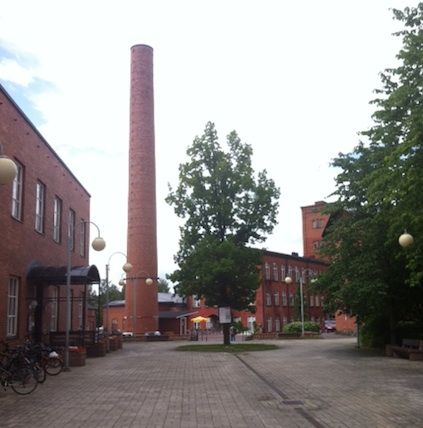
The small Finnish town close to where we’re staying is not alone in experiencing something similar to many other towns around the world – the death of the High Street. This has nothing to do with the current economic crisis and more to do with town planning, but the effects are devastating on local shops and the sense of community. Only on market days do the streets now come alive. The ‘action’ is now a mile down the road in not one, but two mega-shopping centres.

There’s something quite strange about walking through a town centre on a fine, early afternoon and being one of only a handful of people around. Locals do see what’s happening, but for many it’s too late. For the town centre to come alive again, and for people to begin supporting local shops again, and meeting up in the square again, people are going to have to mobilise and, more importantly, want it to happen. A community-lead revival – and this is what that needs – must be lead by the community.

It remains to be seen what will happen here, but many people back home in the UK do have the drive, passion, desire and commitment to rebuild their local communities, and my belief is that appropriate technologies can play a major part in promoting that revival.

I’m in if you are.