From text messaging to economic resilience

Three weeks ago we announced that I was stepping down from day-to-day operations at FrontlineSMS to hand over to a new senior management team. It’s clear from the success of the global launch of version 2 of the software over the past week that FrontlineSMS is in safe hands, and the reworked software, outreach and launch were all handled by the team with little involvement from me. It was great to see all their hard work come together, and I congratulate everyone on a job extremely well done. \o/
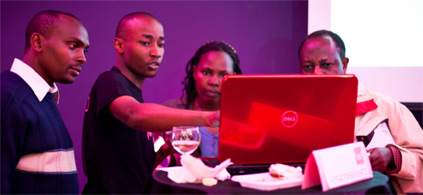
Photo: Laura W Hudson

As I mentioned in my recent post, I’ll remain involved with the project and will continue to support innovation and entrepreneurship in the developing (and developed) world, will continue to write about technology and Africa, and will continue with mentoring and speaking. The ICT4D and social innovation fields continue to fascinate and inspire me as much as they did all those years ago when I started out, and I’ll remain involved as long as I continue to add value.

Introducing “Means of Exchange”

So, what else will I be working on? Well, for the past two years I’ve been taking an increasing interest in economic resilience, particularly how technology might help buffer local communities from global economic downturns. Ironically, since I started my research the world has entered a period of growing economic uncertainty. The causes – although fascinating – don’t so much interest me, more the response at local, grassroots level.

As we all know, in times of hardship people tend to become increasingly innovative. As Greeks have found themselves with less and less cash in their pockets, many have turned to bartering. It’s how communities react to economic shocks that I’ll be focussing on, and how tools like bartering, swapping, LETS schemes and local currencies are applied and deployed in response.

We pay too little attention to the reserve power of the people to take care of themselves. We are too solicitous for government intervention, on the theory, first, that the people themselves are helpless, and second, that the government has superior capacity for action. Often times both of these conclusions are wrong

Calvin Coolidge

It’s only when things go wrong that we question the systems which regulate, control and dominate our lives. We enter 2012 at a time of great economic uncertainty. Millions of people around the world have lost jobs, homes, businesses, independence and purpose. Millions more face growing uncertainty and insecurity. Many hard working people have been hard hit. In the greater scheme of things they’re simply collateral damage in the rebalancing of a larger, broken world economic system.

While it’s impossible for most of us to remove ourselves entirely from the world economic system, there is a lot we can do to lessen our dependence on it. Funnily enough it’s something our ancestors managed to do pretty well. It’s called self-sufficiency.

For the majority of people, self-sufficiency conjures up images of grow-your-own vegetables on village allotments, but more meaningful economic self-sufficiency is possible if people are creative in how they earn, trade and share with one another. As money has taken over as our primary means of exchange, other more traditional methods have been lost.

What we’ve been left with is an economic system we have little control over, a loss of community and a drift away from the consumption of locally produced goods and services.

But all is not lost. This can be halted, and by using the very technologies which enable us to take part in a globalised society, it can be reversed. If you’re interested in learning more about methods of economic self-sufficiency, or you’re interested in tools and resources to make it happen, then Means of Exchange is for you.

Firstly, the website will focus on how emerging, everyday technologies can be used to democratise opportunities for economic self-sufficiency, rebuild local communities and promote a return to local resource use.

Secondly, if they don’t already exist, we’ll build you the tools so you can make it happen wherever you are. Our first flagship “app” will be released within the next few weeks.

To keep up-to-date with new releases and latest news, check us out via:

See you on the other side.

Closing mobile’s data divide

Good mobile data is hard to come by. Much is either speculative, out of date or – if based on more recent research – expensive. And what is freely available is often spread far and wide across the Web. If you’re into mobiles for development then today your life is set to become a lot easier with the launch of “Mobile and Development Intelligence” (MDI), a new open data platform from the GSM Association which aims to “educate and unite all who want to harness the power of mobile for good”.

A key objective of MDI is to help increase investment and activity in the mobile for development field, and in turn amplify the social, economic and environmental benefits the technology can bring. That positive impact has already touched a wide range of development sectors from education and health to financial services, government transparency and democracy, and agriculture. With mobile phones now in the hands of the very people the development community have historically tried to help – billions of them, and counting – exciting new opportunities have emerged. According to the GSMA:

The mobile phone’s ubiquity is uniquely well-placed to drive economic and social development in emerging markets. Investments in the mobile and development sectors are rising yet there is limited data on which to base these decisions. MDI is designed to bridge this information gap.

These gaps include:

  • The lack of data for business cases, product strategies and programmes
  • Limited visibility of organisations and communities
  • Limited understanding of the impact of mobiles on development
  • Fragmentation of platforms and limited cross-sector convergence

In line with these challenges, MDI aims to provide:

A freely accessible, online repository of data and analysis
MDI will aggregate, cleanse and categorise data from multiple internal and external sources into a single, centralised data repository. Users will have the ability to manipulate, visualise and export the datasets (below: the ratio of total mobile connections to total population, 2009-2011).

Visibility of organisations, products and services and community
MDI will provide an online directory where users can access information about organisations and their products, services and initiatives. It will provide the “who, what, where and how”.

Clarify the impact of mobile on development
Develop impact pathways for each specific sector to find and map evidence of socio-economic benefit, and host impact metrics from other GSMA departments e.g. the impact of mobile on GDP.

Thought leadership on technology convergence
Working outwards from user needs to design common platforms to deliver them.

Future functionality will include an investor hub, document repository, online community and coverage maps making MDI a one-stop shop for NGOs, international NGOs, government departments and the private sector interested in leveraging the power of mobile technology for development.

You can visit the MDI site here.

Congratulations to the GSMA team, partners ThoughtWorks and PwC, and investor the Omidyar Network.

Back to the Future: Seventeen things you might not know about FrontlineSMS

This post was first published on the FrontlineSMS website last October to celebrate six years since the software’s launch. This week the FrontlineSMS team – which now spans three continents – are preparing for the release of the latest version. Launch events are being held in the US, UK and Kenya. Further details are available here.

With this, and our transition announcement a couple of weeks ago, it felt like a good time to reflect on the early days of the software. Thanks to the great support of our online community, users, staff, donors, bloggers and the media, FrontlineSMS today is well known throughout the wider ICT4D world. But it wasn’t always that way. Here’s that post in full.

In late October 2005, an early beta – “proof-of-concept” – version of FrontlineSMS was released to the world. It took just ten months for the idea to shape itself into the early stages of what you see today. In this, the second and last of our sixth birthday celebration posts (you can read the first here), we dig deep into our email archives and reveal some of the more interesting early – and perhaps surprising – moments of the project.

The idea for FrontlineSMS was conceived in early 2005 with the help of several field trips to South Africa and Mozambique, a bottle of beer and “Match of the Day”. All is revealed in this fun, short National Geographic video made in 2010:

The very first email which specifically references FrontlineSMS was sent on 6th March, 2005 at 0853 to register the domain name.

Prior to that the working title was “Project SMS”. The first email to reference “Project SMS” was sent on Wednesday 26th January, 2005 at 12:02. In it, the entire concept was described in just 963 words with an initial estimated budget of just £2,000 ($3,000).

Factoring in equipment and other costs, personal gifts totaling £10,000 were secured on 16th March, 2005 from two former Vodafone directors.

“The potential for FrontlineSMS is very exciting, and I am very much looking forward to working on the project. The potential impact for conservation and development is considerable.” – Email from me to one of the supporters, 3rd May, 2005.

Preparation for the project officially got underway with the purchase of equipment totaling £1,476.09 on 22nd May, 2005:

One month later the timeline for the project was laid out. FrontlineSMS was delivered bang on schedule. From an email on 22nd June, 2005:

“I will begin working on the specification over the next couple of weeks, and will then get stuck into the initial programming phase during August. I have allocated that whole month to FrontlineSMS. As per the original timeline, July will be preparation, and August to September development time, so by October we should have something to trial.”

August 2005: The Beta version of FrontlineSMS was developed on this kitchen table in Finland. In the absence of any other images, the forest view from the window was used as the main banner for the first FrontlineSMS website later that month.

News of FrontlineSMS was first revealed to the media in an interview with the Charity Times [PDF] in August, 2005. Software development was briefly paused on 26th August so that the first FrontlineSMS website could be hastily put together ahead of the article’s release.

“I have very high hopes that FrontlineSMS is really going to open the door to SMS technology to the wider NGO community” – Email to World Wildlife Fund, who were interested in trailing the software. 2nd September, 2005.

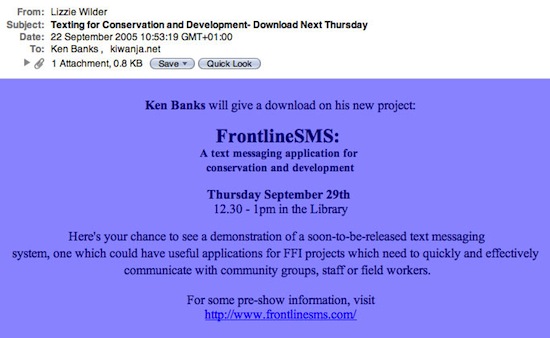
On 29th September, 2005 FrontlineSMS was presented for the first time at an internal event at Fauna & Flora International in Cambridge, UK:

On 5th October, 2005, to celebrate its imminent launch, FrontlineSMS buys up 200 pixels on the Million Dollar Homepage, a site which has since gone down in Internet folklore. (Read more on this here).

Email, 6th October, 2005: “Google now gives us around 80 results when searching for FrontlineSMS”. Today the number is well over 100,000.

Email to supporters, 31st October, 2005: “The FrontlineSMS texting system is now ready for trial”. These nine words signaled our official launch exactly six years ago today.

Email dated 14th November, 2005 from the MacArthur Foundation: “The MacArthur Foundation’s Technology Grants Committee is always looking for innovative applications of technology for the NGO sector. I’d love to have a chat with you about your application if you have the time”. Two years later MacArthur would become the first donor to make an investment in FrontlineSMS with a $200,000 grant. This funded a major rewrite and a new website in 2008.

14th November, 2005: 160 Characters are the first mobile-focused news site to announce the release of FrontlineSMS.

15th November, 2005: We receive an email enquiry from Kubatana, a Zimbabwean civil society organisation. Days later FrontlineSMS had its first official implementation. Kubatana still use FrontlineSMS today.

Today, with fifteen staff over three continents, users in over 80 countries across 20 different non-profit sectors, and over 25,000 downloads, the rest – as they say – is history…  \o/

Mobile Convention Amsterdam. In tweets.

A couple of weeks ago I was invited to speak at Mobile Convention Amsterdam. It was a largely commercial event, with a focus on marketing in particular, but the organisers wanted at least one session on the social impact of the technology. Before and after my talk there was plenty to tweet about, so in the spirit of previous “in tweets” posts here’s a summary of some of the more interesting takeaways from the day.

Context: For years our single digital view of the world was through a desktop computer, later wired to a modem and later again, the Internet. Today we’re free to roam and are spoilt for choice with multiple views – from PC’s to laptops to tablets to mobiles. The landscape is unrecognisable from just a few years ago.

Context: A comment which will ring alarm bells among privacy and security experts, but one not lost on the mobile marketing community (or dictatorial, oppressive regimes come to that).

Context: Not everything has to be “new” to be “innovative”.

Context: How Nokia, a mobile pioneer, saw the shift as mobiles became smaller and smaller, and smarter and smarter.

Context: Anyone aware of the history of this fascinating company will know they’ve already re-invented themselves a number of times in their long history. Rubber, cabling and paper all feature. Mobile phones were nowhere in site until the 1980’s. It was a surprise move back then – any future move out of mobiles will be the same, but not impossible given their current troubles.

Context: The iPhone was somewhat written-off by analysts in its early days. That’s the beauty of disruptive technology.

Context: As if we needed reminding of the lightning speed of innovation in the mobile space, Horace Dediu makes the point that the biggest thing in mobile today wasn’t even around a few short years ago.

Context: This is arguably one of the problems being faced by Nokia (with Symbian) and Microsoft (with Windows). Apple had no legacy to deal with, no backwards compatibility to consider, no ‘shoehorning’ of platforms. Symbian, by way of a counter example, was never designed for touch screens but ended up powering many of Nokia’s.

Context: If Apple are to stay ahead in a ridiculously fast-paced industry then they’ll need to be the ones to supersede the iPhone for style, speed and functionality. If they don’t, someone else will. Samsung are certainly having a good go.

Context: A splash of self-promotion ahead of my lunchtime talk.

Context: One of the growing criticisms of the ICT4D approach is that technology often leads the way. Start with the problem – the experience – whether you’re designing for a merchant banker in New York or a fisherman in Mombassa.

Context: QR codes certainly haven’t set the mobile world on fire, but it was a surprise to hear that when they are used properly (which isn’t often) they have a pretty good hit rate.

Context: The BBC talk about their approach to the 2012 Olympics digital coverage, where the user experience will be consistent across multiple platforms (they hope).

Context: Nice to have some numbers on this. Tomi certainly highlights the usefulness of SMS in emergency and disaster reporting/response.

Context: Text messages may be small, but send enough of them and you’ve got the equivalent of a pretty wide pipe.

Context: No-one in the audience expected this. “Visa”, “m-PESA”, “Mastercard” were all favourites as the inventors of mobile money (it depends, of course, how you define ‘invent’). Thinking of mobile money as 13 years old also reminds us that, even though it’s got the buzz right now, it’s not all that new.

Context: The meteoric rise of m-PESA continues. It’s streets ahead of anything else even before it hits that magical 50% figure.

Context: Tomi is a great and engaging speaker. Check out his free eBook if you want more.

Previous “In tweets” posts include:
The Networked Society Forum. In tweets.
The Aspen Environment Forum. In tweets.
Tim Smit. In tweets.