The “emerging market” handset trap

Today at Mobile World Congress, Vodafone announced “the world’s cheapest phone”. At $15 it certainly scores low on the price tag – which is good – but it also scores low on functionality – not so good. Not only is this a problem for any end user who might need (or want) to use it for things beyond voice calling and SMS, but it’s also perpetuating a long-standing problem in the social mobile world dating back over five years.

With the ICT4D community putting an increasing focus on “smarter phones” – ones which feature downloadable applications and allow for cloud-based solutions, for example – where do phones like today’s Vodafone 150 fit in? Aimed specifically at emerging markets, these are the kinds of phones Vodafone are hoping will end up in the hands of the very patients or farmers the ICT4D world is itself working hard to reach.

Low-cost phones have certainly achieved one thing – low cost – and in price terms they’ve done exactly what they said on the tin. Over the past five years or so, prices have indeed steadily dropped, as we can see if we pick an early “emerging market handset” winner from 2005 (the Motorola C113), a ZTE phone widely available in East Africa in 2008, and today’s Vodafone 150.
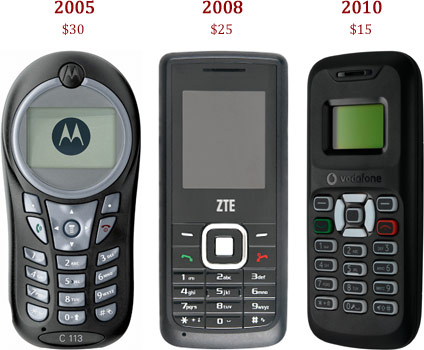
The prices may have changed, but functionality has largely stagnated. You couldn’t browse the web on the Motorola in 2005, nor the ZTE in 2008, and today you’d have the same problem on the Vodafone 150. You can’t download applications onto any of them, either. They all have monochrome screens and look pretty-much-the-same despite having a five year gap between them. Very little has changed other than price, it would seem. Voice and SMS remain king at the bottom of the pyramid, or so it would seem.

The real trick is to reduce the price of these phones whilst at the same time increasing (or at very least maintaining) functionality, a combination which no manufacturer has yet managed to crack. Nokia’s announcement last week of their cheapest 3G-enabled phone for the Indian market shows prices are shifting downward for data enabled phones, but at $90 it’s still some way off what most would consider affordable for the remaining 1.5 billion people in the world without a phone.

From today’s announcement, a sub-$40 smart phone – which really would change the game – looks to be as far off as ever.

[Related post: “The Digital Divider“]

NASA on Mars vs. Development in Africa?

Better late than never, I’m about to start reading “Dead Aid“, Dambisa Moyo’s much touted book. I’ve already read a few blog posts and reviews – some about her, some about her book – and the Guardian’s “An evening with Dambisa Moyo” seemed worth a look. In an otherwise downbeat review, one statement stood out a mile.

“Africa is to development what Mars is to NASA” – the ultimate development studies essay question. It certainly got me thinking. To what extent is Africa development’s playground, a place to ‘try things’, to experiment? Often with so little accountability – see Bill Easterly‘s “White Man’s Burden” – it’s easy to see why it’s thought of as an easy place to pilot, to test, to try out. “And if it goes wrong, well, let’s try something else, somewhere else”.

During a workshop at IDS a couple of weeks ago, I commented that the development sector in Africa was littered with the carcasses of failed projects, a kind of ‘elephant graveyard’ for the well-intended.

I’d love to see an ICT4D/African technology conference pick up on the “NASA, Mars, Development, Africa” theme. And I’d love to be in the audience. Any takers?

Social mobile and the missing metrics

Scenario 1: Five hundred people gather together for three days. They talk, they discuss, they share and they learn. And then they leave. Some stay in touch, others have picked up enough to start a project of their own. Others just leave with a satisfied curiosity, others with the odd new blog post behind them

Scenario 2: A charitable foundation funds the creation of a new mobile tool. Over a one year period there is software development, a new website, user testing and roll-out

Scenario 3: A university professor embarks on a piece of field-based research to examine the impact of a mobile-based health initiative in Africa. He or she writes a paper, highlights what did and didn’t work, gets it published and presents it at a conference

Question: What do these three scenarios have in common?
Answer: It’s unlikely we’ll ever know their full, or real, impact

Let’s assume, for one moment, that everyone working in social mobile wants to see their work have real, tangible impact on the ground. That would equate to:

  • A patient receiving health information through their phone which can be directly attributed to improving their health, or their likelihood of staying alive
  • A farmer receiving agricultural information which can be directly attributed to better family nutrition, or an increase in income or standard of living
  • A team of human rights activist reporting violations which can be directly attributed to the fall of an evil regime, or the passing of new legislation, or the saving of a specific person’s life
  • And so on…

Fine. But are things ever this clear cut? Ever this black or white?

The social mobile world is full of anecdotes. Qualitative data on how certain services in certain places have been used to apparent great effect by end-users. But what we so often lack is the quantitive data which donors and critics clamour for. You know – real numbers. Take the 2007 Nigerian Presidential elections, an event close to my own heart because of the role of FrontlineSMS. This year – 2010 – will witness another election in Nigeria. What was the lasting impact of the 2007 mobile election monitoring project? Will things be done any differently this year because of it? Did it have any long-term impact on behaviour, or anti-corruption efforts?

Much of the data we have on FrontlineSMS falls into the anecdotal and qualitative categories. Like many – maybe most – mobile-based projects, we have a lot of work to do in determining the very real, on-the-ground impact of our technology on individuals. We regularly write and talk about these challenges. But it’s not just about having the funding or the time to do it. It’s figuring out how we measure it.

If a farmer increases his income through a FrontlineSMS-powered agriculture initiative, for example, but then spends that extra money on beer, that’s hardly a positive outcome. But it is if he passes it to his wife who then uses it to send their third or fourth daughter to school. How on earth do we track this, make sense of it, monitor it, measure it, or even decide how we do all of these things? Do we even need bother at all?

Of course, as my recent Tweet suggests, we shouldn’t get too obsessed with the data. But it’s important that we don’t forget it altogether, either. We need to recognise the scale of the challenge – not just us as software developers or innovators, but also the mobile conference or workshop organiser, and the professor, both of whom need to face up to exactly the same set of questions. The case of the missing metrics applies just as much to one as it does to the others, and we all need to be part of finding the answer.

Talking to the trees?

The UK’s Guardian newspaper ran an interesting photo gallery last week showing mobile phone masts ‘dressed’ up as trees. For a while it seemed these might catch on as increasing numbers of people complained about the appearance of ‘ugly’ metal masts in their neighbourhoods. While inner-city masts can be hidden, in the country there are fewer options. Disguising them as trees is a favourite.

More images and descriptions on the Guardian website gallery here.