
A few months ago Josh Nesbit, a Senior in the Human Biology Program at Stanford University, travelled to east Africa where he spent the best part of his summer introducing FrontlineSMS into a rural hospital in Malawi.
St. Gabriel’s Hospital, where Josh worked, is located in Namitete. It serves 250,000 rural Malawians spread throughout a catchment area one hundred miles in radius. With a national HIV prevalence rate of 15-20%, children orphaned by AIDS will represent as much as one tenth of the country’s population by 2010. With tuberculosis (TB), malaria, malnutrition and pneumonia ravaging immuno-compromised populations, the health system – including St. Gabriel’s Hospital – faces a disquieting burden. Malawi’s health challenges are compounded by its devastatingly low GDP per capita, by some measures the lowest in the world, and with just two doctors and a handful of clinical officers, St. Gabriel’s Hospital is also strikingly understaffed.

With woefully inadequate communications exacerbating the problem, Josh – with the help of the Haas Center for Public Service at Stanford University and the Donald A. Strauss Foundation – implemented kiwanja‘s FrontlineSMS software to connect the hospital with its community health workers (CHW). Now, drug adherence monitors are able to message the hospital, reporting how local patients are doing on their TB or HIV drug regimens. Home-Based Care volunteers are sent texts with names of patients that need to be traced, and their condition is reported. The “People Living with HIV and AIDS” (PLWHA) Support Group leaders can use FrontlineSMS to communicate meeting times. Volunteers can be messaged before the hospital’s mobile testing and immunization teams arrive in their village, so they can mobilize the community. According to Josh, FrontlineSMS has essentially adopted the new role of coordinating a far-reaching community health network.
The hospital sees intense promise in the formidable duo of FrontlineSMS and the cell-phone-yielding health worker. The usefulness of a well-managed communications network is undeniable, particularly when the information is so vital. In the first hours of the pilot program, a deceased patient’s extra ARVs were secured, the Home-Based Care unit was alerted of ailing cancer patients, and a death was reported (saving the hospital a day-long motorbike trip to administer additional morphine).
 Since returning to Stanford, Josh has continued his work, speaking at a number of conferences and workshops and producing a user manual – “Building an SMS Network into a Rural Healthcare System” (available here as a PDF, 7Mb). According to Josh, the guide “provides an inexpensive way to create an SMS communications network to enable healthcare field workers as they serve communities and their patients”.
Not only has FrontlineSMS enabled a significant improvement in healthcare delivery for St. Gabriel’s, the project is infinitely scalable and replicable. Coming in at just $2000, Josh has clearly demonstrated what is possible with just three basic ingredients – a single laptop, one hundred recycled mobile phones, and local ownership and engagement. Now, with his step-by-step user guide and the minimum of investment in time and money, rural hospitals the developing world over can easily implement their own SMS communications network.
 “One of the most encouraging aspects of our early work was the excitement generated amongst farmers, traders, ministry officials, silo owners and potential development partners. The SMS concept was very appealing but we faced a real challenge – we wanted to use this excitement to move from a trial project to a fully fledged operating model but we needed a software application that would ensure the long term sustainability of community-based communication systems. Because the project is working with two NGOs based in western Cambodia, it was imperative that we implemented a cost-effective solution that could be managed by local staff. As it turned out,
  With penetration rates in excess of 30%, and handset sales among the highest in the world, Sub-Saharan Africa is witnessing a new kind of home grown, mobile-driven economic development. The numbers may not be that big – yet – but the impact on the ground is obvious and the difference it is making to people’s lives clear. Farmers are now able to access market information through their phones, increasing income in some cases by up to 40%. Casual labourers are able to advertise their services, allowing them to take on more work and avoid down-time waiting on street corners for work to come their way. Unemployed youth can get job vacancies on their phones, alerting them when work becomes available. And, for the first time, the un-banked can transfer money to relatives, or make payments for goods and services, through their phones.
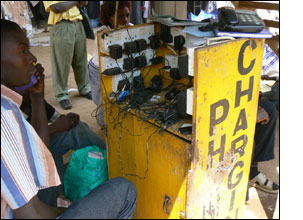 Anyone who’s travelled to an African country in the past couple of years would not have failed to notice women selling airtime on the streets, children dodging cars at main junctions selling chargers and phone covers, street vendors making a living charging people’s phones, and mobile phone repair shops helping people squeeze one last drop of life from their old phones. There is also a thriving second-hand market, with stalls selling all manner of new and recycled handsets. Entrepreneurs are even building their own mobile-mobile services, strapping phones and spare batteries to the front of bikes and travelling to where the business is.