International development: A problem of image, or a problem of substance?

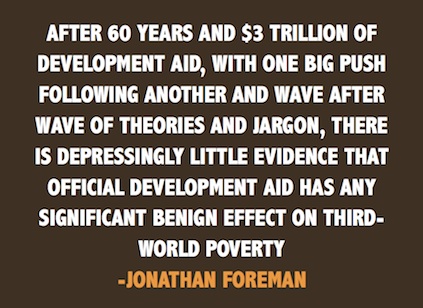
The world has problems. Big problems. They need big answers, ambitious projects and innovative solutions. And that costs money. Lots of it. Three trillion dollars over the past sixty years, if the research is to be believed. Fixing stuff is big business.

With these kinds of resources, what could go wrong? The problem is, many development initiatives have gone wrong, and continue to. Somewhere along the line development has lost it’s way. For many people it is so lost that it’s now become part of the problem.

While donors and other more senior professional development practitioners might disagree, many of the people I know who work in the various guises of ‘development’ admit that – on the whole – it’s not working, that resources are mis-focused, and that the majority of international aid initiatives are not fit for purpose. That’s not to question the motives of those who work to make the world a better place, it’s just that often they choose the wrong vehicle in which to do it. As Bill Easterly says:

The fondness for the Big Goal and the Big Plan is strikingly widespread. It’s part of the second tragedy that so much goodwill and hard work by rich people who care about the poor goes through channels that are ineffective

There’s no shortage of debate, of course. Many academics spend most of their waking hours disecting and analysing the big data on big aid, only to come up with different conclusions. The more practical among us choose to just get on with it, and choose to do it outside the system. Rather than taking jobs in large development structures, we go about it on our own terms. This is the approach featured in my recent book, “The Rise of the Reluctant Innovator“.

There’s no better example of big development than the Millenium Development Goals which, at the time of writing are about 450 days away from ‘maturing’. Progress has been sketchy. Given that it can sometimes take years to collect and analyse the kind of data needed to measure them, it may be some time beyond the 2015 deadline before we know how many were met. And then we’ll never really know whether it was development policies, or simple economic growth, that was responsible. As with most things development, few things are that clear cut. If they’re met it might not be clear who to thank, and if we fail we’ll not know who to blame, either.

That all said, it’s far easier for critics who sit on the sidelines and say how rubbish it all is. It’s much harder coming up with actual answers, and harder still acting on them. I, for one, have always tried to balance my criticism of the technology-for development (ICT4D) sector with suggestions, ideas and thoughts on how we might improve our effectiveness. Just last week I announced my Donors Charter, an attempt to bring some harmony to how technology-for-development projects get funded.

Going by a recent article in the Huffington Post, many donors are becoming increasingly concerned about how aid – and their work – is perceived outside the sector. That concern has lead to the birth of the Narrative Project, whose goal is “to reverse the decline of public support for our work” and to counteract “fatigue” among rank-and-file supporters of these charities, many of whom increasingly view aid as “a good idea, done badly”.

Reading between the lines it might appear that many of the donors involved believe that aid is fundamentally “a good idea, done well” and that the problem is simply one of PR. Let’s hope this isn’t the case. While aid definitely does have a PR problem, there’s also plenty wrong with how it’s executed – and we can only hope that those present at the meetings accept that, and have committed to addressing it, too.

The Narrative Project does include a call for “a co-ordinated development sector”, and donors hold many of the cards (as I argue with the Donors Charter). It also makes the point that independence and self-reliance, i.e. people in the developing world solving their own problems, should be key development objectives. And that people need to believe they can make a difference. None of this is new, but it’s refreshing to see it being discussed at such a high level.

One huge red flag, however, are the parties to the work. The UN Foundation, Bond, The Bill & Melinda Gates Foundation, ONE, Oxfam, Comic Relief and others. All large international players. Let’s hope that somewhere along the way they consulted smaller organisations, local organisations, local innovators, small projects and low-level grantees. We all know what happens when you talk in silos. And this looks like an international donor silo to me.

Like many colleagues and friends, I’ve grown increasingly despondent with the international development sector, and have only managed to stay positive thanks to my early decision to ‘go it alone’. Aid does do good, but it could do so much better if it got it’s house in order. And that’s the frustrating thing for me. In a career spanning 21 years, many of the bigger institutional problems persist, with no-one seemingly having the energy, the influence or the political will to fix any of it.

In my ICT4D world, there are some very simple (and I’d argue, obvious) things, for example.

  1. Focus more on enabling environments – genuine empowerment opportunities for those who own, or who are closest to, the problem.
  2. Seriously get behind, and support, projects that we know are working, or know have the best approach. Stop always looking for the next big thing.
  3. Have at least a few innovators on staff. Don’t head up innovation teams with people who have never built anything.
  4. Adopt best practice, along the lines of the Donors Charter.
  5. Give local innovators a voice.

The world needs a strong international development sector, particularly when it’s called to deliver emergency aid in times of greatest need. But beyond that it needs to work for the people it seeks to help, not in the interests of itself. It needs to be bold, be brave, and do things that might not always be in its best interests.

And it needs an exit strategy. Without one, how is anyone expected to have confidence that they’re doing the right thing, the right way?

Time for a Donor Funding Charter?

Innovation isn’t about green bean bags and whacky idea sessions. It is a long term business development strategy
Lucy Gower

Behind almost every good social entrepreneur you’ll find a donor. These donors come in all shapes and sizes – family members, friends, companies, CSR departments and sponsors are the most typical, increasingly followed by the crowd funders among us. While plenty of great things get funded, pretty crazy stuff does, too. Zack Danger Brown just raised $55,000 on Kickstarter to make a potato salad, for example.

More often than not, the really big bucks come from government and philanthropic foundations. The UK’s Department for International Development will hand out £10.765 billion this financial year, funding all manner of projects that help those in greatest need. The Bill and Melinda Gates Foundation, the biggest private foundation in the world, gave $3.6 billion last year. The world has plenty of problems – big problems – and these budgets reflect that. Donors get to choose which ones they fix, too. The Rockefeller Foundation, for example, currently focuses on resilient cities, digital jobs in Africa, food security, gender equality and universal health coverage, among a few others.

Donors also pay attention to what other donors do, and to what and who they fund. They love, for example, the idea of matched funding where two or more will put in an equal share of funds for a project. It spreads the risk, and gives them all comfort that they’ve not made a silly decision. If the project is good enough for someone else’s money, it’s good enough for theirs. Getting funded by one of the bigger foundations often makes it easier to get money from the others – a sort of shared due diligence, if you like.

Despite all the money and resources – and attempts to apply them to all manner of projects and initiatives – problems remain. During my “Rise of the Reluctant Innovator” book talks, I draw on some of the bigger challenges and failures of international development. Yes, a lot of good work has been done, but I often wonder if we’re getting value for money. Over the past 60 years, we’ve sure spent a huge amount of it.

Plenty of things have been tried, and continue to be tried. Much of the failure is put down to the people and projects (who in turn often blame the target communities), but in many cases responsibility also needs to fall on the people who backed them. Under pressure to support ‘innovative’ (often crazy) ideas, and often under pressure to spend their large budgets, Programme Officers often resort to funding projects they shouldn’t be going anywhere near.

What we end up with is a sector full of replication, small-scale (failed) pilots, secrecy and near-zero levels of collaboration. This negatively impacts not only other poorly-planned initiatives, but it also complicates things for the better ones. On top of all that, it confuses the end user who is expected to make sense of all 75 mobile data collection tools that end up on offer. The policy of funding many in the hope that the odd one shines through – the so-called “let a thousand flowers bloom” scenario – belongs to an earlier era. Today, we know enough about what works and what doesn’t to be far more targeted in what is funded and supported.

Given the vast majority of projects would never get started without some form of funding, donors are the ideal position to put this right. So here’s my proposal.

All major philanthropic foundations – and, where appropriate, government development/aid agencies – sign up to a Funding Charter which encourages much greater scrutiny of the technology projects they’re considering funding. This Charter will be available online, offering considerably more transparency for projects looking for money.

In the first instance, project owners will need to answer the following questions before their grant application is considered:

Preliminary questions

  1. Do you understand the problem? Have you seen, experienced or witnessed the problem? Why are you the one fixing it?
  2. Does anything else exist that might solve the problem? Have you searched for existing solutions?
  3. Could anything that you found be adapted to solve the problem?
  4. Have you spoken to anyone working on the same problem? Is collaboration possible? If not, why not?
  5. Is your solution economically, technically and culturally appropriate?

Implementation questions

  1. Have you carried out base research to understand the scale of the problem before you start?
  2. Will you be working with locally-based people and organisations to carry out your implementation? If not, why not?
  3. Are you making full use of the skills and experience of these local partners? How?

Evaluation and post-implementation questions

  1. How do you plan to measure your impact? How will you know if your project was a success or not?
  2. Do you plan to scale up or scale out that impact? If not, why not? If yes, how?
  3. What is your business/sustainability model?

Transparency questions

  1. Are you willing to have your summary project proposal, and any future summary progress reports, posted on the Donors Charter website for the benefit of transparency and more open sharing?

Not being able to answer these questions fully and reasonably needn’t be the difference between funding or no funding – donors would be allowed wildcards – but it would serve two purposes. First, it would force implementers to consider key issues before reaching out for support, resulting in a reinforcement of best practice. And second, it will help the donors themselves by focusing their resources and dollars on projects which are better thought out and less likely to fail.

The simple adoption of this kind of Charter might do more to solve many of the niggling problems we regularly write, talk, complain and moan about in the ICT4D sector. Any takers?

A more concise version of the proposal is available on the dedicated Donors Charter website.

Field of dreams

Two years ago this summer, long-time friend Erik Hersman and I took a stroll through this grass meadow in St. Ives, a small market town in Cambridgeshire where I work from a small office above a supermarket. Erik was on holiday, but that didn’t stop us taking a long walk discussing life, family and work. Erik had a few ideas on the boil, and I was entering a new phase after stepping back from day-to-day operations at FrontlineSMS a couple of months earlier.

I walk a lot, and often use the time to think, strategise and develop my ideas. The walk with Erik that day wasn’t particularly unusual, but something rather rare and unusual has happened since.

During our conversation, I told Erik I was thinking of publishing a book on social innovation – something I’d always wanted to do but lacked the seed of what I thought was a solid enough idea. That summer, a short article I’d penned – Genius Happens When You Plan Something Else – had appeared in the print edition of Wired magazine in the UK. The article looked at the concept of reluctant innovation, but was only 600 words long. I felt there was much more of a story to tell, and discussed the idea of turning the article into a full book. Erik was, of course, invited to contribute a chapter on his own life and work.

Once I’d decided to go for it, the next fifteen months were frantic. There were times the book looked like it wouldn’t come off. The first Kickstarter campaign was a spectacular failure. The second was better thought out and successful. That campaign was topped up by the Curry Stone Foundation, and a little personal funding on top took the book past a key financial hurdle. Along the way I managed to find a publisher, secure a foreword from Archbishop Desmond Tutu and collect two dozen high profile endorsements. Everything finally fell into place and in November 2013 “The Rise of the Reluctant Innovator” hit the shelves, hitting top spot in Amazon’s ‘Development Studies’ chart a few months later. A number of colleges and universities in the US and UK have also picked up on the book, using it as part of their social innovation courses.

Self-publishing is tough, and a massive learning curve, but it’s been well worth it. “The Rise of the Reluctant Innovator” always felt like a book that needed to exist. Thanks to that walk in the meadow, today it does.

If my book was to be difficult, Erik’s idea was on another planet. Today you’ll know the vague little black box we discussed as BRCK. The conversation was fascinating on a number of levels, and I loved the idea of a Kenyan outfit fixing an African problem that others either didn’t know about, or didn’t care about. But while we were both serial software developers, neither of us had built hardware before (although we had talked about designing and building a FrontlineSMS/Ushahidi GSM modem a couple of years earlier during one of our stints at PopTech). That summer I was about to throw myself into the murky world of publishing. Erik was on the verge of doing the same in the hardware industry. I didn’t envy him.

Two years on, and the BRCK is a reality thanks to a Kickstarter campaign that blew their total out of the water, followed up by a further $1.2 million in venture funding. (Erik was always determined to make this a business, not another non-profit venture. We’ve had many conversations about the need for a more solid business approach to the kinds of ‘development’ problems BRCK was built to solve). It’s not been easy for the team, and I’ve been fortunate to see early prototypes and have numerous behind-the-scenes conversations on the challenges of not only building hardware, but doing it from East Africa.

That said, the BRCK team have been very open about the process and they’ve regularly blogged updates when things have been going well, and not so well. “Problems, Perseverance, and Patience” gives great insight, as does this post by Erik himself which will take you through the whole BRCK story. No mention of the meadow there, though.

We constantly hear that ideas are cheap, and that it’s all about execution. To an extent, that’s true. What was unusual about that summer walk in the meadow – our field of dreams – wasn’t so much two friends sharing ideas, but two friends with a dream they both saw through. In both our worlds, BRCK and “The Rise” both felt like things that needed to exist.

Thankfully, today, they do.

Innovation out of necessity is alive and well

(This article first appeared on the Virgin website as part of their special feature on innovation and disruption. The original post can be read here).

While much of the West debates the pros, cons, merits and current state of technological innovation, innovators in the developing world just get on with it. And they’ve never been so busy. Innovation out of necessity is alive and well, and on the rise, according to Ashoka Fellow, Ken Banks.

For many of us, innovation is the iPhone, iPad or pretty much anything that comes from today’s high-tech production line. It’s the latest phone, laptop, smart watch or passenger aircraft, and it’s designed to make things easier, quicker, more convenient and, in some cases, just more fun. We rarely question why we feel we need the latest and greatest, why we change our phones every year, or even what the drivers might be for all these high-tech innovations. Who, for example, decided the world needed an iPad-powered coffee machine?

Much of the innovation we see in the developing world, whether the innovators behind them come from there or not, is done out of necessity. They solve very real problems, many of which happen to be faced on a daily basis by many of the poorest and most vulnerable people on the planet. Innovation here isn’t about fast, shiny or modern, it’s about solving very real problems. And many of those problems aren’t going away any time soon.

Entrepreneurs in the West may well be losing the will to innovate, although I’d suggest it’s more about ability and a conducive environment than will. Many face difficulties with funding, highly competitive markets and patent wars, all of which make for challenging times. But this is far from the case throughout much of Africa, where I’ve focused most of my efforts for the past 20 years. Many innovations here are born by the side of the road, or in rural villages without any funding at all. Furthermore, market opportunities abound and patents are the last things on people’s minds. Compared to the West, African markets are still something of a Wild West in innovation terms, and this is precisely why there’s so much focus there.

Innovation out of necessity has given Kenya, for example, a world-leading position in mobile payments. On a continent where hundreds of millions of people lacked bank accounts, mobile phones provided the answer. An estimated 40% of Kenya’s GDP now works its way through Safaricom’s M-PESA system. It’s an innovation success story, and it’s provided a platform for many other innovators to offer everything from pay-as-you-go solar lighting to villagers to automated payment platforms for microfinance organisations. The further (anticipated) opening up of systems like M-PESA will spur even more innovation in the future. This is just the beginning.

When faced with very real problems that in many cases cost lives, innovators in the developing world kick into a different gear. With little funding or resources, it’s innovation in this ‘long tail’ that is most interesting – a place where people innovate out of necessity, not luxury, and as a matter of survival or ethics, not profit or markets. Health is a classic example of these drivers at work.

Six out of the 10 chapters in my recent book, “The Rise of the Reluctant Innovator”, cover health. The issues these innovators address include data collection, genetic disorders, communications between community health workers, patents, access to medicines, and solar energy as a lighting solution for maternity wards. The range of examples shows how broad and complex an issue health is, as well as the sheer scale of the need for its improvement across much of the developing world.

Many others are better placed to comment on whether entrepreneurs in the West are losing the will to innovate. Whatever the outcome of that debate, thankfully this isn’t the case in the places that matter – the places where far too many people still die from perfectly treatable diseases, or fail to reach their potential because of a lack of access to the most basic of education.

To paraphrase former Liverpool football manager, Bill Shankly, in the developing world innovation isn’t just a matter of life or death. It’s more
important than that.