How “Designing with the end user” undermines ICT4D best practice

After years of near-invisible end users, it’s promising to see the beginnings of ‘end-user recognition’ in much of ICT4D‘s emerging best practice. It looks like we’ve made a big stride forward, but we’re not where we need to be yet, despite making all the right noises. To a great extent, we’re still saying one thing and doing another.

The international development sector, which includes the ICT4D community, is famously uncoordinated. That’s no surprise to many of the people who work in it. You would hope that, at least if the wrong things were being done they’d be being done in a coordinated way, but that’s rarely the case. Haiti is a great case in point, where “a confused aid effort‘ has only added to the difficulties. You’d be right to ask why so many people continue to live in tents nearly five years after the earthquake.

Very recently, the Narrative Project – which I blogged about here – included a call for “a co-ordinated development sector”. It also made the point that independence and self-reliance, i.e. people in the developing world solving their own problems, should be key development objectives. And that people need to believe they can make a difference. This is good to hear, but they’re empty words if ‘best’ practice continues to undermine it.

You could argue that “designing with the user” is a sensible approach – it’s certainly better than designing without them – but is it taking us closer to an end-game of “people in the developing world solving their own problems”? It may if you’re working with them to build a tool or platform which they, and other communities elsewhere, can then take and subsequently deploy on their own terms to solve whatever problem they see fit, in whatever way they decide, without the ‘solution’ provider needing to be involved.

To me, “Design with the user” makes more sense to a local solutions developer, who can simply jump on a bus to go and work with them. But it doesn’t for the overseas solutions developer, for example the student group designing an ICT4D intervention as part of their design thinking course. Local empowerment can only genuinely happen if it’s local people helping local people. So what we need to do is work towards a place where that can happen. “Allowing the user to design” is that place.

The truth of the matter is that far too many ICT4D projects are still initiated from the outside. When I initially launched FrontlineSMS in 2005, the platform was squarely designed to allow local people to conceive, design and run their own projects. The only outside help they needed was for someone to provide something that allowed them to do that. It really isn’t rocket science.

Yet, despite its successes, it still seems to be a model, and an approach, in the minority.

I worry that people who read, study and follow the “Design with the end user” mantra might feel more than ever that they’re doing the right thing, but they’ll simply be reinforcing the outside-in, top down approach without realising it. “Design with the end user” is a step in the right direction, but it’s not the end of the journey, and we shouldn’t kid ourselves that it is.

International development: A problem of image, or a problem of substance?

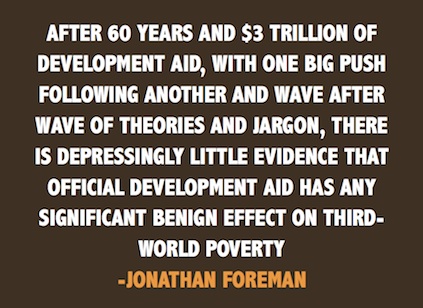
The world has problems. Big problems. They need big answers, ambitious projects and innovative solutions. And that costs money. Lots of it. Three trillion dollars over the past sixty years, if the research is to be believed. Fixing stuff is big business.

With these kinds of resources, what could go wrong? The problem is, many development initiatives have gone wrong, and continue to. Somewhere along the line development has lost it’s way. For many people it is so lost that it’s now become part of the problem.

While donors and other more senior professional development practitioners might disagree, many of the people I know who work in the various guises of ‘development’ admit that – on the whole – it’s not working, that resources are mis-focused, and that the majority of international aid initiatives are not fit for purpose. That’s not to question the motives of those who work to make the world a better place, it’s just that often they choose the wrong vehicle in which to do it. As Bill Easterly says:

The fondness for the Big Goal and the Big Plan is strikingly widespread. It’s part of the second tragedy that so much goodwill and hard work by rich people who care about the poor goes through channels that are ineffective

There’s no shortage of debate, of course. Many academics spend most of their waking hours disecting and analysing the big data on big aid, only to come up with different conclusions. The more practical among us choose to just get on with it, and choose to do it outside the system. Rather than taking jobs in large development structures, we go about it on our own terms. This is the approach featured in my recent book, “The Rise of the Reluctant Innovator“.

There’s no better example of big development than the Millenium Development Goals which, at the time of writing are about 450 days away from ‘maturing’. Progress has been sketchy. Given that it can sometimes take years to collect and analyse the kind of data needed to measure them, it may be some time beyond the 2015 deadline before we know how many were met. And then we’ll never really know whether it was development policies, or simple economic growth, that was responsible. As with most things development, few things are that clear cut. If they’re met it might not be clear who to thank, and if we fail we’ll not know who to blame, either.

That all said, it’s far easier for critics who sit on the sidelines and say how rubbish it all is. It’s much harder coming up with actual answers, and harder still acting on them. I, for one, have always tried to balance my criticism of the technology-for development (ICT4D) sector with suggestions, ideas and thoughts on how we might improve our effectiveness. Just last week I announced my Donors Charter, an attempt to bring some harmony to how technology-for-development projects get funded.

Going by a recent article in the Huffington Post, many donors are becoming increasingly concerned about how aid – and their work – is perceived outside the sector. That concern has lead to the birth of the Narrative Project, whose goal is “to reverse the decline of public support for our work” and to counteract “fatigue” among rank-and-file supporters of these charities, many of whom increasingly view aid as “a good idea, done badly”.

Reading between the lines it might appear that many of the donors involved believe that aid is fundamentally “a good idea, done well” and that the problem is simply one of PR. Let’s hope this isn’t the case. While aid definitely does have a PR problem, there’s also plenty wrong with how it’s executed – and we can only hope that those present at the meetings accept that, and have committed to addressing it, too.

The Narrative Project does include a call for “a co-ordinated development sector”, and donors hold many of the cards (as I argue with the Donors Charter). It also makes the point that independence and self-reliance, i.e. people in the developing world solving their own problems, should be key development objectives. And that people need to believe they can make a difference. None of this is new, but it’s refreshing to see it being discussed at such a high level.

One huge red flag, however, are the parties to the work. The UN Foundation, Bond, The Bill & Melinda Gates Foundation, ONE, Oxfam, Comic Relief and others. All large international players. Let’s hope that somewhere along the way they consulted smaller organisations, local organisations, local innovators, small projects and low-level grantees. We all know what happens when you talk in silos. And this looks like an international donor silo to me.

Like many colleagues and friends, I’ve grown increasingly despondent with the international development sector, and have only managed to stay positive thanks to my early decision to ‘go it alone’. Aid does do good, but it could do so much better if it got it’s house in order. And that’s the frustrating thing for me. In a career spanning 21 years, many of the bigger institutional problems persist, with no-one seemingly having the energy, the influence or the political will to fix any of it.

In my ICT4D world, there are some very simple (and I’d argue, obvious) things, for example.

  1. Focus more on enabling environments – genuine empowerment opportunities for those who own, or who are closest to, the problem.
  2. Seriously get behind, and support, projects that we know are working, or know have the best approach. Stop always looking for the next big thing.
  3. Have at least a few innovators on staff. Don’t head up innovation teams with people who have never built anything.
  4. Adopt best practice, along the lines of the Donors Charter.
  5. Give local innovators a voice.

The world needs a strong international development sector, particularly when it’s called to deliver emergency aid in times of greatest need. But beyond that it needs to work for the people it seeks to help, not in the interests of itself. It needs to be bold, be brave, and do things that might not always be in its best interests.

And it needs an exit strategy. Without one, how is anyone expected to have confidence that they’re doing the right thing, the right way?

Rethinking livelihoods.

This post appeared on the PopTech blog and has been republished with permission. You can read the original post here.

This post is co-authored by PopTech president Leetha Filderman, and Ken Banks, founder of kiwanja.net and FrontlineSMS. Together they are co-facilitators of the 2014 Bellagio/PopTech Fellows program. 

We are pleased to announce the 2014 class of Bellagio/PopTech Fellows, a diverse group of designers, social innovators, technologists and writers with expertise in technology, global health, poverty alleviation, environmental sustainability and informal sector economics.


Sean Blagsvedt, Alexice Tô-Camier, Dominic Muren, Robtel Neajai Pailey, Solomon Prakash

This year’s program is focused on rethinking livelihoods. Now more than ever, the world’s population is contending with a multitude of challenges: demographic shifts, environmental stressors, unrestrained financial capital flow, shifting political landscapes, emerging technologies, and changing economic growth patterns and labor markets – all of which are shaping the notion of what livelihoods look like today and may look like in the future.

For two weeks this August the Bellagio/PopTech Fellows will convene at the Rockefeller Foundation’s Bellagio Center in Italy. We will collaboratively work to define the notion of livelihood in the 21st century, while simultaneously exploring the challenges, opportunities and complex interdependencies that will impact sustainable livelihood achievement in the coming decades.

Our goal is to initiate a conversation designed to inform and inspire global, national and local efforts to improve livelihoods. Conversations will be complemented and challenged by an incredible group of catalysts, which bring a diverse and unique set of insights to the table.

Areas of exploration will include an examination of the central tenets of livelihoods strategy, the interplay between livelihood productivity at national and individual level, and the opportunities offered by the often-opposing formal and informal sectors. We’ll look at the positive and negative impacts of technology on livelihoods, and how both global security (and insecurity) and the geopolitical landscape impact sustainable development goals. It would be impossible to have this kind of discussion without recognition of the environmental challenges facing the planet, so we’ll be looking at how climate change and other threats could impact livelihoods development now and into the future.


Members of the 2013 class of Bellagio/PopTech Fellows presenting at PopTech 2013

Following their immersion at the Bellagio Center, the Bellagio/PopTech Fellows will reunite in Camden, Maine at PopTech 2014: Rebellion, where they will present their work and explore opportunities for collaboration with the global PopTech network.

About the Bellagio/PopTech Fellows program:
In 2012, PopTech and the Rockefeller Foundation created a joint Fellows program that brings together small, interdisciplinary groups for a two-week immersion program at the Foundation’s renowned Bellagio Center in Lake Como, Italy. Learn more about the inaugural class.

The Bellagio/PopTech Fellows program is designed to be a unique incubator of unconventional collaboration around critical topics relevant to the lives of poor and vulnerable populations, and also serves as a laboratory to study the nature of collaboration itself as a profound tool for creative problem solving and solution development.

Time for a Donor Funding Charter?

Innovation isn’t about green bean bags and whacky idea sessions. It is a long term business development strategy
Lucy Gower

Behind almost every good social entrepreneur you’ll find a donor. These donors come in all shapes and sizes – family members, friends, companies, CSR departments and sponsors are the most typical, increasingly followed by the crowd funders among us. While plenty of great things get funded, pretty crazy stuff does, too. Zack Danger Brown just raised $55,000 on Kickstarter to make a potato salad, for example.

More often than not, the really big bucks come from government and philanthropic foundations. The UK’s Department for International Development will hand out £10.765 billion this financial year, funding all manner of projects that help those in greatest need. The Bill and Melinda Gates Foundation, the biggest private foundation in the world, gave $3.6 billion last year. The world has plenty of problems – big problems – and these budgets reflect that. Donors get to choose which ones they fix, too. The Rockefeller Foundation, for example, currently focuses on resilient cities, digital jobs in Africa, food security, gender equality and universal health coverage, among a few others.

Donors also pay attention to what other donors do, and to what and who they fund. They love, for example, the idea of matched funding where two or more will put in an equal share of funds for a project. It spreads the risk, and gives them all comfort that they’ve not made a silly decision. If the project is good enough for someone else’s money, it’s good enough for theirs. Getting funded by one of the bigger foundations often makes it easier to get money from the others – a sort of shared due diligence, if you like.

Despite all the money and resources – and attempts to apply them to all manner of projects and initiatives – problems remain. During my “Rise of the Reluctant Innovator” book talks, I draw on some of the bigger challenges and failures of international development. Yes, a lot of good work has been done, but I often wonder if we’re getting value for money. Over the past 60 years, we’ve sure spent a huge amount of it.

Plenty of things have been tried, and continue to be tried. Much of the failure is put down to the people and projects (who in turn often blame the target communities), but in many cases responsibility also needs to fall on the people who backed them. Under pressure to support ‘innovative’ (often crazy) ideas, and often under pressure to spend their large budgets, Programme Officers often resort to funding projects they shouldn’t be going anywhere near.

What we end up with is a sector full of replication, small-scale (failed) pilots, secrecy and near-zero levels of collaboration. This negatively impacts not only other poorly-planned initiatives, but it also complicates things for the better ones. On top of all that, it confuses the end user who is expected to make sense of all 75 mobile data collection tools that end up on offer. The policy of funding many in the hope that the odd one shines through – the so-called “let a thousand flowers bloom” scenario – belongs to an earlier era. Today, we know enough about what works and what doesn’t to be far more targeted in what is funded and supported.

Given the vast majority of projects would never get started without some form of funding, donors are the ideal position to put this right. So here’s my proposal.

All major philanthropic foundations – and, where appropriate, government development/aid agencies – sign up to a Funding Charter which encourages much greater scrutiny of the technology projects they’re considering funding. This Charter will be available online, offering considerably more transparency for projects looking for money.

In the first instance, project owners will need to answer the following questions before their grant application is considered:

Preliminary questions

  1. Do you understand the problem? Have you seen, experienced or witnessed the problem? Why are you the one fixing it?
  2. Does anything else exist that might solve the problem? Have you searched for existing solutions?
  3. Could anything that you found be adapted to solve the problem?
  4. Have you spoken to anyone working on the same problem? Is collaboration possible? If not, why not?
  5. Is your solution economically, technically and culturally appropriate?

Implementation questions

  1. Have you carried out base research to understand the scale of the problem before you start?
  2. Will you be working with locally-based people and organisations to carry out your implementation? If not, why not?
  3. Are you making full use of the skills and experience of these local partners? How?

Evaluation and post-implementation questions

  1. How do you plan to measure your impact? How will you know if your project was a success or not?
  2. Do you plan to scale up or scale out that impact? If not, why not? If yes, how?
  3. What is your business/sustainability model?

Transparency questions

  1. Are you willing to have your summary project proposal, and any future summary progress reports, posted on the Donors Charter website for the benefit of transparency and more open sharing?

Not being able to answer these questions fully and reasonably needn’t be the difference between funding or no funding – donors would be allowed wildcards – but it would serve two purposes. First, it would force implementers to consider key issues before reaching out for support, resulting in a reinforcement of best practice. And second, it will help the donors themselves by focusing their resources and dollars on projects which are better thought out and less likely to fail.

The simple adoption of this kind of Charter might do more to solve many of the niggling problems we regularly write, talk, complain and moan about in the ICT4D sector. Any takers?

A more concise version of the proposal is available on the dedicated Donors Charter website.