Mobile technology and the last mile

Since our founding in 2003, kiwanja.net has been primarily focused on serving the needs of the smaller, local, grassroots NGO community. FrontlineSMS is testament to that approach – a low-tech, appropriate technology which works on locally available hardware and without the need for NGOs to employ the services of teams of technical experts. We haven’t got everything right, and FrontlineSMS remains a work in progress, but we’re excited about where we are, how we got here and where we’re headed.

We were recently approached by Philip Auerswald, Editor of “innovations“, to write an article on that journey, and our approach to mobiles-for-development. The result was a tri-authored piece by three members of the FrontlineSMS team – Sean McDonald, Flo Scialom and myself. A PDF of that article – “Mobile technology and the last mile” – is available here.

About “Innovations”:
“The journal features cases authored by exceptional innovators; commentary and research from leading academics; and essays from globally recognized executives and political leaders. The journal is jointly hosted at George Mason University’s School of Public Policy, Harvard’s Kennedy School of Government, and MIT’s Legatum Center for Development and Entrepreneurship”.

Many thanks to Phil and the “Innovations” team for inviting us to contribute.

Future innovation: Threat or opportunity?

A year may have passed since this particular edition of the Economist hit the shelves, but I bet you could replace “April 2010” with “April 2011” and few people would notice. I kept this edition back because of it’s special report on business and innovation in the developing world. It goes a long way to explaining and describing what’s happening not only in the commercial world, but also the informal sector. I’d say that makes it a must read for members of the ICT4D community.

There are dozens of takeaways from the report. Here are a few of the highlights which resonated most with me:

“Most striking is the emerging world’s growing ability to make established products for dramatically lower costs – no frills $3,000 cars, $300 laptops and $30 mobile phones may not seem as exciting as a new iPad, but they promise to change far more people’s lives”

“Emerging countries are no longer content to be cheap sources of cheap hands and low-cost brains. Instead, they too are becoming hotbeds of innovation, producing breakthroughs in everything from telecoms to car making to health care”

“Innovation in the emerging world will encourage, rather than undermine, innovation in the rich world”

“Emerging economies are not merely challenging [our lead] in innovation. They are unleashing a wave of low-cost, disruptive innovations that will, as they spread to the rich world, shake many industries to their foundations”

“Multinationals expect about 70% of the world’s growth over the next few years to come from emerging markets”

“Old assumptions about innovation are being challenged. People in the West like to believe that their companies cook up new ideas in their laboratories at home and then export them to the developing world, which makes it easier to accept job losses in manufacturing. This is proving less true by the day”

“Because so many consumers are poor, companies [in emerging markets] have to go for volume. But because piracy is so commonplace, they also have to keep upgrading their products”

“General Electric and Tata Consultancy Services are doing something more exciting than fiddling with existing products – they are taking the needs of poor consumers as a starting point and working backwards. This approach has been dubbed ‘reverse innovation’, or ‘frugal’ or ‘constraint-based’ innovation”

“Emerging markets are far more varied and volatile than mature ones. Cultural complexities are confounding and tastes are extraordinary fluid”

“Indians often see frugal innovation as their distinctive contribution to management thinking. They point to a national tradition of ‘jugaad’ – meaning, roughly, making do with what you have and never giving up – and cite many examples of ordinary Indians solving seemingly insoluble problems”

“Because of the lack of brand loyalty, companies have to put even more thought into marketing than they do in the West”

(This image, taken on one of my trips to Uganda, shows ‘alternative’ advertising at work)


“To flourish in this atmosphere it helps to have a spirit of a frontier settler, not a corporate bureaucrat. A property company, say, might suddenly move into computers. Rather than worrying about synergies or core competencies, they see opportunities and seize them”

“The corporate go-getters love to explain that if you can make it here – despite the poverty, the dismal infrastructure and the unpredictable politicians – you can make it anywhere”

“Hostility to globalisation in the developed world is likely to grow as emerging giants disrupt one product market after another”

I find the whole topic of innovation, emerging markets and globalisation – and how the three intertwine – fascinating. What would our reaction be if globalisation, for example – which has long been accused of disadvantaging the developing world – turned on us? And what for the international development community? As more and more countries “emerge” less and less remain to be “developed”. A fully emergent African continent would leave a considerable number of international NGOs looking for a new home, and in dire need of a little innovation themselves.

Maybe that’s one measure of success they wouldn’t be so keen to find themselves meeting.

The innovation/entrepreneurship divide

Last month I attended the Global Competitiveness Forum in Riyadh, Saudi Arabia, and sat on a Panel discussing “Conscious Capitalism” with Sally Osberg from Skoll, Bright Simons from IMANI, Michael Strong from FLOW and Mabel van Oranje from The Elders. It was during preparation for a short ten minute talk that my concept of “reluctant innovators” took shape, something I blogged about in more detail here.

Here’s the video of that introduction (you can also watch on YouTube), in which I briefly touch on our work with FrontlineSMS and why we focus on the “social mobile long tail“. It ends with a summary of some of the challenges entrepreneurs and innovators face working in the mobile-for-development field – nasties such as business models, measuring impact and scale.

The rise of the reluctant innovator

Last month I attended the Global Competitiveness Forum in Riyadh, Saudi Arabia. More business-focused than developmental, it gave me the chance to take our work not only to a new audience, but to a new region. The “Conscious Capitalism” panel I sat on also focused on some of the questions I’ve been increasingly thinking about, and the conference theme of “innovation as a means to competitiveness” resonated.

Despite that, it was never going to be easy to get away from the fact that this was primarily a business conference. The discussion was dominated by how you might “harness innovation”, if that were ever possible. How could businesses become innovation hubs or centres of excellence? Why is it important to link the business, technology and education communities (something Silicon Valley seems to do so well)? It was a fascinating three days, but many of the delegates seemed to be missing a trick. (To be fair, many of them probably weren’t looking).

Entrepreneurs were worshipped, and business models praised, but much of the focus only took into account those people with an eye for business, or a knack for creating compelling business models, or making money. I found myself sitting in the middle of an “innovation divide”.

After a few years working in the non-profit/technology world, I’d say the landscape could be summed up as:

1. People with ideas and business models are called entrepreneurs.
2. Everyone else is an innovator.

The interesting thing for me is that, whilst the mechanics of entrepreneurship can be taught, most innovation is random, personal, demand-driven, inspired and instinctive. In short, innovation occurs naturally in the real world. Balance sheets and P&Ls, on the other hand, do not.

From where I sit, the whole “social entrepreneurship” discussion to date seems to have been dominated by the business side of things – those predominantly in the first line. Innovators unable to make a business case for their ideas struggle for visibility. To compound the problem further, for technology innovators in particular, “unsustainable” is a four letter word in their industry, resulting in even more doors closing ahead of them. Examples of fully sustainable mobile-based innovations are few and far between, as anyone who works in “mobiles for development” will know.

Innovators with world-changing ideas, solid business models and a steady income stream are the creme de la creme. They’re the ones paraded around at social entrepreneurship conferences. Many started off wanting to be “social entrepreneurs”, and many are highly ambitious and studied hard to get there. I’ve probably met hundreds over the years.

Most innovators I know never started off as such. Few remember ever saying to themselves “I want to innovate”. They’re what I’d call “reluctant innovators” – people who found themselves in the midst of a problem they felt compelled to solve. Frontline healthcare workers who see a medial problem with no solution and come up with one, or a farmer who loses a crop but finds an answer and implements and shares it. The majority of people in the developing world finding everyday solutions to everyday problems are reluctant innovators. They didn’t ask to be, they became. Real world experience was their education, not an MBA.

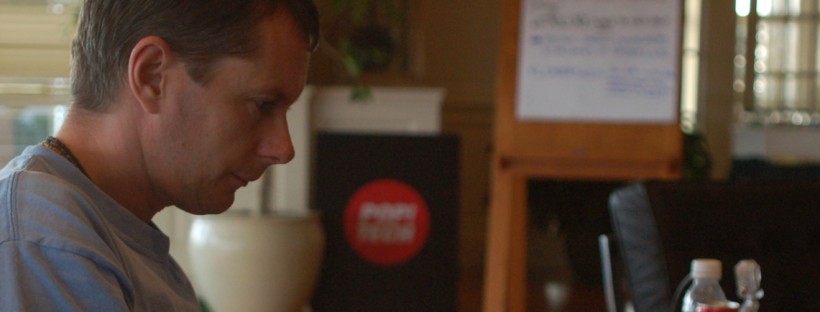
One of the best examples of a “reluctant innovator” I’ve come across is Laura Stachel, who I first met at a conference in New York back in 2009. Laura’s organisation – WE CARE Solar – designs portable solar lighting kits for maternity wards in developing countries (click the image above to watch her five minute Pop!Tech 2010 video).

When she first headed out to Nigeria, she was planning to work on something entirely different, but after realising that a simple lack of lighting was responsible for an unacceptable number of mother and child deaths – maternal mortality rates in Nigeria are among the highest in the world, with a ratio of 1,100 maternal deaths occurring for every 100,000 live births – she turned her attention to helping design, build and distribute solar kits to solve it (see photo below). Laura never intended to build and run an organisation, and never chose to become a solar innovator, but seeing a problem she felt compelled to fix, she reluctantly became one.

I would also count myself as a reluctant innovator – FrontlineSMS was never planned – and the team behind Ushahidi would likely feel the same. They were simply responding to a crisis in their country. None of us went out looking for something to solve. A problem found us, and we felt compelled to solve it.

I’d argue that most of the more successful innovations in ICT4D have come about this way – solutions created not by ‘traditional’ innovators, or technologists, but regular people who find themselves on the frontline of a challenge, and who decide to not turn their backs but to take it on. I think we can all learn from this – the social entrepreneurship sector included.

Further reading
Cometh the hour. Cometh the technology
Mechanics vs. motivation: The two faces of social innovation
Enabling the inspiration generation
Wrong model. Wrong place
Mobile technology and the last mile

Further viewing
The innovation/entrepreneurship divide